

advantage, because the physical proximity of the active sites of the two enzymes can
enhance product flux [141, 142]. Polyprenyl diphosphates 7 and 8, which are
produced by the prenyltransferase, could be efficiently moved into the active site
of the terpene cyclase if these enzymes are linked together, namely, exist near each
other.
The prenyltransferase domain of the fungal diterpene synthase (C 20 ) might
produce mainly the (C 20 ) polyprenyl diphosphate 7, while that of sesterterpene
synthase might yield primarily the (C 25 ) version 8. Therefore, even when the terpene
cyclase domain of a fungal diterpene cyclase has the potential to cyclize not only
7 but also 8, the major products of the enzyme should be diterpenes (C 20 ), because
the prenyltransferase domain supplies principally (C 20 ) 7, not (C 25 ) 8, to the terpene
cyclase domain.
Accordingly, a protein engineering experiment, in which the prenyltransferase
domain of a fungal diterpene synthase is exchanged with that of a sesterterpene
synthase, could enable the terpene cyclase domain of the diterpene synthase to
produce sesterterpenoids, since the prenyltransferase domain of the sesterterpene
synthases can supply a sufficient amount of 8.
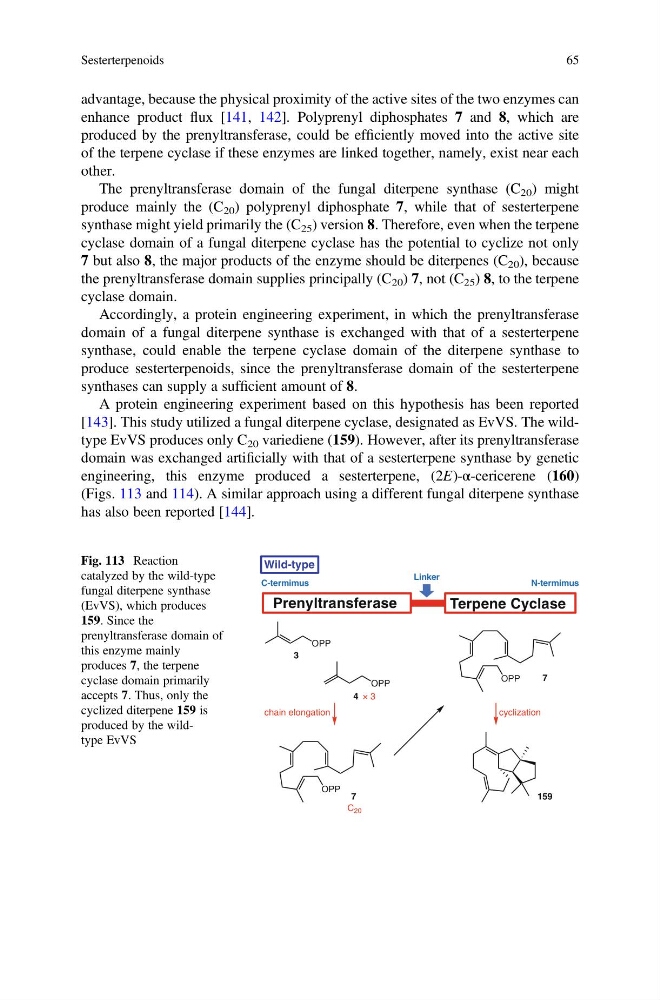
A protein engineering experiment based on this hypothesis has been reported
[143]. This study utilized a fungal diterpene cyclase, designated as EvVS. The wildtype EvVS produces only C 20 variediene (159). However, after its prenyltransferase
domain was exchanged artificially with that of a sesterterpene synthase by genetic
engineering, this enzyme produced a sesterterpene, (2E)-α-cericerene (160)
(Figs. 113 and 114). A similar approach using a different fungal diterpene synthase
has also been reported [144].
Prenyltransferase
Terpene Cyclase
N-termimus
C-termimus
Linker
3
4 3
OPP
OPP
cyclization
chain elongation
OPP
OPP
7
159
7
C 20
Wild-type
Fig. 113 Reaction
catalyzed by the wild-type
fungal diterpene synthase
(EvVS), which produces
159. Since the
prenyltransferase domain of
this enzyme mainly
produces 7, the terpene
cyclase domain primarily
accepts 7. Thus, only the
cyclized diterpene 159 is
produced by the wildtype EvVS
Sesterterpenoids
65
enhance product flux [141, 142]. Polyprenyl diphosphates 7 and 8, which are
produced by the prenyltransferase, could be efficiently moved into the active site
of the terpene cyclase if these enzymes are linked together, namely, exist near each
other.
The prenyltransferase domain of the fungal diterpene synthase (C 20 ) might
produce mainly the (C 20 ) polyprenyl diphosphate 7, while that of sesterterpene
synthase might yield primarily the (C 25 ) version 8. Therefore, even when the terpene
cyclase domain of a fungal diterpene cyclase has the potential to cyclize not only
7 but also 8, the major products of the enzyme should be diterpenes (C 20 ), because
the prenyltransferase domain supplies principally (C 20 ) 7, not (C 25 ) 8, to the terpene
cyclase domain.
Accordingly, a protein engineering experiment, in which the prenyltransferase
domain of a fungal diterpene synthase is exchanged with that of a sesterterpene
synthase, could enable the terpene cyclase domain of the diterpene synthase to
produce sesterterpenoids, since the prenyltransferase domain of the sesterterpene
synthases can supply a sufficient amount of 8.
A protein engineering experiment based on this hypothesis has been reported
[143]. This study utilized a fungal diterpene cyclase, designated as EvVS. The wildtype EvVS produces only C 20 variediene (159). However, after its prenyltransferase
domain was exchanged artificially with that of a sesterterpene synthase by genetic
engineering, this enzyme produced a sesterterpene, (2E)-α-cericerene (160)
(Figs. 113 and 114). A similar approach using a different fungal diterpene synthase
has also been reported [144].
Prenyltransferase
Terpene Cyclase
N-termimus
C-termimus
Linker
3
4 3
OPP
OPP
cyclization
chain elongation
OPP
OPP
7
159
7
C 20
Wild-type
Fig. 113 Reaction
catalyzed by the wild-type
fungal diterpene synthase
(EvVS), which produces
159. Since the
prenyltransferase domain of
this enzyme mainly
produces 7, the terpene
cyclase domain primarily
accepts 7. Thus, only the
cyclized diterpene 159 is
produced by the wildtype EvVS
Sesterterpenoids
65