

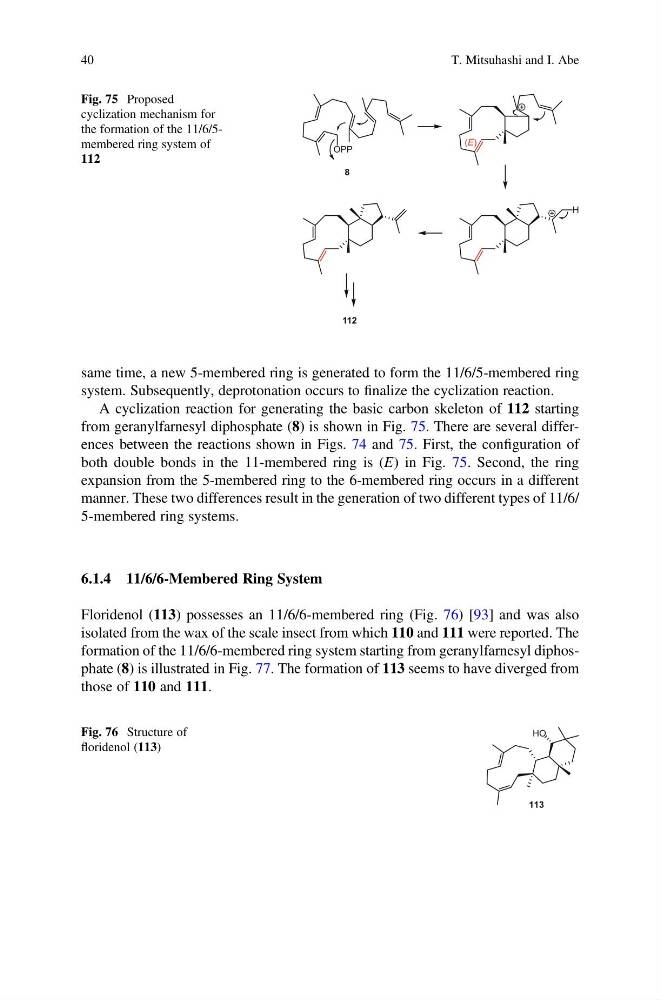
same time, a new 5-membered ring is generated to form the 11/6/5-membered ring
system. Subsequently, deprotonation occurs to finalize the cyclization reaction.
A cyclization reaction for generating the basic carbon skeleton of 112 starting
from geranylfarnesyl diphosphate (8) is shown in Fig. 75. There are several differences between the reactions shown in Figs. 74 and 75. First, the configuration of
both double bonds in the 11-membered ring is (E) in Fig. 75. Second, the ring
expansion from the 5-membered ring to the 6-membered ring occurs in a different
manner. These two differences result in the generation of two different types of 11/6/
5-membered ring systems.
6.1.4 11/6/6-Membered Ring System
Floridenol (113) possesses an 11/6/6-membered ring (Fig. 76) [93] and was also
isolated from the wax of the scale insect from which 110 and 111 were reported. The
formation of the 11/6/6-membered ring system starting from geranylfarnesyl diphosphate (8) is illustrated in Fig. 77. The formation of 113 seems to have diverged from
those of 110 and 111.
OPP
H
8
112
(E)
Fig. 75 Proposed
cyclization mechanism for
the formation of the 11/6/5membered ring system of
112
113
HO
Fig. 76 Structure of
floridenol (113)
40
T. Mitsuhashi and I. Abe
system. Subsequently, deprotonation occurs to finalize the cyclization reaction.
A cyclization reaction for generating the basic carbon skeleton of 112 starting
from geranylfarnesyl diphosphate (8) is shown in Fig. 75. There are several differences between the reactions shown in Figs. 74 and 75. First, the configuration of
both double bonds in the 11-membered ring is (E) in Fig. 75. Second, the ring
expansion from the 5-membered ring to the 6-membered ring occurs in a different
manner. These two differences result in the generation of two different types of 11/6/
5-membered ring systems.
6.1.4 11/6/6-Membered Ring System
Floridenol (113) possesses an 11/6/6-membered ring (Fig. 76) [93] and was also
isolated from the wax of the scale insect from which 110 and 111 were reported. The
formation of the 11/6/6-membered ring system starting from geranylfarnesyl diphosphate (8) is illustrated in Fig. 77. The formation of 113 seems to have diverged from
those of 110 and 111.
OPP
H
8
112
(E)
Fig. 75 Proposed
cyclization mechanism for
the formation of the 11/6/5membered ring system of
112
113
HO
Fig. 76 Structure of
floridenol (113)
40
T. Mitsuhashi and I. Abe