

6.1.3 11/6/5-Membered Ring System
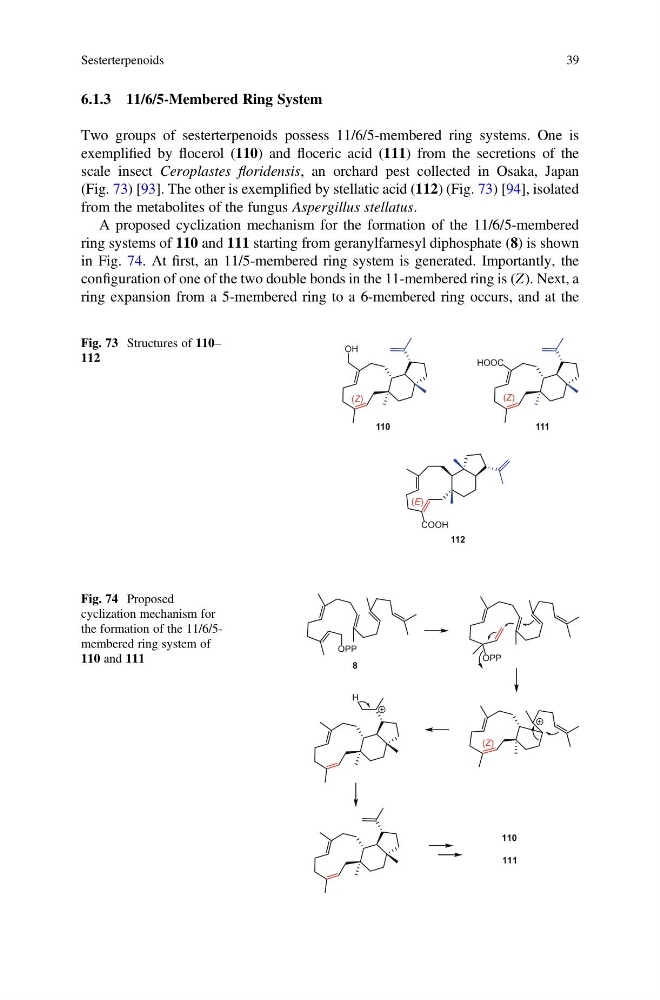
Two groups of sesterterpenoids possess 11/6/5-membered ring systems. One is
exemplified by flocerol (110) and floceric acid (111) from the secretions of the
scale insect Ceroplastes floridensis, an orchard pest collected in Osaka, Japan
(Fig. 73) [93]. The other is exemplified by stellatic acid (112) (Fig. 73) [94], isolated
from the metabolites of the fungus Aspergillus stellatus.
A proposed cyclization mechanism for the formation of the 11/6/5-membered
ring systems of 110 and 111 starting from geranylfarnesyl diphosphate (8) is shown
in Fig. 74. At first, an 11/5-membered ring system is generated. Importantly, the
configuration of one of the two double bonds in the 11-membered ring is (Z). Next, a
ring expansion from a 5-membered ring to a 6-membered ring occurs, and at the
COOH
HOOC
OH
110
111
112
(Z)
(Z)
(E)
Fig. 73 Structures of 110–
112
8
OPP
OPP
H
(Z)
110
111
Fig. 74 Proposed
cyclization mechanism for
the formation of the 11/6/5membered ring system of
110 and 111
Sesterterpenoids
39
Two groups of sesterterpenoids possess 11/6/5-membered ring systems. One is
exemplified by flocerol (110) and floceric acid (111) from the secretions of the
scale insect Ceroplastes floridensis, an orchard pest collected in Osaka, Japan
(Fig. 73) [93]. The other is exemplified by stellatic acid (112) (Fig. 73) [94], isolated
from the metabolites of the fungus Aspergillus stellatus.
A proposed cyclization mechanism for the formation of the 11/6/5-membered
ring systems of 110 and 111 starting from geranylfarnesyl diphosphate (8) is shown
in Fig. 74. At first, an 11/5-membered ring system is generated. Importantly, the
configuration of one of the two double bonds in the 11-membered ring is (Z). Next, a
ring expansion from a 5-membered ring to a 6-membered ring occurs, and at the
COOH
HOOC
OH
110
111
112
(Z)
(Z)
(E)
Fig. 73 Structures of 110–
112
8
OPP
OPP
H
(Z)
110
111
Fig. 74 Proposed
cyclization mechanism for
the formation of the 11/6/5membered ring system of
110 and 111
Sesterterpenoids
39