

5 Bicarbocyclic Sesterterpenoids
5.1 Bicarbocyclic Sesterterpenoids Constructed by
the Type 1 Terpene Cyclases
5.1.1 15/5-Membered Ring System
Bicarbocyclic sesterterpenoids, constructed by the type 1 terpene cyclases, have
been reported from fungi. Terpestacin (77), a representative compound with a 15/5membered ring system (Fig. 53) [57, 58], has been isolated from the fungi
Arthrinium sp. [57] and Phomopsis sp. XZ-26 [58]. Compound 77 reportedly
inhibits tumor angiogenesis by binding to the 13.4-kDa subunit of the mitochondrial
complex III and suppresses hypoxia-induced reactive oxygen species production and
cellular oxygen sensing [59].
O
OH
O
OH
75
76
O
O
O
O
HO
HO
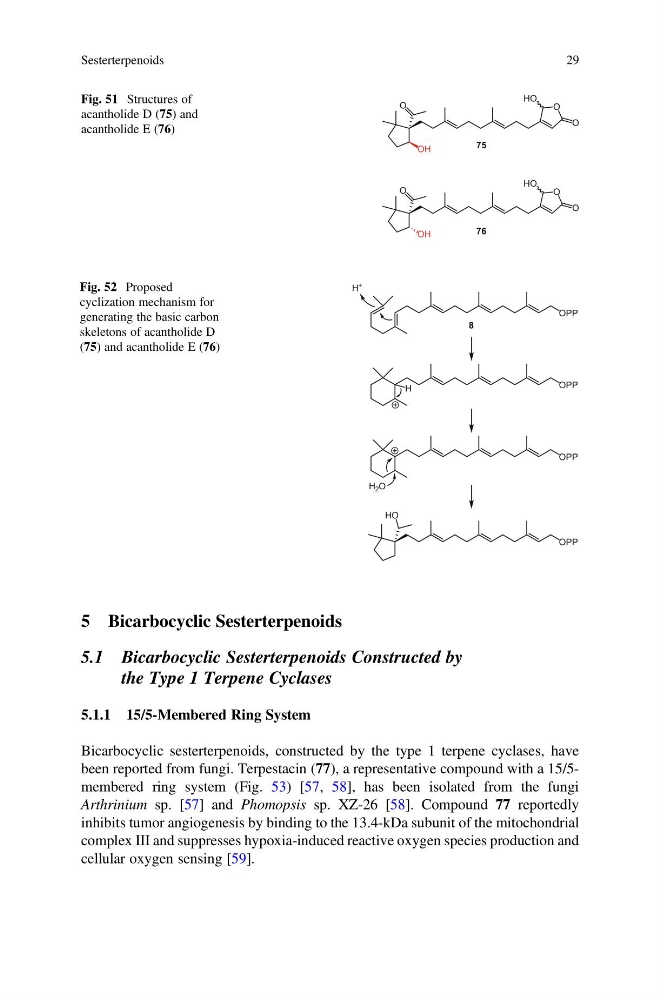
Fig. 51 Structures of
acantholide D (75) and
acantholide E (76)
8
OPP
H
+
OPP
OPP
H
H 2 O
OPP
HO
Fig. 52 Proposed
cyclization mechanism for
generating the basic carbon
skeletons of acantholide D
(75) and acantholide E (76)
Sesterterpenoids
29
5.1 Bicarbocyclic Sesterterpenoids Constructed by
the Type 1 Terpene Cyclases
5.1.1 15/5-Membered Ring System
Bicarbocyclic sesterterpenoids, constructed by the type 1 terpene cyclases, have
been reported from fungi. Terpestacin (77), a representative compound with a 15/5membered ring system (Fig. 53) [57, 58], has been isolated from the fungi
Arthrinium sp. [57] and Phomopsis sp. XZ-26 [58]. Compound 77 reportedly
inhibits tumor angiogenesis by binding to the 13.4-kDa subunit of the mitochondrial
complex III and suppresses hypoxia-induced reactive oxygen species production and
cellular oxygen sensing [59].
O
OH
O
OH
75
76
O
O
O
O
HO
HO
Fig. 51 Structures of
acantholide D (75) and
acantholide E (76)
8
OPP
H
+
OPP
OPP
H
H 2 O
OPP
HO
Fig. 52 Proposed
cyclization mechanism for
generating the basic carbon
skeletons of acantholide D
(75) and acantholide E (76)
Sesterterpenoids
29