

4.2.2 5-Membered Ring
Monocarbocyclic sesterterpenoids with 5-membered ring systems also exist. However, they are rare, as compared with the monocarbocyclic sesterterpenoids with
6-membered ring systems. Such sesterterpenoids are exemplified by
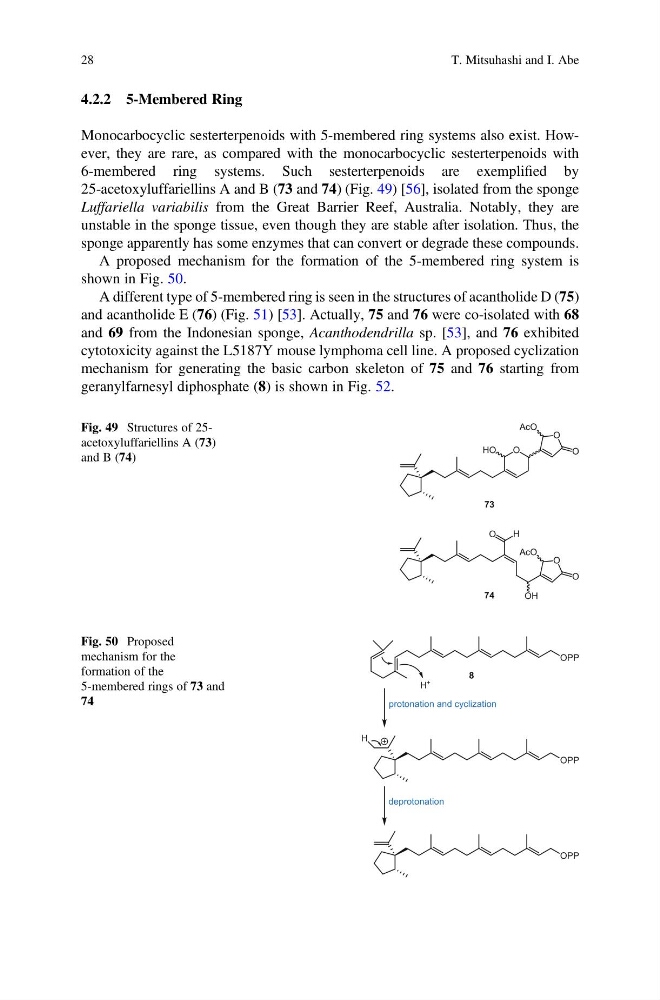
25-acetoxyluffariellins A and B (73 and 74) (Fig. 49) [56], isolated from the sponge
Luffariella variabilis from the Great Barrier Reef, Australia. Notably, they are
unstable in the sponge tissue, even though they are stable after isolation. Thus, the
sponge apparently has some enzymes that can convert or degrade these compounds.
A proposed mechanism for the formation of the 5-membered ring system is
shown in Fig. 50.
A different type of 5-membered ring is seen in the structures of acantholide D (75)
and acantholide E (76) (Fig. 51) [53]. Actually, 75 and 76 were co-isolated with 68
and 69 from the Indonesian sponge, Acanthodendrilla sp. [53], and 76 exhibited
cytotoxicity against the L5187Y mouse lymphoma cell line. A proposed cyclization
mechanism for generating the basic carbon skeleton of 75 and 76 starting from
geranylfarnesyl diphosphate (8) is shown in Fig. 52.
73
O
HO
O
H
OH
74
O
O
AcO
AcO
O
O
Fig. 49 Structures of 25acetoxyluffariellins A (73)
and B (74)
8
OPP
H
+
H
OPP
OPP
protonation and cyclization
deprotonation
Fig. 50 Proposed
mechanism for the
formation of the
5-membered rings of 73 and
74
28
T. Mitsuhashi and I. Abe
Monocarbocyclic sesterterpenoids with 5-membered ring systems also exist. However, they are rare, as compared with the monocarbocyclic sesterterpenoids with
6-membered ring systems. Such sesterterpenoids are exemplified by
25-acetoxyluffariellins A and B (73 and 74) (Fig. 49) [56], isolated from the sponge
Luffariella variabilis from the Great Barrier Reef, Australia. Notably, they are
unstable in the sponge tissue, even though they are stable after isolation. Thus, the
sponge apparently has some enzymes that can convert or degrade these compounds.
A proposed mechanism for the formation of the 5-membered ring system is
shown in Fig. 50.
A different type of 5-membered ring is seen in the structures of acantholide D (75)
and acantholide E (76) (Fig. 51) [53]. Actually, 75 and 76 were co-isolated with 68
and 69 from the Indonesian sponge, Acanthodendrilla sp. [53], and 76 exhibited
cytotoxicity against the L5187Y mouse lymphoma cell line. A proposed cyclization
mechanism for generating the basic carbon skeleton of 75 and 76 starting from
geranylfarnesyl diphosphate (8) is shown in Fig. 52.
73
O
HO
O
H
OH
74
O
O
AcO
AcO
O
O
Fig. 49 Structures of 25acetoxyluffariellins A (73)
and B (74)
8
OPP
H
+
H
OPP
OPP
protonation and cyclization
deprotonation
Fig. 50 Proposed
mechanism for the
formation of the
5-membered rings of 73 and
74
28
T. Mitsuhashi and I. Abe