

Interestingly, many of the C 21 linear sesterterpenoids possess furan ring moieties
at both ends of their structures. For example, untenospongin C (42), obtained from
an Okinawan sponge Hippospongia sp. (Fig. 32) [33], exhibited cytotoxicity against
murine lymphoma L1210 cells (in vitro experiment). Another example is isonitenin
(43) from the sponge Spongia officinalis collected at O Grove, Pontevedra, Spain
(Fig. 32) [34]. Anhydrofurospongin-1 (44) [35] and furospongin-1 (45) [36] have
been found in both the Spongia officinalis and Hippospongia communis sponges,
39
OH
OH
HOOC
HOOC
22
40
41
tetronic acid moiety
tetronic acid moiety
C 25
C 21
C 25
C 21
O
O
O
O
O
O
O
O
O
O
O
O
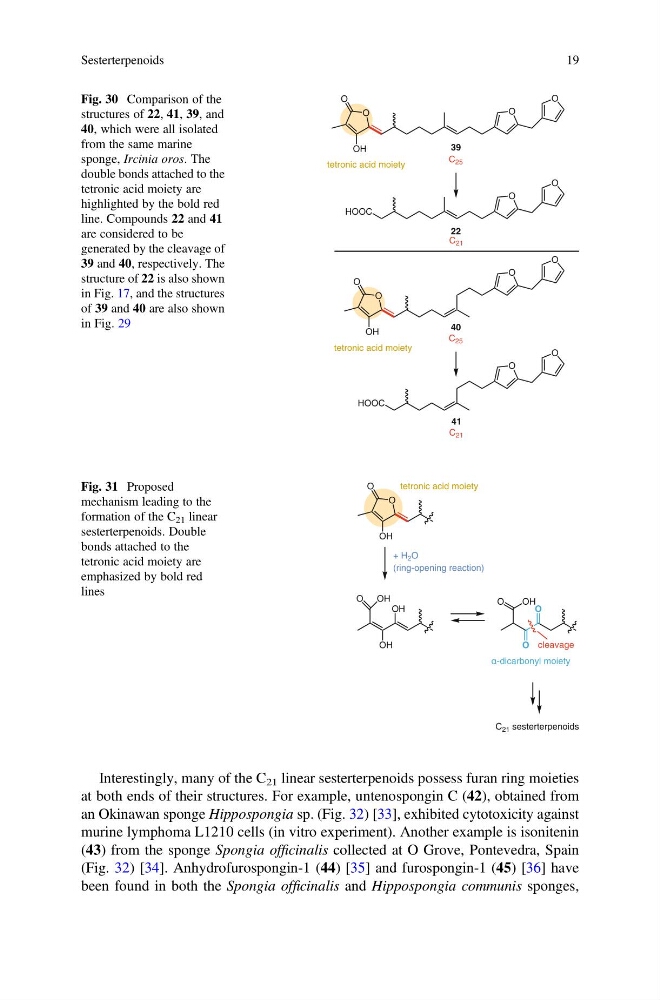
Fig. 30 Comparison of the
structures of 22, 41, 39, and
40, which were all isolated
from the same marine
sponge, Ircinia oros. The
double bonds attached to the
tetronic acid moiety are
highlighted by the bold red
line. Compounds 22 and 41
are considered to be
generated by the cleavage of
39 and 40, respectively. The
structure of 22 is also shown
in Fig. 17, and the structures
of 39 and 40 are also shown
in Fig. 29
OH
O
O
O
OH
O
OH
OH
OH
+ H 2 O
(ring opening reaction)
tetronic acid moiety
cleavage
-dicarbonyl moiety
C 21 sesterterpenoids
O
O
Fig. 31 Proposed
mechanism leading to the
formation of the C 21 linear
sesterterpenoids. Double
bonds attached to the
tetronic acid moiety are
emphasized by bold red
lines
Sesterterpenoids
19
at both ends of their structures. For example, untenospongin C (42), obtained from
an Okinawan sponge Hippospongia sp. (Fig. 32) [33], exhibited cytotoxicity against
murine lymphoma L1210 cells (in vitro experiment). Another example is isonitenin
(43) from the sponge Spongia officinalis collected at O Grove, Pontevedra, Spain
(Fig. 32) [34]. Anhydrofurospongin-1 (44) [35] and furospongin-1 (45) [36] have
been found in both the Spongia officinalis and Hippospongia communis sponges,
39
OH
OH
HOOC
HOOC
22
40
41
tetronic acid moiety
tetronic acid moiety
C 25
C 21
C 25
C 21
O
O
O
O
O
O
O
O
O
O
O
O
Fig. 30 Comparison of the
structures of 22, 41, 39, and
40, which were all isolated
from the same marine
sponge, Ircinia oros. The
double bonds attached to the
tetronic acid moiety are
highlighted by the bold red
line. Compounds 22 and 41
are considered to be
generated by the cleavage of
39 and 40, respectively. The
structure of 22 is also shown
in Fig. 17, and the structures
of 39 and 40 are also shown
in Fig. 29
OH
O
O
O
OH
O
OH
OH
OH
+ H 2 O
(ring opening reaction)
tetronic acid moiety
cleavage
-dicarbonyl moiety
C 21 sesterterpenoids
O
O
Fig. 31 Proposed
mechanism leading to the
formation of the C 21 linear
sesterterpenoids. Double
bonds attached to the
tetronic acid moiety are
emphasized by bold red
lines
Sesterterpenoids
19