

3.4 Degraded Linear Sesterterpenoids
As mentioned in Sect. 2.3.3, the numbers of carbon atoms in some sesterterpenoids
are less than 25, because of degradation reactions in their biosynthesis. Herein, we
introduce the “C 21 ” and “C 24 ” linear sesterterpenoids.
3.4.1 “C 21 ” Linear Sesterterpenoids
The C 21 linear sesterterpenoids are one of the largest groups among the degraded
linear sesterterpenoids. The C 21 linear sesterterpenoids are considered to arise from
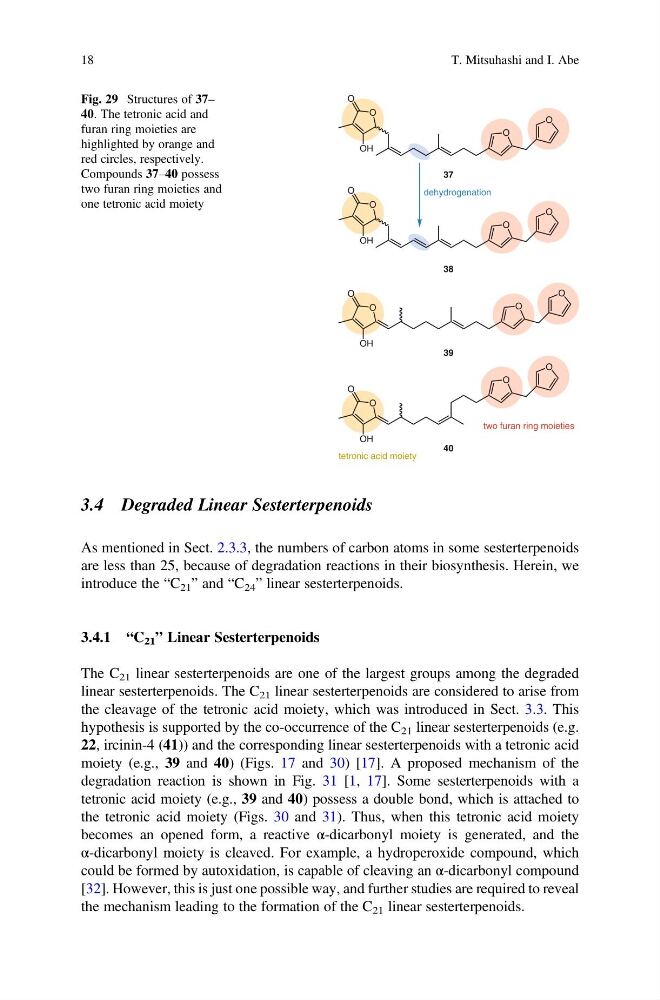
the cleavage of the tetronic acid moiety, which was introduced in Sect. 3.3. This
hypothesis is supported by the co-occurrence of the C 21 linear sesterterpenoids (e.g.
22, ircinin-4 (41)) and the corresponding linear sesterterpenoids with a tetronic acid
moiety (e.g., 39 and 40) (Figs. 17 and 30) [17]. A proposed mechanism of the
degradation reaction is shown in Fig. 31 [1, 17]. Some sesterterpenoids with a
tetronic acid moiety (e.g., 39 and 40) possess a double bond, which is attached to
the tetronic acid moiety (Figs. 30 and 31). Thus, when this tetronic acid moiety
becomes an opened form, a reactive α-dicarbonyl moiety is generated, and the
α-dicarbonyl moiety is cleaved. For example, a hydroperoxide compound, which
could be formed by autoxidation, is capable of cleaving an α-dicarbonyl compound
[32]. However, this is just one possible way, and further studies are required to reveal
the mechanism leading to the formation of the C 21 linear sesterterpenoids.
37
OH
OH
OH
OH
38
39
40
dehydrogenation
tetronic acid moiety
two furan ring moieties
O
O
O
O
O
O
O
O
O
O
O
O
O
O
O
O
Fig. 29 Structures of 37–
40. The tetronic acid and
furan ring moieties are
highlighted by orange and
red circles, respectively.
Compounds 37–40 possess
two furan ring moieties and
one tetronic acid moiety
18
T. Mitsuhashi and I. Abe
As mentioned in Sect. 2.3.3, the numbers of carbon atoms in some sesterterpenoids
are less than 25, because of degradation reactions in their biosynthesis. Herein, we
introduce the “C 21 ” and “C 24 ” linear sesterterpenoids.
3.4.1 “C 21 ” Linear Sesterterpenoids
The C 21 linear sesterterpenoids are one of the largest groups among the degraded
linear sesterterpenoids. The C 21 linear sesterterpenoids are considered to arise from
the cleavage of the tetronic acid moiety, which was introduced in Sect. 3.3. This
hypothesis is supported by the co-occurrence of the C 21 linear sesterterpenoids (e.g.
22, ircinin-4 (41)) and the corresponding linear sesterterpenoids with a tetronic acid
moiety (e.g., 39 and 40) (Figs. 17 and 30) [17]. A proposed mechanism of the
degradation reaction is shown in Fig. 31 [1, 17]. Some sesterterpenoids with a
tetronic acid moiety (e.g., 39 and 40) possess a double bond, which is attached to
the tetronic acid moiety (Figs. 30 and 31). Thus, when this tetronic acid moiety
becomes an opened form, a reactive α-dicarbonyl moiety is generated, and the
α-dicarbonyl moiety is cleaved. For example, a hydroperoxide compound, which
could be formed by autoxidation, is capable of cleaving an α-dicarbonyl compound
[32]. However, this is just one possible way, and further studies are required to reveal
the mechanism leading to the formation of the C 21 linear sesterterpenoids.
37
OH
OH
OH
OH
38
39
40
dehydrogenation
tetronic acid moiety
two furan ring moieties
O
O
O
O
O
O
O
O
O
O
O
O
O
O
O
O
Fig. 29 Structures of 37–
40. The tetronic acid and
furan ring moieties are
highlighted by orange and
red circles, respectively.
Compounds 37–40 possess
two furan ring moieties and
one tetronic acid moiety
18
T. Mitsuhashi and I. Abe