

containing new natural products including alkaloids (33 new natural products, 21%)
and peptides (31 new natural products, 20%) was in comparison higher than that of
polyketides (54 new natural products, 35%).
The number of new natural products reported from marine-derived fungi from
China as well as the total number of publications mostly from groups from China
devoted to this field has shown a sharp increase especially within the last decade
(Fig. 38), which emphasizes the growing attention of Chinese natural product
research to the marine environment as source of structurally unique bioactive
metabolites. Compared to other countries like the USA or Japan where marine
natural product research has already been a productive field of science for at least
the last 40 years [190], this is a fairly recent development in China where the
emphasis on terrestrial sources of natural products such as plants used in TCM
(Traditional Chinese Medicine) has been far more prominent historically. Over the
last few years, we have seen an impressive flow of publications of Chinese groups
not only devoted to natural products from marine-derived fungi but also to bioactive
compounds from other marine macro- and microorganisms. This underscores the
growing importance of marine natural product research in China. Whereas in many
countries of the Western world natural product research in general is declining due to
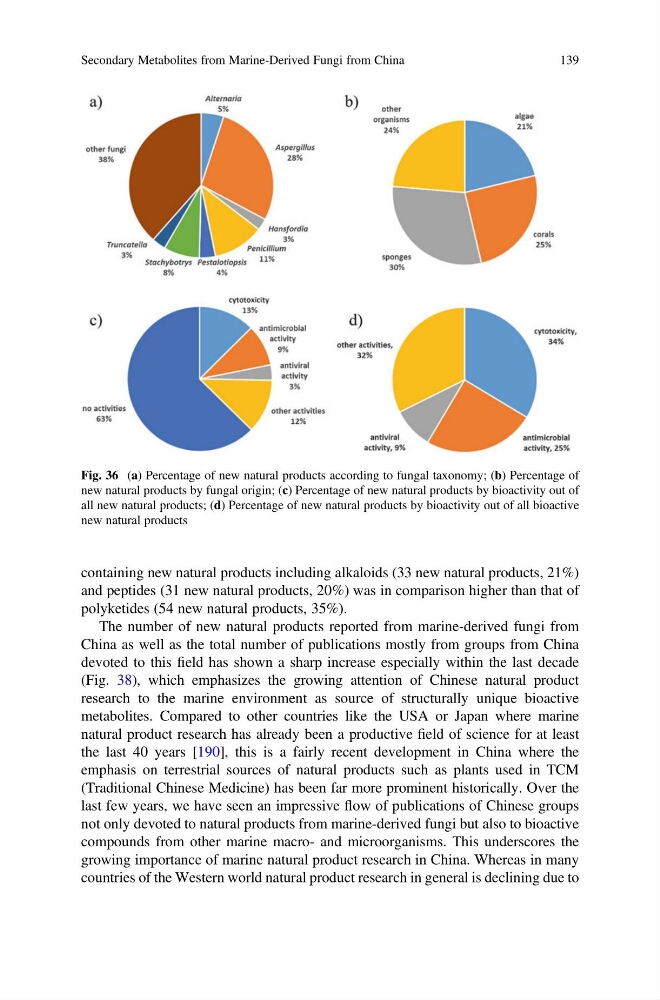
Fig. 36 (a) Percentage of new natural products according to fungal taxonomy; (b) Percentage of
new natural products by fungal origin; (c) Percentage of new natural products by bioactivity out of
all new natural products; (d) Percentage of new natural products by bioactivity out of all bioactive
new natural products
Secondary Metabolites from Marine-Derived Fungi from China
139
and peptides (31 new natural products, 20%) was in comparison higher than that of
polyketides (54 new natural products, 35%).
The number of new natural products reported from marine-derived fungi from
China as well as the total number of publications mostly from groups from China
devoted to this field has shown a sharp increase especially within the last decade
(Fig. 38), which emphasizes the growing attention of Chinese natural product
research to the marine environment as source of structurally unique bioactive
metabolites. Compared to other countries like the USA or Japan where marine
natural product research has already been a productive field of science for at least
the last 40 years [190], this is a fairly recent development in China where the
emphasis on terrestrial sources of natural products such as plants used in TCM
(Traditional Chinese Medicine) has been far more prominent historically. Over the
last few years, we have seen an impressive flow of publications of Chinese groups
not only devoted to natural products from marine-derived fungi but also to bioactive
compounds from other marine macro- and microorganisms. This underscores the
growing importance of marine natural product research in China. Whereas in many
countries of the Western world natural product research in general is declining due to
Fig. 36 (a) Percentage of new natural products according to fungal taxonomy; (b) Percentage of
new natural products by fungal origin; (c) Percentage of new natural products by bioactivity out of
all new natural products; (d) Percentage of new natural products by bioactivity out of all bioactive
new natural products
Secondary Metabolites from Marine-Derived Fungi from China
139