

example of those compounds was carba-NAD where an oxygen atom was replaced
with a methylene group [35, 36].
There are some other NAD
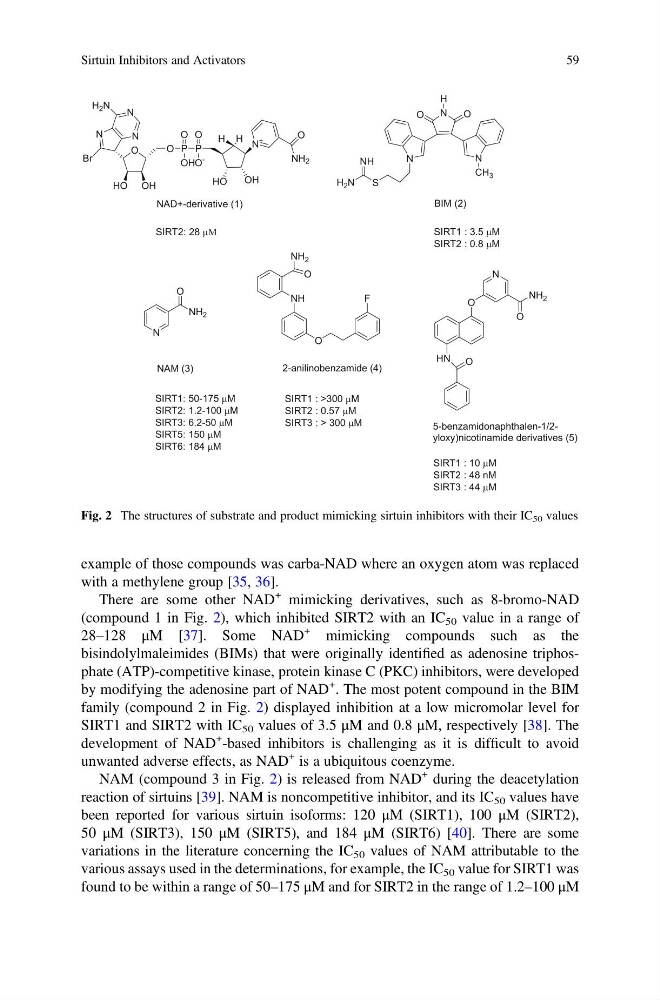
+ mimicking derivatives, such as 8-bromo-NAD
(compound 1 in Fig. 2), which inhibited SIRT2 with an IC 50 value in a range of
28–128 μM [37]. Some NAD
+
mimicking compounds such as the
bisindolylmaleimides (BIMs) that were originally identified as adenosine triphosphate (ATP)-competitive kinase, protein kinase C (PKC) inhibitors, were developed
by modifying the adenosine part of NAD
+
. The most potent compound in the BIM
family (compound 2 in Fig. 2) displayed inhibition at a low micromolar level for
SIRT1 and SIRT2 with IC 50 values of 3.5 μM and 0.8 μM, respectively [38]. The
development of NAD
+ -based inhibitors is challenging as it is difficult to avoid
unwanted adverse effects, as NAD
+ is a ubiquitous coenzyme.
NAM (compound 3 in Fig. 2) is released from NAD
+ during the deacetylation
reaction of sirtuins [39]. NAM is noncompetitive inhibitor, and its IC 50 values have
been reported for various sirtuin isoforms: 120 μM (SIRT1), 100 μM (SIRT2),
50 μM (SIRT3), 150 μM (SIRT5), and 184 μM (SIRT6) [40]. There are some
variations in the literature concerning the IC 50 values of NAM attributable to the
various assays used in the determinations, for example, the IC 50 value for SIRT1 was
found to be within a range of 50–175 μM and for SIRT2 in the range of 1.2–100 μM
N
O
NH 2
NAM (3)
O
O P
O
OH
P
O
O
-
HO OH
HO
OH
N
+
O
NH 2
H
H
NAD+-derivative (1)
N
O
O
H
N
N
CH 3
S
NH
H 2 N
BIM (2)
NH
O
F
O
NH 2
2-anilinobenzamide (4)
SIRT1 : >300 M
SIRT2 : 0.57 M
SIRT3 : > 300 M
SIRT1 : 3.5 M
SIRT2 : 0.8 M
SIRT1: 50-175 M
SIRT2: 1.2-100 M
SIRT3: 6.2-50 M
SIRT5: 150 M
SIRT6: 184 M
N
N
N
H 2 N
Br
SIRT2: 28
O
N
O
NH 2
HN
O
5-benzamidonaphthalen-1/2yloxy)nicotinamide derivatives (5)
SIRT1 : 10 M
SIRT2 : 48 nM
SIRT3 : 44 M
Fig. 2 The structures of substrate and product mimicking sirtuin inhibitors with their IC 50 values
Sirtuin Inhibitors and Activators
59
with a methylene group [35, 36].
There are some other NAD
+ mimicking derivatives, such as 8-bromo-NAD
(compound 1 in Fig. 2), which inhibited SIRT2 with an IC 50 value in a range of
28–128 μM [37]. Some NAD
+
mimicking compounds such as the
bisindolylmaleimides (BIMs) that were originally identified as adenosine triphosphate (ATP)-competitive kinase, protein kinase C (PKC) inhibitors, were developed
by modifying the adenosine part of NAD
+
. The most potent compound in the BIM
family (compound 2 in Fig. 2) displayed inhibition at a low micromolar level for
SIRT1 and SIRT2 with IC 50 values of 3.5 μM and 0.8 μM, respectively [38]. The
development of NAD
+ -based inhibitors is challenging as it is difficult to avoid
unwanted adverse effects, as NAD
+ is a ubiquitous coenzyme.
NAM (compound 3 in Fig. 2) is released from NAD
+ during the deacetylation
reaction of sirtuins [39]. NAM is noncompetitive inhibitor, and its IC 50 values have
been reported for various sirtuin isoforms: 120 μM (SIRT1), 100 μM (SIRT2),
50 μM (SIRT3), 150 μM (SIRT5), and 184 μM (SIRT6) [40]. There are some
variations in the literature concerning the IC 50 values of NAM attributable to the
various assays used in the determinations, for example, the IC 50 value for SIRT1 was
found to be within a range of 50–175 μM and for SIRT2 in the range of 1.2–100 μM
N
O
NH 2
NAM (3)
O
O P
O
OH
P
O
O
-
HO OH
HO
OH
N
+
O
NH 2
H
H
NAD+-derivative (1)
N
O
O
H
N
N
CH 3
S
NH
H 2 N
BIM (2)
NH
O
F
O
NH 2
2-anilinobenzamide (4)
SIRT1 : >300 M
SIRT2 : 0.57 M
SIRT3 : > 300 M
SIRT1 : 3.5 M
SIRT2 : 0.8 M
SIRT1: 50-175 M
SIRT2: 1.2-100 M
SIRT3: 6.2-50 M
SIRT5: 150 M
SIRT6: 184 M
N
N
N
H 2 N
Br
SIRT2: 28
O
N
O
NH 2
HN
O
5-benzamidonaphthalen-1/2yloxy)nicotinamide derivatives (5)
SIRT1 : 10 M
SIRT2 : 48 nM
SIRT3 : 44 M
Fig. 2 The structures of substrate and product mimicking sirtuin inhibitors with their IC 50 values
Sirtuin Inhibitors and Activators
59