

2 Sirtuin Inhibitors
Sirtuins are a family of proteins which share a highly conserved approximately
275 amino acid-long catalytic core [29, 30]. The catalytic core of sirtuins consists
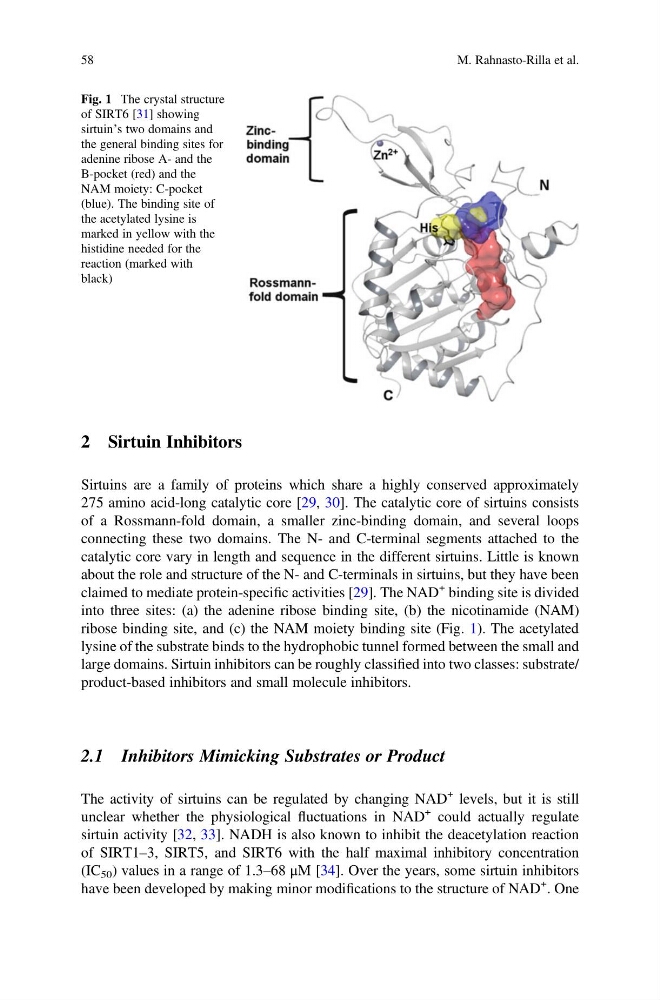
of a Rossmann-fold domain, a smaller zinc-binding domain, and several loops
connecting these two domains. The N- and C-terminal segments attached to the
catalytic core vary in length and sequence in the different sirtuins. Little is known
about the role and structure of the N- and C-terminals in sirtuins, but they have been
claimed to mediate protein-specific activities [29]. The NAD
+ binding site is divided
into three sites: (a) the adenine ribose binding site, (b) the nicotinamide (NAM)
ribose binding site, and (c) the NAM moiety binding site (Fig. 1). The acetylated
lysine of the substrate binds to the hydrophobic tunnel formed between the small and
large domains. Sirtuin inhibitors can be roughly classified into two classes: substrate/
product-based inhibitors and small molecule inhibitors.
2.1 Inhibitors Mimicking Substrates or Product
The activity of sirtuins can be regulated by changing NAD
+ levels, but it is still
unclear whether the physiological fluctuations in NAD
+ could actually regulate
sirtuin activity [32, 33]. NADH is also known to inhibit the deacetylation reaction
of SIRT1–3, SIRT5, and SIRT6 with the half maximal inhibitory concentration
(IC 50 ) values in a range of 1.3–68 μM [34]. Over the years, some sirtuin inhibitors
have been developed by making minor modifications to the structure of NAD
+ . One
Fig. 1 The crystal structure
of SIRT6 [31] showing
sirtuin’s two domains and
the general binding sites for
adenine ribose A- and the
B-pocket (red) and the
NAM moiety: C-pocket
(blue). The binding site of
the acetylated lysine is
marked in yellow with the
histidine needed for the
reaction (marked with
black)
58
M. Rahnasto-Rilla et al.
Sirtuins are a family of proteins which share a highly conserved approximately
275 amino acid-long catalytic core [29, 30]. The catalytic core of sirtuins consists
of a Rossmann-fold domain, a smaller zinc-binding domain, and several loops
connecting these two domains. The N- and C-terminal segments attached to the
catalytic core vary in length and sequence in the different sirtuins. Little is known
about the role and structure of the N- and C-terminals in sirtuins, but they have been
claimed to mediate protein-specific activities [29]. The NAD
+ binding site is divided
into three sites: (a) the adenine ribose binding site, (b) the nicotinamide (NAM)
ribose binding site, and (c) the NAM moiety binding site (Fig. 1). The acetylated
lysine of the substrate binds to the hydrophobic tunnel formed between the small and
large domains. Sirtuin inhibitors can be roughly classified into two classes: substrate/
product-based inhibitors and small molecule inhibitors.
2.1 Inhibitors Mimicking Substrates or Product
The activity of sirtuins can be regulated by changing NAD
+ levels, but it is still
unclear whether the physiological fluctuations in NAD
+ could actually regulate
sirtuin activity [32, 33]. NADH is also known to inhibit the deacetylation reaction
of SIRT1–3, SIRT5, and SIRT6 with the half maximal inhibitory concentration
(IC 50 ) values in a range of 1.3–68 μM [34]. Over the years, some sirtuin inhibitors
have been developed by making minor modifications to the structure of NAD
+ . One
Fig. 1 The crystal structure
of SIRT6 [31] showing
sirtuin’s two domains and
the general binding sites for
adenine ribose A- and the
B-pocket (red) and the
NAM moiety: C-pocket
(blue). The binding site of
the acetylated lysine is
marked in yellow with the
histidine needed for the
reaction (marked with
black)
58
M. Rahnasto-Rilla et al.