

yield and poor luminescent stability of BRET [31]. Nluc uses furimazine, an
engineered small protein (19 kDa), as the donor, which produces a higher luminescent signal than Rluc and allows better discrimination with acceptor fluorophores,
and a fluorescently labelled HaloTag fusion protein as the acceptor. A recent study
demonstrated that chloroalkane derivative of non-chloro TOM dye is the best
acceptor substrate [31]. It provides peak light emission at 635 nm, and so the spectra
are separated by 175 nm. Nluc is able to visualize subcellular translocation events
with sub-second temporal resolution. It is in fact possible to evaluate bromodomain
activity and identify compounds that inhibit it using HTS. The interaction between
the bromodomain and the acetylated histone substrate can be monitored by
expressing Nluc-BRD4 (one of the BET family members [32] in mammalian cells
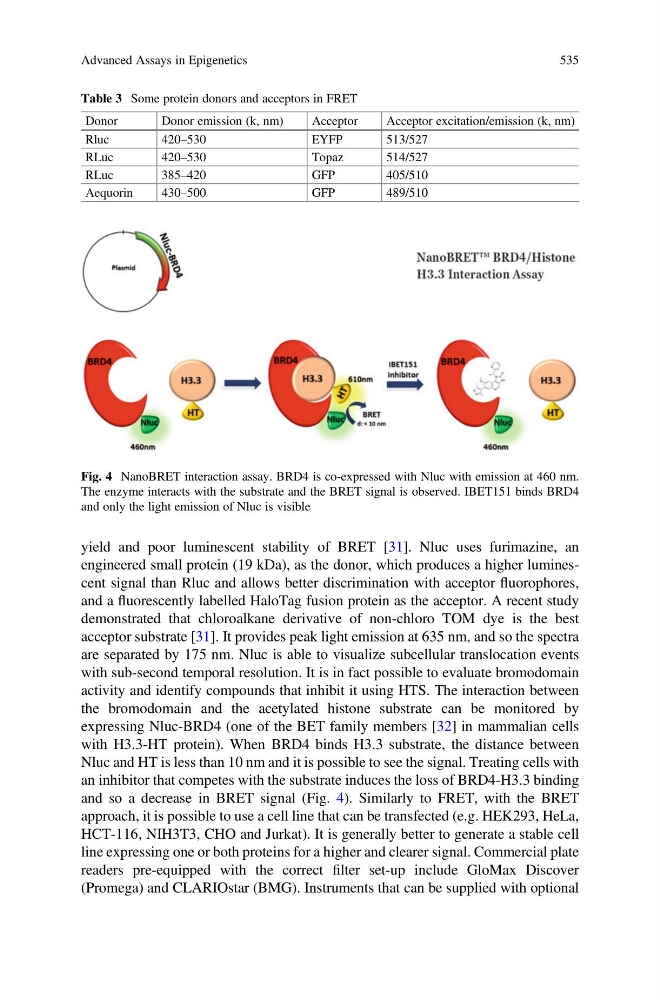
with H3.3-HT protein). When BRD4 binds H3.3 substrate, the distance between
Nluc and HT is less than 10 nm and it is possible to see the signal. Treating cells with
an inhibitor that competes with the substrate induces the loss of BRD4-H3.3 binding
and so a decrease in BRET signal (Fig. 4). Similarly to FRET, with the BRET
approach, it is possible to use a cell line that can be transfected (e.g. HEK293, HeLa,
HCT-116, NIH3T3, CHO and Jurkat). It is generally better to generate a stable cell
line expressing one or both proteins for a higher and clearer signal. Commercial plate
readers pre-equipped with the correct filter set-up include GloMax Discover
(Promega) and CLARIOstar (BMG). Instruments that can be supplied with optional
Table 3 Some protein donors and acceptors in FRET
Donor
Donor emission (k, nm)
Acceptor
Acceptor excitation/emission (k, nm)
Rluc
420–530
EYFP
513/527
RLuc
420–530
Topaz
514/527
RLuc
385–420
GFP
405/510
Aequorin
430–500
GFP
489/510
Fig. 4 NanoBRET interaction assay. BRD4 is co-expressed with Nluc with emission at 460 nm.
The enzyme interacts with the substrate and the BRET signal is observed. IBET151 binds BRD4
and only the light emission of Nluc is visible
Advanced Assays in Epigenetics
535
engineered small protein (19 kDa), as the donor, which produces a higher luminescent signal than Rluc and allows better discrimination with acceptor fluorophores,
and a fluorescently labelled HaloTag fusion protein as the acceptor. A recent study
demonstrated that chloroalkane derivative of non-chloro TOM dye is the best
acceptor substrate [31]. It provides peak light emission at 635 nm, and so the spectra
are separated by 175 nm. Nluc is able to visualize subcellular translocation events
with sub-second temporal resolution. It is in fact possible to evaluate bromodomain
activity and identify compounds that inhibit it using HTS. The interaction between
the bromodomain and the acetylated histone substrate can be monitored by
expressing Nluc-BRD4 (one of the BET family members [32] in mammalian cells
with H3.3-HT protein). When BRD4 binds H3.3 substrate, the distance between
Nluc and HT is less than 10 nm and it is possible to see the signal. Treating cells with
an inhibitor that competes with the substrate induces the loss of BRD4-H3.3 binding
and so a decrease in BRET signal (Fig. 4). Similarly to FRET, with the BRET
approach, it is possible to use a cell line that can be transfected (e.g. HEK293, HeLa,
HCT-116, NIH3T3, CHO and Jurkat). It is generally better to generate a stable cell
line expressing one or both proteins for a higher and clearer signal. Commercial plate
readers pre-equipped with the correct filter set-up include GloMax Discover
(Promega) and CLARIOstar (BMG). Instruments that can be supplied with optional
Table 3 Some protein donors and acceptors in FRET
Donor
Donor emission (k, nm)
Acceptor
Acceptor excitation/emission (k, nm)
Rluc
420–530
EYFP
513/527
RLuc
420–530
Topaz
514/527
RLuc
385–420
GFP
405/510
Aequorin
430–500
GFP
489/510
Fig. 4 NanoBRET interaction assay. BRD4 is co-expressed with Nluc with emission at 460 nm.
The enzyme interacts with the substrate and the BRET signal is observed. IBET151 binds BRD4
and only the light emission of Nluc is visible
Advanced Assays in Epigenetics
535