

and affinity interactions. The Monolith NT.Automated is specifically designed with
high-throughput capabilities for HTS approaches. In recent years MTS has also been
used to study interactions directly in cell lysates using fluorescence fusion proteins.
To bypass fluorescence artefacts, MST experiments can be performed with two
different cell lysates expressing different fluorescence fusion proteins. These
approaches can be used to rapidly test whether and in what manner proteins of
interest interact in close-to-native conditions without protein purification. As
reported in several studies, MST can be used to characterize protein-histone interactions. Alpatov et al. identified the fragile X mental retardation protein [18] as a
chromatin-binding protein that uses its tandem Tudor domain for binding. Josling
et al. also demonstrated that the bromodomain protein PfBDP1 binds specifically to
H3K9Ac and H3K14Ac peptides with Kd ¼ 110.79 Æ 10.31 μM (R2 ¼ 0.995) and
Kd ¼ 126.17 Æ 14.39 μM (R2 ¼ 0.993), respectively. In conclusion, MST technology is able to perform screening assays, binding assays and competition assays with
multiple binding partners [19]. The advantages and disadvantages of these last two
techniques are summarized in Table 2.
1.2 Cell-Based Assays
The presence of numerous binding sites, molecular dynamics, interaction complexity and external factors complicates the study of macromolecular complexes in cells.
Several new techniques have been developed to study protein-protein interaction
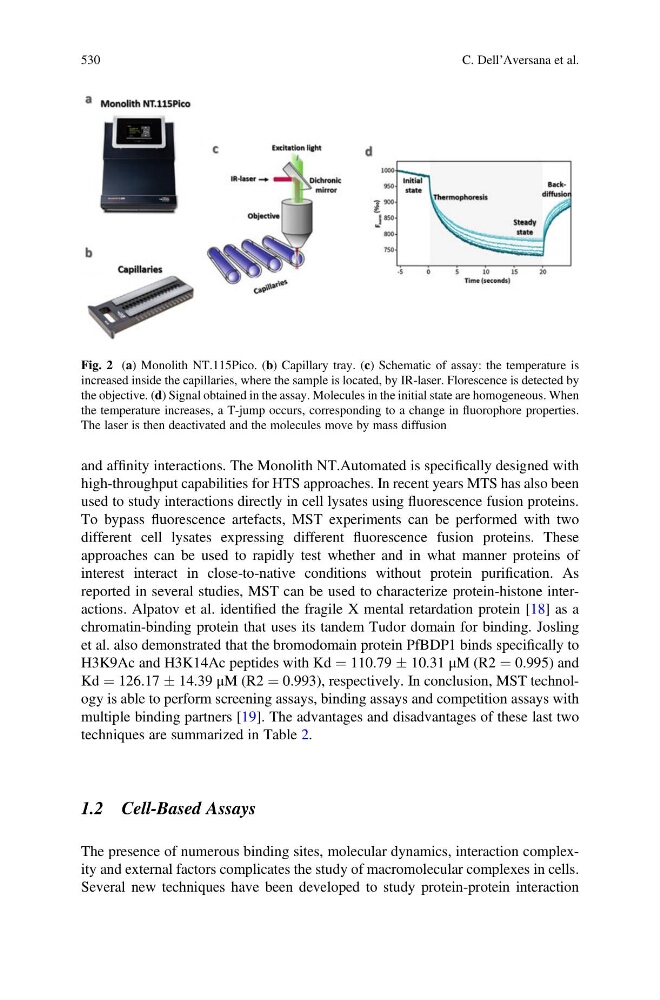
Fig. 2 (a) Monolith NT.115Pico. (b) Capillary tray. (c) Schematic of assay: the temperature is
increased inside the capillaries, where the sample is located, by IR-laser. Florescence is detected by
the objective. (d) Signal obtained in the assay. Molecules in the initial state are homogeneous. When
the temperature increases, a T-jump occurs, corresponding to a change in fluorophore properties.
The laser is then deactivated and the molecules move by mass diffusion
530
C. Dell’Aversana et al.
high-throughput capabilities for HTS approaches. In recent years MTS has also been
used to study interactions directly in cell lysates using fluorescence fusion proteins.
To bypass fluorescence artefacts, MST experiments can be performed with two
different cell lysates expressing different fluorescence fusion proteins. These
approaches can be used to rapidly test whether and in what manner proteins of
interest interact in close-to-native conditions without protein purification. As
reported in several studies, MST can be used to characterize protein-histone interactions. Alpatov et al. identified the fragile X mental retardation protein [18] as a
chromatin-binding protein that uses its tandem Tudor domain for binding. Josling
et al. also demonstrated that the bromodomain protein PfBDP1 binds specifically to
H3K9Ac and H3K14Ac peptides with Kd ¼ 110.79 Æ 10.31 μM (R2 ¼ 0.995) and
Kd ¼ 126.17 Æ 14.39 μM (R2 ¼ 0.993), respectively. In conclusion, MST technology is able to perform screening assays, binding assays and competition assays with
multiple binding partners [19]. The advantages and disadvantages of these last two
techniques are summarized in Table 2.
1.2 Cell-Based Assays
The presence of numerous binding sites, molecular dynamics, interaction complexity and external factors complicates the study of macromolecular complexes in cells.
Several new techniques have been developed to study protein-protein interaction
Fig. 2 (a) Monolith NT.115Pico. (b) Capillary tray. (c) Schematic of assay: the temperature is
increased inside the capillaries, where the sample is located, by IR-laser. Florescence is detected by
the objective. (d) Signal obtained in the assay. Molecules in the initial state are homogeneous. When
the temperature increases, a T-jump occurs, corresponding to a change in fluorophore properties.
The laser is then deactivated and the molecules move by mass diffusion
530
C. Dell’Aversana et al.