

assay, mechanism-of-action assay, cellular H3 trimethylation assay, biophysical
assay, and HMT profiling. Data and chemoinformatic clustering analyses allowed
to classify some hits as SAM competitive, while others as SAM noncompetitive, and
these were further characterized to demonstrate that their mechanism of inhibition
(MOI) was indeed through EED binding [242]. An AlphaScreen assay to measure
the interaction between His-tagged recombinant EED protein and a biotinylated
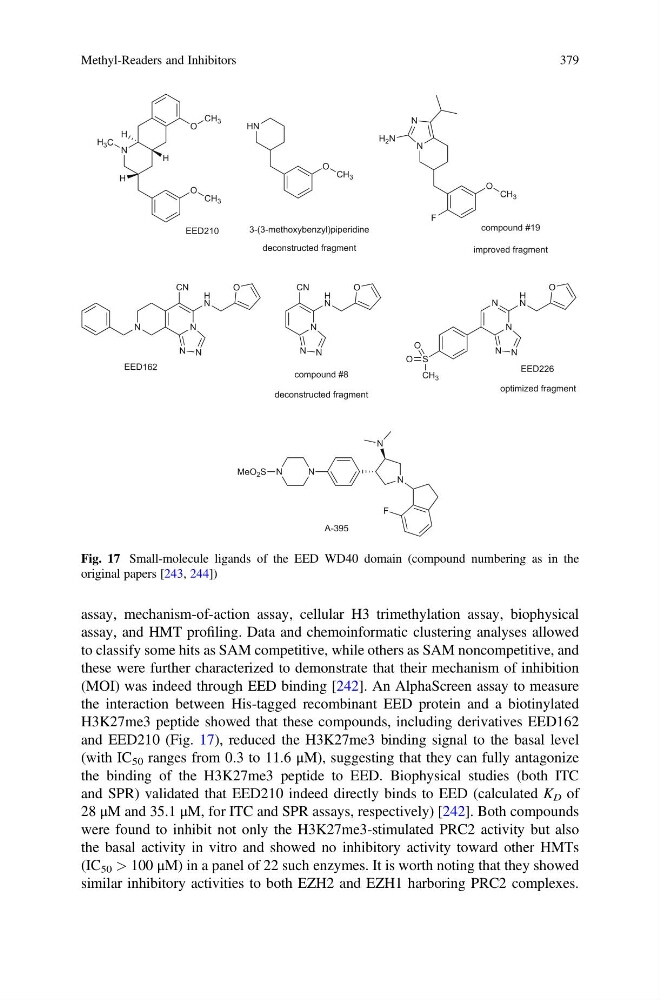
H3K27me3 peptide showed that these compounds, including derivatives EED162
and EED210 (Fig. 17), reduced the H3K27me3 binding signal to the basal level
(with IC 50 ranges from 0.3 to 11.6 μM), suggesting that they can fully antagonize
the binding of the H3K27me3 peptide to EED. Biophysical studies (both ITC
and SPR) validated that EED210 indeed directly binds to EED (calculated K D of
28 μM and 35.1 μM, for ITC and SPR assays, respectively) [242]. Both compounds
were found to inhibit not only the H3K27me3-stimulated PRC2 activity but also
the basal activity in vitro and showed no inhibitory activity toward other HMTs
(IC 50 > 100 μM) in a panel of 22 such enzymes. It is worth noting that they showed
similar inhibitory activities to both EZH2 and EZH1 harboring PRC2 complexes.
N
H 3 C
H
H
H
O
CH 3
O CH 3
N
O CH 3
HN
O CH 3
N
H 2 N
F
N
N
H
N
N N
S
CH 3
O
O
O
EED226
optimized fragment
N
N
MeO 2 S
N
N
F
A-395
EED210
3-(3-methoxybenzyl)piperidine
deconstructed fragment
compound #19
improved fragment
N
H
N
N
N N
O
CN
EED162
N
H
N
N N
O
CN
compound #8
deconstructed fragment
Fig. 17 Small-molecule ligands of the EED WD40 domain (compound numbering as in the
original papers [243, 244])
Methyl-Readers and Inhibitors
379
assay, and HMT profiling. Data and chemoinformatic clustering analyses allowed
to classify some hits as SAM competitive, while others as SAM noncompetitive, and
these were further characterized to demonstrate that their mechanism of inhibition
(MOI) was indeed through EED binding [242]. An AlphaScreen assay to measure
the interaction between His-tagged recombinant EED protein and a biotinylated
H3K27me3 peptide showed that these compounds, including derivatives EED162
and EED210 (Fig. 17), reduced the H3K27me3 binding signal to the basal level
(with IC 50 ranges from 0.3 to 11.6 μM), suggesting that they can fully antagonize
the binding of the H3K27me3 peptide to EED. Biophysical studies (both ITC
and SPR) validated that EED210 indeed directly binds to EED (calculated K D of
28 μM and 35.1 μM, for ITC and SPR assays, respectively) [242]. Both compounds
were found to inhibit not only the H3K27me3-stimulated PRC2 activity but also
the basal activity in vitro and showed no inhibitory activity toward other HMTs
(IC 50 > 100 μM) in a panel of 22 such enzymes. It is worth noting that they showed
similar inhibitory activities to both EZH2 and EZH1 harboring PRC2 complexes.
N
H 3 C
H
H
H
O
CH 3
O CH 3
N
O CH 3
HN
O CH 3
N
H 2 N
F
N
N
H
N
N N
S
CH 3
O
O
O
EED226
optimized fragment
N
N
MeO 2 S
N
N
F
A-395
EED210
3-(3-methoxybenzyl)piperidine
deconstructed fragment
compound #19
improved fragment
N
H
N
N
N N
O
CN
EED162
N
H
N
N N
O
CN
compound #8
deconstructed fragment
Fig. 17 Small-molecule ligands of the EED WD40 domain (compound numbering as in the
original papers [243, 244])
Methyl-Readers and Inhibitors
379