

normal cells stay unaffected, making MM-401 an interesting candidate to be further
evaluated as a potential therapeutic drug [229]. Based upon the co-crystal structure
of MM-401 in complex with WDR5, other macrocyclic peptidomimetics were
designed and synthesized to further determine the structure-activity relationships
for this class [232]. In particular, this study determined the optimal linker length in
these macrocyclic peptidomimetics and discovered a number of potent and promising macrocyclic peptidomimetics with MM-589 (Fig. 15) as the best compound,
capable to bind to WDR5 with a K i value <1 nM and inhibit the MLL HMT activity
with an IC 50 value of 12.7 nM. Significantly, MM-589 resulted >40 times more
potent than MM-401 in inhibition of the MLL HMT activity and growth of MOLM13 and MV4-11 human leukemia cell lines harboring MLL translocation, with >30fold selectivity over HL-60 leukemia cell line lacking MLL translocation. The
compound also displayed excellent metabolic stability in human, mouse, and rat
microsomes (T 1/2 > 60 min). Further optimization of MM-589 may ultimately yield a
new therapy for the treatment of acute human leukemia carrying MLL translocation
and potentially other human diseases and conditions that depend upon the MLL
HTM activity, the WDR5-MLL interaction, or WDR5.
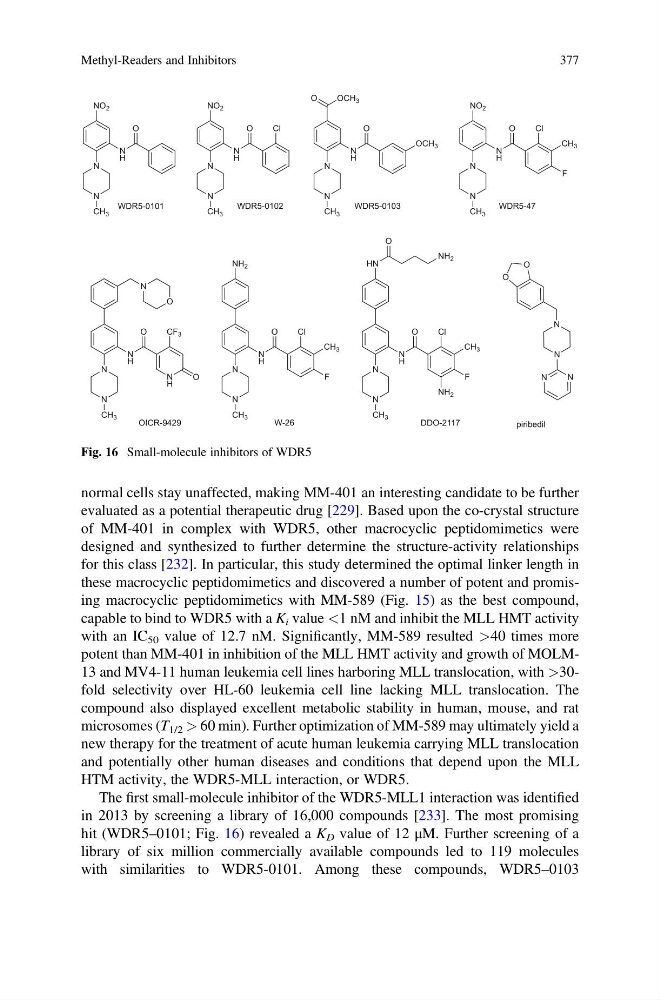
The first small-molecule inhibitor of the WDR5-MLL1 interaction was identified
in 2013 by screening a library of 16,000 compounds [233]. The most promising
hit (WDR5–0101; Fig. 16) revealed a K D value of 12 μM. Further screening of a
library of six million commercially available compounds led to 119 molecules
with similarities to WDR5-0101. Among these compounds, WDR5–0103
NO 2
N
N
H
O
N
CH 3
NO 2
N
N
H
O
N
CH 3
Cl
N
N
H
O
N
CH 3
O
OCH 3
OCH 3
N
N
H
O
N
N
H
CH 3
N
O
O
CF 3
OICR-9429
WDR5-0101
WDR5-0102
WDR5-0103
NO 2
N
N
H
O
N
CH 3
Cl
F
CH 3
WDR5-47
N
N
H
O
N
CH 3
F
Cl
CH 3
NH 2
W-26
N
N
H
O
N
CH 3
F
Cl
CH 3
HN
DDO-2117
O
NH 2
N
N
N
N
O
O
piribedil
NH 2
Fig. 16 Small-molecule inhibitors of WDR5
Methyl-Readers and Inhibitors
377
evaluated as a potential therapeutic drug [229]. Based upon the co-crystal structure
of MM-401 in complex with WDR5, other macrocyclic peptidomimetics were
designed and synthesized to further determine the structure-activity relationships
for this class [232]. In particular, this study determined the optimal linker length in
these macrocyclic peptidomimetics and discovered a number of potent and promising macrocyclic peptidomimetics with MM-589 (Fig. 15) as the best compound,
capable to bind to WDR5 with a K i value <1 nM and inhibit the MLL HMT activity
with an IC 50 value of 12.7 nM. Significantly, MM-589 resulted >40 times more
potent than MM-401 in inhibition of the MLL HMT activity and growth of MOLM13 and MV4-11 human leukemia cell lines harboring MLL translocation, with >30fold selectivity over HL-60 leukemia cell line lacking MLL translocation. The
compound also displayed excellent metabolic stability in human, mouse, and rat
microsomes (T 1/2 > 60 min). Further optimization of MM-589 may ultimately yield a
new therapy for the treatment of acute human leukemia carrying MLL translocation
and potentially other human diseases and conditions that depend upon the MLL
HTM activity, the WDR5-MLL interaction, or WDR5.
The first small-molecule inhibitor of the WDR5-MLL1 interaction was identified
in 2013 by screening a library of 16,000 compounds [233]. The most promising
hit (WDR5–0101; Fig. 16) revealed a K D value of 12 μM. Further screening of a
library of six million commercially available compounds led to 119 molecules
with similarities to WDR5-0101. Among these compounds, WDR5–0103
NO 2
N
N
H
O
N
CH 3
NO 2
N
N
H
O
N
CH 3
Cl
N
N
H
O
N
CH 3
O
OCH 3
OCH 3
N
N
H
O
N
N
H
CH 3
N
O
O
CF 3
OICR-9429
WDR5-0101
WDR5-0102
WDR5-0103
NO 2
N
N
H
O
N
CH 3
Cl
F
CH 3
WDR5-47
N
N
H
O
N
CH 3
F
Cl
CH 3
NH 2
W-26
N
N
H
O
N
CH 3
F
Cl
CH 3
HN
DDO-2117
O
NH 2
N
N
N
N
O
O
piribedil
NH 2
Fig. 16 Small-molecule inhibitors of WDR5
Methyl-Readers and Inhibitors
377