

L3MBTL3 was further confirmed by immunofluorescence, immunoprecipitation,
and mutagenesis experiments. Lastly, AlphaScreen™ assay confirmed that K455me,
the known methylation mark of BCLAF1, effectively bound to L3MBTL3 with
similar affinity as H4K20me histone peptides [178]. The use of UNC1215 to identify
this cellular interaction highlights the importance of developing specific probes for
each of the methyllysine reader proteins [181].
Parallel attempts to enhance the selectivity of the UNC1215 scaffold for
L3MBTL3 focused on substituting a variety of basic amine-containing groups that
were predicted to prevent its interaction with the MBT2 domain of L3MBTL1 [179].
These studies resulted in the identification of two compounds, UNC1679 and analog
#56 (numbering as in original paper; Fig. 13), that demonstrate comparable potency
against L3MBTL3 (IC 50 values 0.17 μM and 0.13 μM, respectively) and no activity
against L3MBTL1 at $10 μM or greater. A series of molecular modeling and
mutational studies provided strong evidence that the enhanced selectivity for
L3MBTL3 demonstrated by these compounds is due to favorable stabilizing π-π
or CH-π bonds between the 2-ethylisoindoline group and Phe387, interactions
that cannot occur in the L3MBTL1 reader domain where the analogous residue
is Leu361 [179]. Both UNC1679 and analog #56 were nontoxic in cell culture,
and their ability to antagonize L3MBTL3 activity in vitro was confirmed by the
eliminating foci formation when HEK293 cells were treated with either compound
conjugated to the cell-permeable merocyanine dye mero76 and GFP-FLMBT.
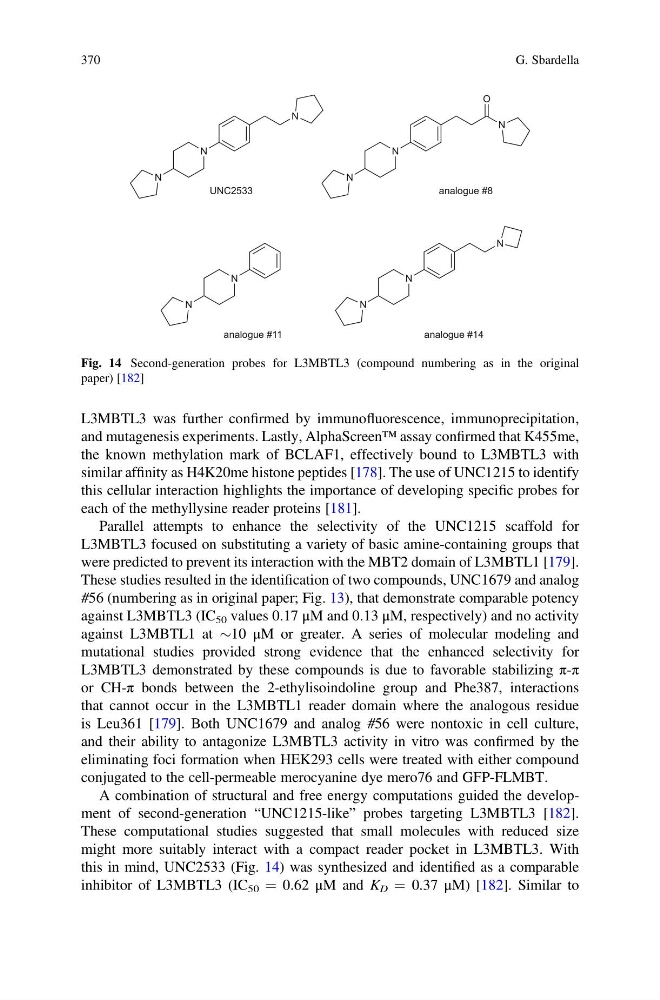
A combination of structural and free energy computations guided the development of second-generation “UNC1215-like” probes targeting L3MBTL3 [182].
These computational studies suggested that small molecules with reduced size
might more suitably interact with a compact reader pocket in L3MBTL3. With
this in mind, UNC2533 (Fig. 14) was synthesized and identified as a comparable
inhibitor of L3MBTL3 (IC 50 ¼ 0.62 μM and K D ¼ 0.37 μM) [182]. Similar to
N
N
N
UNC2533
N
N
N
O
N
N
N
N
N
analogue #11
analogue #14
analogue #8
Fig. 14 Second-generation probes for L3MBTL3 (compound numbering as in the original
paper) [182]
370
G. Sbardella
and mutagenesis experiments. Lastly, AlphaScreen™ assay confirmed that K455me,
the known methylation mark of BCLAF1, effectively bound to L3MBTL3 with
similar affinity as H4K20me histone peptides [178]. The use of UNC1215 to identify
this cellular interaction highlights the importance of developing specific probes for
each of the methyllysine reader proteins [181].
Parallel attempts to enhance the selectivity of the UNC1215 scaffold for
L3MBTL3 focused on substituting a variety of basic amine-containing groups that
were predicted to prevent its interaction with the MBT2 domain of L3MBTL1 [179].
These studies resulted in the identification of two compounds, UNC1679 and analog
#56 (numbering as in original paper; Fig. 13), that demonstrate comparable potency
against L3MBTL3 (IC 50 values 0.17 μM and 0.13 μM, respectively) and no activity
against L3MBTL1 at $10 μM or greater. A series of molecular modeling and
mutational studies provided strong evidence that the enhanced selectivity for
L3MBTL3 demonstrated by these compounds is due to favorable stabilizing π-π
or CH-π bonds between the 2-ethylisoindoline group and Phe387, interactions
that cannot occur in the L3MBTL1 reader domain where the analogous residue
is Leu361 [179]. Both UNC1679 and analog #56 were nontoxic in cell culture,
and their ability to antagonize L3MBTL3 activity in vitro was confirmed by the
eliminating foci formation when HEK293 cells were treated with either compound
conjugated to the cell-permeable merocyanine dye mero76 and GFP-FLMBT.
A combination of structural and free energy computations guided the development of second-generation “UNC1215-like” probes targeting L3MBTL3 [182].
These computational studies suggested that small molecules with reduced size
might more suitably interact with a compact reader pocket in L3MBTL3. With
this in mind, UNC2533 (Fig. 14) was synthesized and identified as a comparable
inhibitor of L3MBTL3 (IC 50 ¼ 0.62 μM and K D ¼ 0.37 μM) [182]. Similar to
N
N
N
UNC2533
N
N
N
O
N
N
N
N
N
analogue #11
analogue #14
analogue #8
Fig. 14 Second-generation probes for L3MBTL3 (compound numbering as in the original
paper) [182]
370
G. Sbardella