

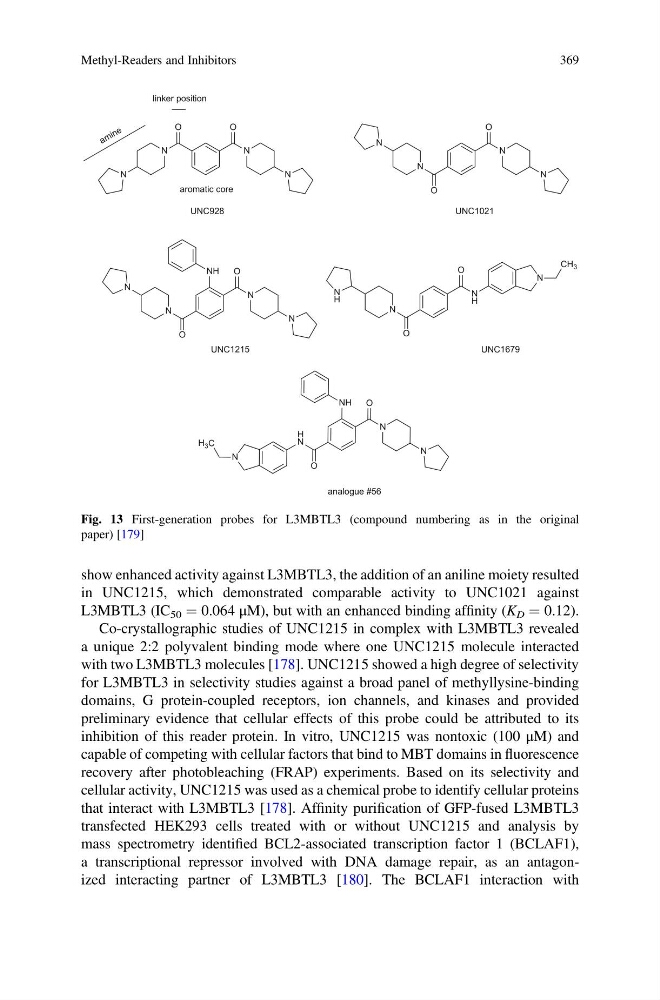
show enhanced activity against L3MBTL3, the addition of an aniline moiety resulted
in UNC1215, which demonstrated comparable activity to UNC1021 against
L3MBTL3 (IC 50 ¼ 0.064 μM), but with an enhanced binding affinity (K D ¼ 0.12).
Co-crystallographic studies of UNC1215 in complex with L3MBTL3 revealed
a unique 2:2 polyvalent binding mode where one UNC1215 molecule interacted
with two L3MBTL3 molecules [178]. UNC1215 showed a high degree of selectivity
for L3MBTL3 in selectivity studies against a broad panel of methyllysine-binding
domains, G protein-coupled receptors, ion channels, and kinases and provided
preliminary evidence that cellular effects of this probe could be attributed to its
inhibition of this reader protein. In vitro, UNC1215 was nontoxic (100 μM) and
capable of competing with cellular factors that bind to MBT domains in fluorescence
recovery after photobleaching (FRAP) experiments. Based on its selectivity and
cellular activity, UNC1215 was used as a chemical probe to identify cellular proteins
that interact with L3MBTL3 [178]. Affinity purification of GFP-fused L3MBTL3
transfected HEK293 cells treated with or without UNC1215 and analysis by
mass spectrometry identified BCL2-associated transcription factor 1 (BCLAF1),
a transcriptional repressor involved with DNA damage repair, as an antagonized interacting partner of L3MBTL3 [180]. The BCLAF1 interaction with
N
O
N
N
O
N
a m in e
aromatic core
linker position
UNC928
N
O
N
N
O
N
UNC1021
N
O
N
N
O
N
UNC1215
NH
N
H
O
N
H
O
N
UNC1679
N
CH 3
N
O
N
NH
analogue #56
H
N
O
N
H 3 C
Fig. 13 First-generation probes for L3MBTL3 (compound numbering as in the original
paper) [179]
Methyl-Readers and Inhibitors
369
in UNC1215, which demonstrated comparable activity to UNC1021 against
L3MBTL3 (IC 50 ¼ 0.064 μM), but with an enhanced binding affinity (K D ¼ 0.12).
Co-crystallographic studies of UNC1215 in complex with L3MBTL3 revealed
a unique 2:2 polyvalent binding mode where one UNC1215 molecule interacted
with two L3MBTL3 molecules [178]. UNC1215 showed a high degree of selectivity
for L3MBTL3 in selectivity studies against a broad panel of methyllysine-binding
domains, G protein-coupled receptors, ion channels, and kinases and provided
preliminary evidence that cellular effects of this probe could be attributed to its
inhibition of this reader protein. In vitro, UNC1215 was nontoxic (100 μM) and
capable of competing with cellular factors that bind to MBT domains in fluorescence
recovery after photobleaching (FRAP) experiments. Based on its selectivity and
cellular activity, UNC1215 was used as a chemical probe to identify cellular proteins
that interact with L3MBTL3 [178]. Affinity purification of GFP-fused L3MBTL3
transfected HEK293 cells treated with or without UNC1215 and analysis by
mass spectrometry identified BCL2-associated transcription factor 1 (BCLAF1),
a transcriptional repressor involved with DNA damage repair, as an antagonized interacting partner of L3MBTL3 [180]. The BCLAF1 interaction with
N
O
N
N
O
N
a m in e
aromatic core
linker position
UNC928
N
O
N
N
O
N
UNC1021
N
O
N
N
O
N
UNC1215
NH
N
H
O
N
H
O
N
UNC1679
N
CH 3
N
O
N
NH
analogue #56
H
N
O
N
H 3 C
Fig. 13 First-generation probes for L3MBTL3 (compound numbering as in the original
paper) [179]
Methyl-Readers and Inhibitors
369