

mouse embryonic stem cells at 1–5 μM and 1–2 μM, respectively. The crystal
structure of CBX7 complexed with MS351 further supported the allosteric influence
RNA binding has on H3K27me3 recognition by CBX7 [93].
4.2.2.2 Targeting CBX6
As described above, the overall similarity of the aromatic cage pockets regarding
the chromodomains of the CBX proteins within Polycomb group makes their
selective inhibition challenging. Nonetheless, another peptide-based approach,
aimed at targeting the more diverse hydrophobic clasp region of CBX chromodomains, successfully led to the identification of CBX6 inhibitors [94]. As mentioned above, CBX4 and CBX7 contain a Val13 residue, whereas CBX2, CBX6,
and CBX8 have an Ala residue in the same location at the bottom of the pocket.
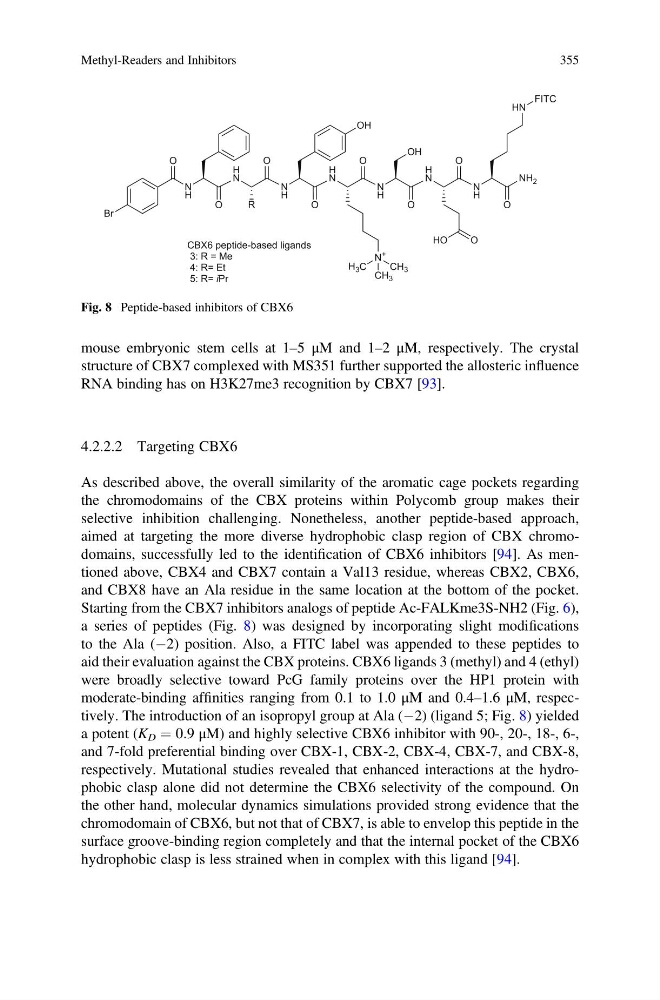
Starting from the CBX7 inhibitors analogs of peptide Ac-FALKme3S-NH2 (Fig. 6),
a series of peptides (Fig. 8) was designed by incorporating slight modifications
to the Ala (À2) position. Also, a FITC label was appended to these peptides to
aid their evaluation against the CBX proteins. CBX6 ligands 3 (methyl) and 4 (ethyl)
were broadly selective toward PcG family proteins over the HP1 protein with
moderate-binding affinities ranging from 0.1 to 1.0 μM and 0.4–1.6 μM, respectively. The introduction of an isopropyl group at Ala (À2) (ligand 5; Fig. 8) yielded
a potent (K D ¼ 0.9 μM) and highly selective CBX6 inhibitor with 90-, 20-, 18-, 6-,
and 7-fold preferential binding over CBX-1, CBX-2, CBX-4, CBX-7, and CBX-8,
respectively. Mutational studies revealed that enhanced interactions at the hydrophobic clasp alone did not determine the CBX6 selectivity of the compound. On
the other hand, molecular dynamics simulations provided strong evidence that the
chromodomain of CBX6, but not that of CBX7, is able to envelop this peptide in the
surface groove-binding region completely and that the internal pocket of the CBX6
hydrophobic clasp is less strained when in complex with this ligand [94].
HN
O
N
H
O
HO
O
H
N
OH
O
N
H
N
+
O
H
N
OH
O
N
H
O
H
N
R
O
N
H
NH 2
O
Br
CH 3
H 3 C
CH 3
FITC
CBX6 peptide-based ligands
3: R = Me
4: R= Et
5: R= i Pr
Fig. 8 Peptide-based inhibitors of CBX6
Methyl-Readers and Inhibitors
355
structure of CBX7 complexed with MS351 further supported the allosteric influence
RNA binding has on H3K27me3 recognition by CBX7 [93].
4.2.2.2 Targeting CBX6
As described above, the overall similarity of the aromatic cage pockets regarding
the chromodomains of the CBX proteins within Polycomb group makes their
selective inhibition challenging. Nonetheless, another peptide-based approach,
aimed at targeting the more diverse hydrophobic clasp region of CBX chromodomains, successfully led to the identification of CBX6 inhibitors [94]. As mentioned above, CBX4 and CBX7 contain a Val13 residue, whereas CBX2, CBX6,
and CBX8 have an Ala residue in the same location at the bottom of the pocket.
Starting from the CBX7 inhibitors analogs of peptide Ac-FALKme3S-NH2 (Fig. 6),
a series of peptides (Fig. 8) was designed by incorporating slight modifications
to the Ala (À2) position. Also, a FITC label was appended to these peptides to
aid their evaluation against the CBX proteins. CBX6 ligands 3 (methyl) and 4 (ethyl)
were broadly selective toward PcG family proteins over the HP1 protein with
moderate-binding affinities ranging from 0.1 to 1.0 μM and 0.4–1.6 μM, respectively. The introduction of an isopropyl group at Ala (À2) (ligand 5; Fig. 8) yielded
a potent (K D ¼ 0.9 μM) and highly selective CBX6 inhibitor with 90-, 20-, 18-, 6-,
and 7-fold preferential binding over CBX-1, CBX-2, CBX-4, CBX-7, and CBX-8,
respectively. Mutational studies revealed that enhanced interactions at the hydrophobic clasp alone did not determine the CBX6 selectivity of the compound. On
the other hand, molecular dynamics simulations provided strong evidence that the
chromodomain of CBX6, but not that of CBX7, is able to envelop this peptide in the
surface groove-binding region completely and that the internal pocket of the CBX6
hydrophobic clasp is less strained when in complex with this ligand [94].
HN
O
N
H
O
HO
O
H
N
OH
O
N
H
N
+
O
H
N
OH
O
N
H
O
H
N
R
O
N
H
NH 2
O
Br
CH 3
H 3 C
CH 3
FITC
CBX6 peptide-based ligands
3: R = Me
4: R= Et
5: R= i Pr
Fig. 8 Peptide-based inhibitors of CBX6
Methyl-Readers and Inhibitors
355