

H3K27me3 and CBX7 outside of the methyllysine-binding domain. Selectivity
evaluation of MS37452 toward other chromodomain-containing proteins revealed
a threefold weaker affinity for CBX4 and even a tenfold lower-binding potency
for the other members of the PcG family than for CBX7. Moreover, MS37452
shows almost no binding to the chromodomains of HP1 proteins [89]. Compound
MS37452 was further characterized on a cellular level where it induced transcriptional depression of p16/CDKN2A by disrupting CBX7-CHD binding to
H3K27me3 at the INK4A/ARF locus in PC3 prostate cancer cells, which was
determined by chromatin immunoprecipitation (ChIP) [89].
Later, an in silico screening performed by the same group led to the identification
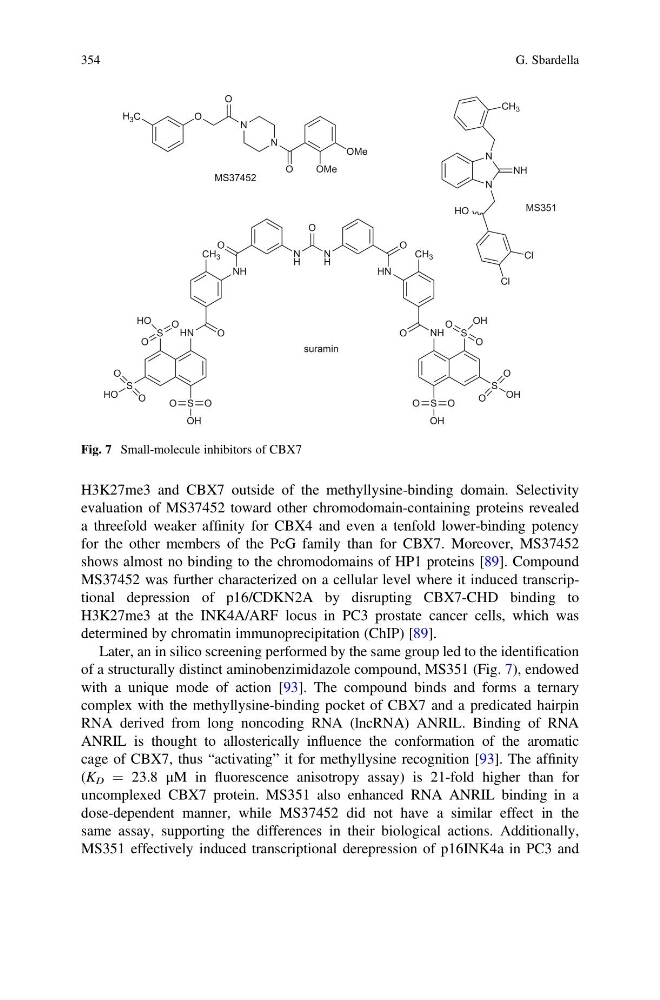
of a structurally distinct aminobenzimidazole compound, MS351 (Fig. 7), endowed
with a unique mode of action [93]. The compound binds and forms a ternary
complex with the methyllysine-binding pocket of CBX7 and a predicated hairpin
RNA derived from long noncoding RNA (lncRNA) ANRIL. Binding of RNA
ANRIL is thought to allosterically influence the conformation of the aromatic
cage of CBX7, thus “activating” it for methyllysine recognition [93]. The affinity
(K D ¼ 23.8 μM in fluorescence anisotropy assay) is 21-fold higher than for
uncomplexed CBX7 protein. MS351 also enhanced RNA ANRIL binding in a
dose-dependent manner, while MS37452 did not have a similar effect in the
same assay, supporting the differences in their biological actions. Additionally,
MS351 effectively induced transcriptional derepression of p16INK4a in PC3 and
H 3 C
O
N
O
N
O
OMe
OMe
MS37452
N
N
Cl
Cl
CH 3
NH
HO
MS351
suramin
S
O
O
OH
S O
O
OH
S
O
O
OH
NH
O
CH 3
HN
O
N
H
N
H
O
NH
CH 3
O
HN
HO
O
O
S
OH
O
O S
HO
O
O
S
O
Fig. 7 Small-molecule inhibitors of CBX7
354
G. Sbardella
evaluation of MS37452 toward other chromodomain-containing proteins revealed
a threefold weaker affinity for CBX4 and even a tenfold lower-binding potency
for the other members of the PcG family than for CBX7. Moreover, MS37452
shows almost no binding to the chromodomains of HP1 proteins [89]. Compound
MS37452 was further characterized on a cellular level where it induced transcriptional depression of p16/CDKN2A by disrupting CBX7-CHD binding to
H3K27me3 at the INK4A/ARF locus in PC3 prostate cancer cells, which was
determined by chromatin immunoprecipitation (ChIP) [89].
Later, an in silico screening performed by the same group led to the identification
of a structurally distinct aminobenzimidazole compound, MS351 (Fig. 7), endowed
with a unique mode of action [93]. The compound binds and forms a ternary
complex with the methyllysine-binding pocket of CBX7 and a predicated hairpin
RNA derived from long noncoding RNA (lncRNA) ANRIL. Binding of RNA
ANRIL is thought to allosterically influence the conformation of the aromatic
cage of CBX7, thus “activating” it for methyllysine recognition [93]. The affinity
(K D ¼ 23.8 μM in fluorescence anisotropy assay) is 21-fold higher than for
uncomplexed CBX7 protein. MS351 also enhanced RNA ANRIL binding in a
dose-dependent manner, while MS37452 did not have a similar effect in the
same assay, supporting the differences in their biological actions. Additionally,
MS351 effectively induced transcriptional derepression of p16INK4a in PC3 and
H 3 C
O
N
O
N
O
OMe
OMe
MS37452
N
N
Cl
Cl
CH 3
NH
HO
MS351
suramin
S
O
O
OH
S O
O
OH
S
O
O
OH
NH
O
CH 3
HN
O
N
H
N
H
O
NH
CH 3
O
HN
HO
O
O
S
OH
O
O S
HO
O
O
S
O
Fig. 7 Small-molecule inhibitors of CBX7
354
G. Sbardella