

3.2.3 Targeting BAZ-PHD Fingers
More recently, another fragment-based approach demonstrated the ligandability
of the PHD fingers of two proteins of the BAZ (bromodomain adjacent to zinc
finger) family, namely, BAZ2A and BAZ2B [52]. First, the ligandability of the
histone pocket of BAZ2A was assessed using an in silico analysis that highlighted
two potential druggable pockets. Then, targeted virtual screening of a diverse virtual
library of a thousand low-molecular-weight compounds identified a set of fragments
that were validated experimentally for protein binding using a biophysical screening
cascade, using 2-D NMR spectroscopy, thermal shift assay (TSA), AlphaLISA
competition assay, and X-ray crystallography. From the set of validated fragments,
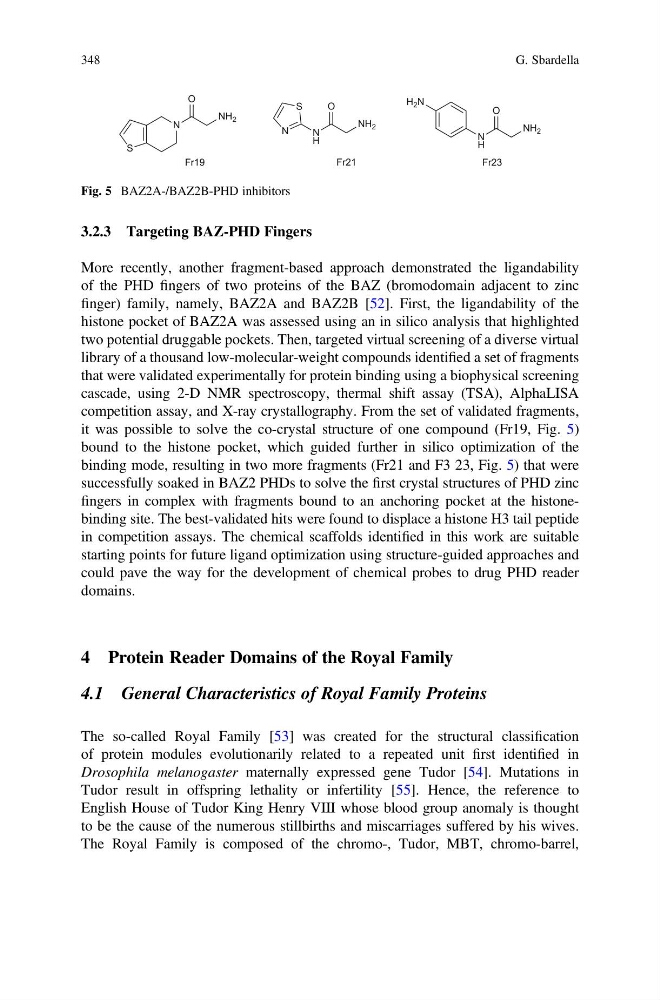
it was possible to solve the co-crystal structure of one compound (Fr19, Fig. 5)
bound to the histone pocket, which guided further in silico optimization of the
binding mode, resulting in two more fragments (Fr21 and F3 23, Fig. 5) that were
successfully soaked in BAZ2 PHDs to solve the first crystal structures of PHD zinc
fingers in complex with fragments bound to an anchoring pocket at the histonebinding site. The best-validated hits were found to displace a histone H3 tail peptide
in competition assays. The chemical scaffolds identified in this work are suitable
starting points for future ligand optimization using structure-guided approaches and
could pave the way for the development of chemical probes to drug PHD reader
domains.
4 Protein Reader Domains of the Royal Family
4.1 General Characteristics of Royal Family Proteins
The so-called Royal Family [53] was created for the structural classification
of protein modules evolutionarily related to a repeated unit first identified in
Drosophila melanogaster maternally expressed gene Tudor [54]. Mutations in
Tudor result in offspring lethality or infertility [55]. Hence, the reference to
English House of Tudor King Henry VIII whose blood group anomaly is thought
to be the cause of the numerous stillbirths and miscarriages suffered by his wives.
The Royal Family is composed of the chromo-, Tudor, MBT, chromo-barrel,
H 2 N
N
H
O
NH 2
N
H
O
NH 2
S
N
N
O
NH 2
S
Fr19
Fr21
Fr23
Fig. 5 BAZ2A-/BAZ2B-PHD inhibitors
348
G. Sbardella
More recently, another fragment-based approach demonstrated the ligandability
of the PHD fingers of two proteins of the BAZ (bromodomain adjacent to zinc
finger) family, namely, BAZ2A and BAZ2B [52]. First, the ligandability of the
histone pocket of BAZ2A was assessed using an in silico analysis that highlighted
two potential druggable pockets. Then, targeted virtual screening of a diverse virtual
library of a thousand low-molecular-weight compounds identified a set of fragments
that were validated experimentally for protein binding using a biophysical screening
cascade, using 2-D NMR spectroscopy, thermal shift assay (TSA), AlphaLISA
competition assay, and X-ray crystallography. From the set of validated fragments,
it was possible to solve the co-crystal structure of one compound (Fr19, Fig. 5)
bound to the histone pocket, which guided further in silico optimization of the
binding mode, resulting in two more fragments (Fr21 and F3 23, Fig. 5) that were
successfully soaked in BAZ2 PHDs to solve the first crystal structures of PHD zinc
fingers in complex with fragments bound to an anchoring pocket at the histonebinding site. The best-validated hits were found to displace a histone H3 tail peptide
in competition assays. The chemical scaffolds identified in this work are suitable
starting points for future ligand optimization using structure-guided approaches and
could pave the way for the development of chemical probes to drug PHD reader
domains.
4 Protein Reader Domains of the Royal Family
4.1 General Characteristics of Royal Family Proteins
The so-called Royal Family [53] was created for the structural classification
of protein modules evolutionarily related to a repeated unit first identified in
Drosophila melanogaster maternally expressed gene Tudor [54]. Mutations in
Tudor result in offspring lethality or infertility [55]. Hence, the reference to
English House of Tudor King Henry VIII whose blood group anomaly is thought
to be the cause of the numerous stillbirths and miscarriages suffered by his wives.
The Royal Family is composed of the chromo-, Tudor, MBT, chromo-barrel,
H 2 N
N
H
O
NH 2
N
H
O
NH 2
S
N
N
O
NH 2
S
Fr19
Fr21
Fr23
Fig. 5 BAZ2A-/BAZ2B-PHD inhibitors
348
G. Sbardella