

harbors a separate interaction surface for the BCL9 adaptor proteins, which bind to
β-catenin through a short α-helical domain (HD2), simultaneously with TCF. In turn,
BCL9 adaptors use a separate domain (HD1) to bind to the rear of the Pygo PHD
finger. This interaction induces a slight allosteric modulation of the PHD finger,
which facilitates the binding of the protein complex to the histone H3 tail methylated
at lysine 4 (H3K4me) through its frontal surface [50]. Thus, oncogenic β-catenin
could be inhibited by targeting these three unique and relatively small proteinprotein interfaces of the Pygo-BCL9 complex.
The druggability of Pygo PHD fingers to inhibit the Pygo-HD1 complex and
deactivate oncogenic β-catenin transcription was explored through a series of consecutive structure-based virtual screens of a library of 225 K commercially available
compounds, each screen being increasingly refined and constrained based on the
preceding one [51]. Indeed, the potential hits were then further evaluated for direct
binding to PHD-HD1 through 2-D NMR spectroscopy. Only a small number of hits
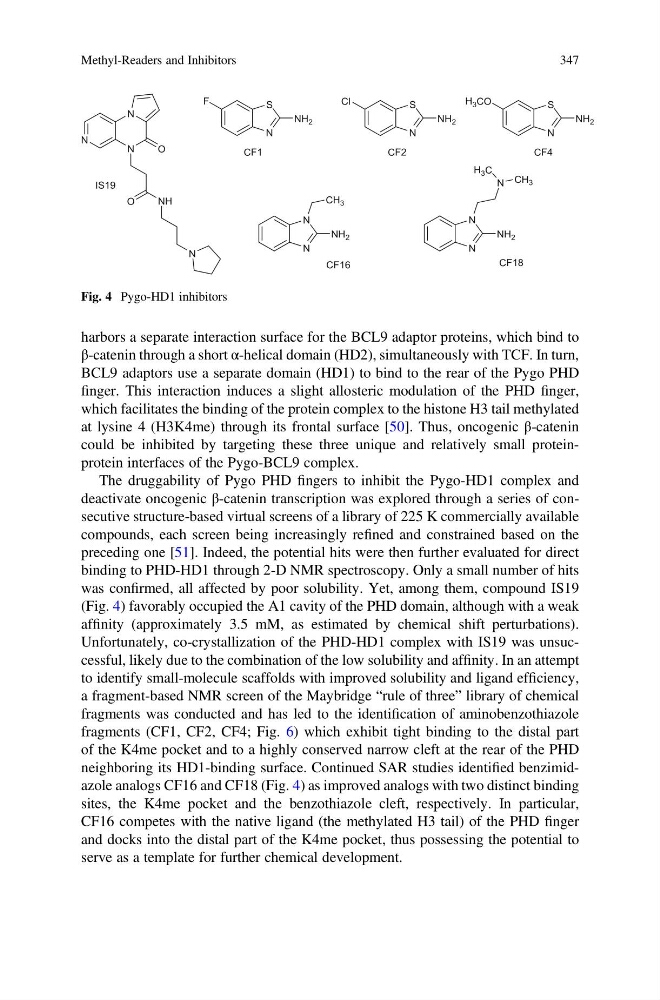
was confirmed, all affected by poor solubility. Yet, among them, compound IS19
(Fig. 4) favorably occupied the A1 cavity of the PHD domain, although with a weak
affinity (approximately 3.5 mM, as estimated by chemical shift perturbations).
Unfortunately, co-crystallization of the PHD-HD1 complex with IS19 was unsuccessful, likely due to the combination of the low solubility and affinity. In an attempt
to identify small-molecule scaffolds with improved solubility and ligand efficiency,
a fragment-based NMR screen of the Maybridge “rule of three” library of chemical
fragments was conducted and has led to the identification of aminobenzothiazole
fragments (CF1, CF2, CF4; Fig. 6) which exhibit tight binding to the distal part
of the K4me pocket and to a highly conserved narrow cleft at the rear of the PHD
neighboring its HD1-binding surface. Continued SAR studies identified benzimidazole analogs CF16 and CF18 (Fig. 4) as improved analogs with two distinct binding
sites, the K4me pocket and the benzothiazole cleft, respectively. In particular,
CF16 competes with the native ligand (the methylated H3 tail) of the PHD finger
and docks into the distal part of the K4me pocket, thus possessing the potential to
serve as a template for further chemical development.
N
N
N
O
NH
O
N
N
S
NH 2
F
N
S
NH 2
Cl
N
S
NH 2
H 3 CO
N
N
NH 2
N
N
NH 2
N
H 3 C
CH 3
CH 3
IS19
CF1
CF2
CF16
CF4
CF18
Fig. 4 Pygo-HD1 inhibitors
Methyl-Readers and Inhibitors
347
β-catenin through a short α-helical domain (HD2), simultaneously with TCF. In turn,
BCL9 adaptors use a separate domain (HD1) to bind to the rear of the Pygo PHD
finger. This interaction induces a slight allosteric modulation of the PHD finger,
which facilitates the binding of the protein complex to the histone H3 tail methylated
at lysine 4 (H3K4me) through its frontal surface [50]. Thus, oncogenic β-catenin
could be inhibited by targeting these three unique and relatively small proteinprotein interfaces of the Pygo-BCL9 complex.
The druggability of Pygo PHD fingers to inhibit the Pygo-HD1 complex and
deactivate oncogenic β-catenin transcription was explored through a series of consecutive structure-based virtual screens of a library of 225 K commercially available
compounds, each screen being increasingly refined and constrained based on the
preceding one [51]. Indeed, the potential hits were then further evaluated for direct
binding to PHD-HD1 through 2-D NMR spectroscopy. Only a small number of hits
was confirmed, all affected by poor solubility. Yet, among them, compound IS19
(Fig. 4) favorably occupied the A1 cavity of the PHD domain, although with a weak
affinity (approximately 3.5 mM, as estimated by chemical shift perturbations).
Unfortunately, co-crystallization of the PHD-HD1 complex with IS19 was unsuccessful, likely due to the combination of the low solubility and affinity. In an attempt
to identify small-molecule scaffolds with improved solubility and ligand efficiency,
a fragment-based NMR screen of the Maybridge “rule of three” library of chemical
fragments was conducted and has led to the identification of aminobenzothiazole
fragments (CF1, CF2, CF4; Fig. 6) which exhibit tight binding to the distal part
of the K4me pocket and to a highly conserved narrow cleft at the rear of the PHD
neighboring its HD1-binding surface. Continued SAR studies identified benzimidazole analogs CF16 and CF18 (Fig. 4) as improved analogs with two distinct binding
sites, the K4me pocket and the benzothiazole cleft, respectively. In particular,
CF16 competes with the native ligand (the methylated H3 tail) of the PHD finger
and docks into the distal part of the K4me pocket, thus possessing the potential to
serve as a template for further chemical development.
N
N
N
O
NH
O
N
N
S
NH 2
F
N
S
NH 2
Cl
N
S
NH 2
H 3 CO
N
N
NH 2
N
N
NH 2
N
H 3 C
CH 3
CH 3
IS19
CF1
CF2
CF16
CF4
CF18
Fig. 4 Pygo-HD1 inhibitors
Methyl-Readers and Inhibitors
347