

of genes (e.g. imprinted genes, transposon silencing, X-inactivation, tumour suppressor genes in cancer). DNA methyltransferase activities were isolated and
observed in several eukaryotic cells [17]. The first mammalian DNMT to be identified was Dnmt1 in mouse cells [18]. Interestingly all C5-DNA methyltransferases
share ten motifs that are relatively conserved (the motif IV contains the Pro-Cys
dipeptide, the Cys being involved in the catalytic reaction making a covalent bond
with the dC). Dnmt1 has a preference for hemi-methylated DNA, and it is thus called
maintenance enzyme. Dnmt3A and 3B were discovered later [19] and characterised
to be active also on non-methylated DNA and are thus considered de novo DNMTs.
Dnmt3L was shown to lack the catalytic motif [20], resulting in a catalytically
inactive form. However Dnmt3L plays an important role, especially in development
and in imprinting [21]. It enhances the activity of Dnmt3A and 3B [22] and interacts
with several proteins involved in chromatin regulation. See [23, 24] for recent
reviews on the biology of DNMTs. The highly conserved DNMT2 has been
shown to methylate tRNA and has been renamed tRNA aspartic acid
(D) methyltransferase 1 (TRDM1) [23, 25].
N
N
N
N
NH 2
O
OH
OH
S
+
CH 3
+
H 3 N
COO
-
S-adenosyl-L-methionine
(SAM/AdoMet)
N
N
N
N
NH 2
O
OH
OH
S
+
H 3 N
COO
-
N
N
NH 2
O
N
N
NH 2
O
CH 3
S-adenosyl-L-homocysteine
(SAH/AdoHcy)
cytidine
5-methylcytidine
DNMT
C5 DNA methyltransferase
N
N
NH 2
O
N
N
NH 2
O
5-methylcytidine
5-hydroxymethylcytidine
TET
5mC oxidaze
CH 3
OH
O
O
O
O
O
CO 2
O
O
O
O
O 2
Fe II
B
A
2-Oxoglutarate (2OG)
Succinate
1
2
3
4
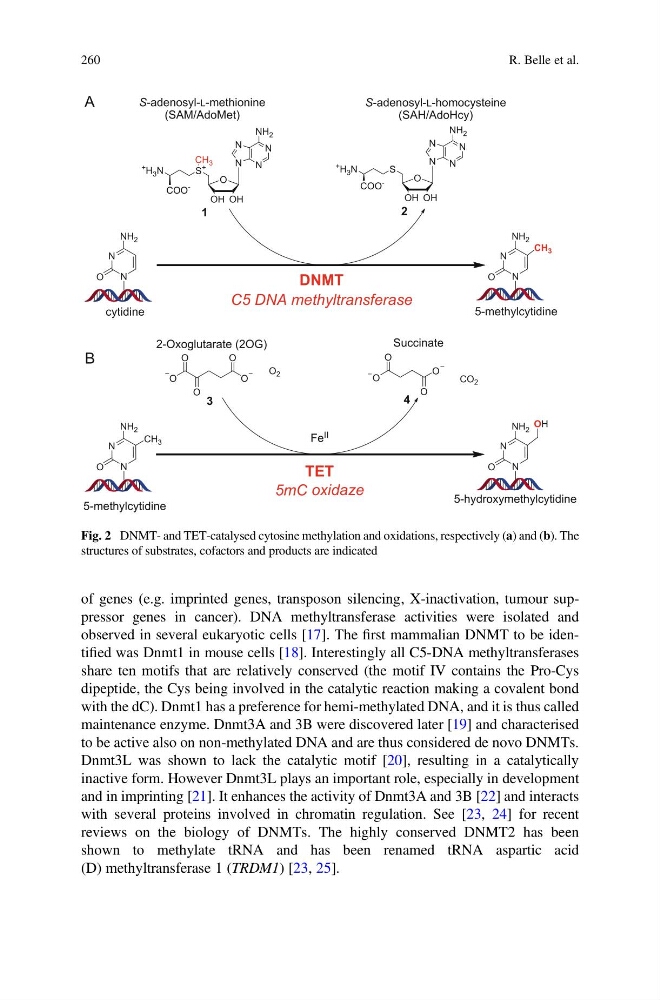
Fig. 2 DNMT- and TET-catalysed cytosine methylation and oxidations, respectively (a) and (b). The
structures of substrates, cofactors and products are indicated
260
R. Belle et al.
observed in several eukaryotic cells [17]. The first mammalian DNMT to be identified was Dnmt1 in mouse cells [18]. Interestingly all C5-DNA methyltransferases
share ten motifs that are relatively conserved (the motif IV contains the Pro-Cys
dipeptide, the Cys being involved in the catalytic reaction making a covalent bond
with the dC). Dnmt1 has a preference for hemi-methylated DNA, and it is thus called
maintenance enzyme. Dnmt3A and 3B were discovered later [19] and characterised
to be active also on non-methylated DNA and are thus considered de novo DNMTs.
Dnmt3L was shown to lack the catalytic motif [20], resulting in a catalytically
inactive form. However Dnmt3L plays an important role, especially in development
and in imprinting [21]. It enhances the activity of Dnmt3A and 3B [22] and interacts
with several proteins involved in chromatin regulation. See [23, 24] for recent
reviews on the biology of DNMTs. The highly conserved DNMT2 has been
shown to methylate tRNA and has been renamed tRNA aspartic acid
(D) methyltransferase 1 (TRDM1) [23, 25].
N
N
N
N
NH 2
O
OH
OH
S
+
CH 3
+
H 3 N
COO
-
S-adenosyl-L-methionine
(SAM/AdoMet)
N
N
N
N
NH 2
O
OH
OH
S
+
H 3 N
COO
-
N
N
NH 2
O
N
N
NH 2
O
CH 3
S-adenosyl-L-homocysteine
(SAH/AdoHcy)
cytidine
5-methylcytidine
DNMT
C5 DNA methyltransferase
N
N
NH 2
O
N
N
NH 2
O
5-methylcytidine
5-hydroxymethylcytidine
TET
5mC oxidaze
CH 3
OH
O
O
O
O
O
CO 2
O
O
O
O
O 2
Fe II
B
A
2-Oxoglutarate (2OG)
Succinate
1
2
3
4
Fig. 2 DNMT- and TET-catalysed cytosine methylation and oxidations, respectively (a) and (b). The
structures of substrates, cofactors and products are indicated
260
R. Belle et al.