

S478 and Y409. N1 was solvent exposed, and therefore alkylation was not tolerated
due to unfavourable hydrophobic interactions. The selectivity over KDM2B was
attributed to the loss of aromatic stacking interactions through replacement of Y472
with a leucine. KDM4 does not differ in the direct binding residues, so selectivity
over this family was likely due to changes to the second shell of amino acids.
A novel series of KDM5 inhibitors was discovered by Genentech and Constellation [71]. Optimisation of a high-throughput screen hit led to a single enantiomer
14 with a core pyrazole which showed a potent IC 50 of 45 nM against KDM5A and
good selectivity over KDM1, KDM2, KDM3, KDM6 and KDM7 and 91-fold
selectivity over most closely related KDM4C. The compound had reasonable cellular potency of 960 nM and demonstrated good in vivo PK properties.
Co-crystallisation of 14 with KDM5A (PDB:5V9T) revealed a bidentate coordination of pyrazole N1 and carbonyl oxygen with the active site metal (Fig. 11d). A
strong hydrogen bonding interaction was observed between pyrazole N2 and E485,
while the cyclopropyl carbonyl oxygen engaged in an interaction with K501. As
observed with other KDM5 inhibitors, the compound did not require a weakly acidic
proton to engage in an ionic interaction with K501, which resulted in improved
cell permeability. Most of the compound was positioned in the 2OG binding site,
while the isopropyl group resided in the histone peptide binding site. Competition
with histone peptide was also confirmed using
19 F NMR which represent a novel
mechanism for KDM5A inhibition.
3.1.3 KDM6 Inhibitors
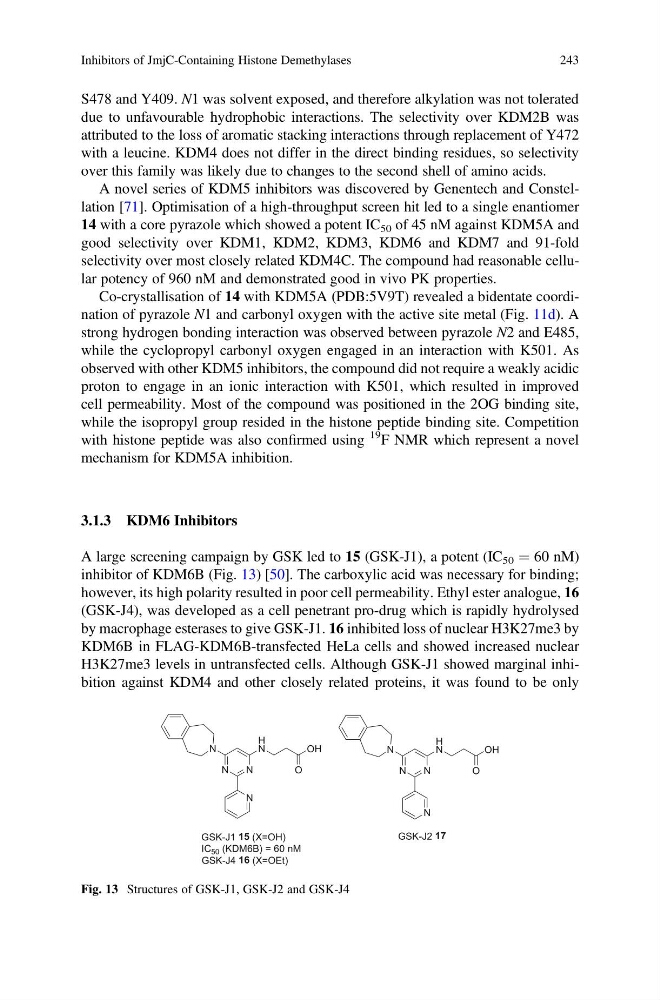
A large screening campaign by GSK led to 15 (GSK-J1), a potent (IC 50 ¼ 60 nM)
inhibitor of KDM6B (Fig. 13) [50]. The carboxylic acid was necessary for binding;
however, its high polarity resulted in poor cell permeability. Ethyl ester analogue, 16
(GSK-J4), was developed as a cell penetrant pro-drug which is rapidly hydrolysed
by macrophage esterases to give GSK-J1. 16 inhibited loss of nuclear H3K27me3 by
KDM6B in FLAG-KDM6B-transfected HeLa cells and showed increased nuclear
H3K27me3 levels in untransfected cells. Although GSK-J1 showed marginal inhibition against KDM4 and other closely related proteins, it was found to be only
N
N
H
N
N
OH
O
N
N
N
H
N
N
OH
O
N
GSK-J1 15 (X=OH)
IC 50 (KDM6B) = 60 nM
GSK-J4 16 (X=OEt)
GSK-J2 17
Fig. 13 Structures of GSK-J1, GSK-J2 and GSK-J4
Inhibitors of JmjC-Containing Histone Demethylases
243
due to unfavourable hydrophobic interactions. The selectivity over KDM2B was
attributed to the loss of aromatic stacking interactions through replacement of Y472
with a leucine. KDM4 does not differ in the direct binding residues, so selectivity
over this family was likely due to changes to the second shell of amino acids.
A novel series of KDM5 inhibitors was discovered by Genentech and Constellation [71]. Optimisation of a high-throughput screen hit led to a single enantiomer
14 with a core pyrazole which showed a potent IC 50 of 45 nM against KDM5A and
good selectivity over KDM1, KDM2, KDM3, KDM6 and KDM7 and 91-fold
selectivity over most closely related KDM4C. The compound had reasonable cellular potency of 960 nM and demonstrated good in vivo PK properties.
Co-crystallisation of 14 with KDM5A (PDB:5V9T) revealed a bidentate coordination of pyrazole N1 and carbonyl oxygen with the active site metal (Fig. 11d). A
strong hydrogen bonding interaction was observed between pyrazole N2 and E485,
while the cyclopropyl carbonyl oxygen engaged in an interaction with K501. As
observed with other KDM5 inhibitors, the compound did not require a weakly acidic
proton to engage in an ionic interaction with K501, which resulted in improved
cell permeability. Most of the compound was positioned in the 2OG binding site,
while the isopropyl group resided in the histone peptide binding site. Competition
with histone peptide was also confirmed using
19 F NMR which represent a novel
mechanism for KDM5A inhibition.
3.1.3 KDM6 Inhibitors
A large screening campaign by GSK led to 15 (GSK-J1), a potent (IC 50 ¼ 60 nM)
inhibitor of KDM6B (Fig. 13) [50]. The carboxylic acid was necessary for binding;
however, its high polarity resulted in poor cell permeability. Ethyl ester analogue, 16
(GSK-J4), was developed as a cell penetrant pro-drug which is rapidly hydrolysed
by macrophage esterases to give GSK-J1. 16 inhibited loss of nuclear H3K27me3 by
KDM6B in FLAG-KDM6B-transfected HeLa cells and showed increased nuclear
H3K27me3 levels in untransfected cells. Although GSK-J1 showed marginal inhibition against KDM4 and other closely related proteins, it was found to be only
N
N
H
N
N
OH
O
N
N
N
H
N
N
OH
O
N
GSK-J1 15 (X=OH)
IC 50 (KDM6B) = 60 nM
GSK-J4 16 (X=OEt)
GSK-J2 17
Fig. 13 Structures of GSK-J1, GSK-J2 and GSK-J4
Inhibitors of JmjC-Containing Histone Demethylases
243