

Curcumin-like structures (45, Fig. 10) have also been found to act as moderate
and somewhat selective CARM1 inhibitors with IC 50 values in the low micromolar
range and no inhibition of PRMT1 or the lysine methyltransferase SET7
[139]. PRMT3 and PRMT6 were inhibited to some extent when 45 was tested at
100 μM. In human LNCaP cells, the prostate-specific antigen promoter was
decreased in a dose-dependent manner by compound 45. Pomegranate-derived
compound ellagic acid (46, Fig. 10) was found to be a site-specific inhibitor of
CARM1, inhibiting methylation of H3R17 but not of H3R26 [140]. Modelling
suggests ellagic acid binds the KAPRK motif present around H3R17. Treatment of
DNA-damaged HEK293T cells with ellagic acid showed a significant decrease in
H3R17 methylation and p21 expression.
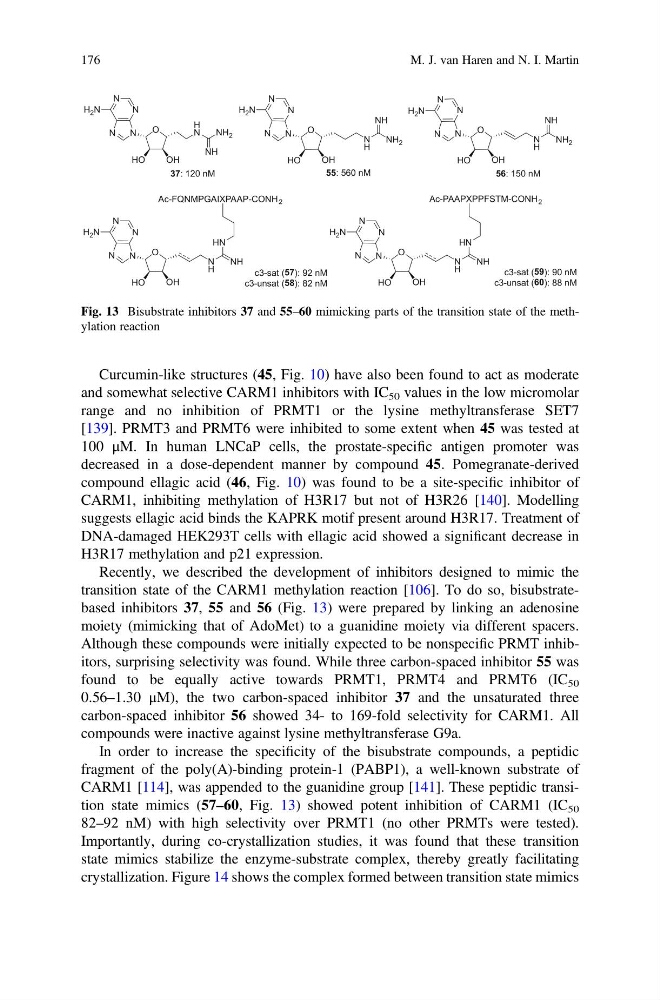
Recently, we described the development of inhibitors designed to mimic the
transition state of the CARM1 methylation reaction [106]. To do so, bisubstratebased inhibitors 37, 55 and 56 (Fig. 13) were prepared by linking an adenosine
moiety (mimicking that of AdoMet) to a guanidine moiety via different spacers.
Although these compounds were initially expected to be nonspecific PRMT inhibitors, surprising selectivity was found. While three carbon-spaced inhibitor 55 was
found to be equally active towards PRMT1, PRMT4 and PRMT6 (IC 50
0.56–1.30 μM), the two carbon-spaced inhibitor 37 and the unsaturated three
carbon-spaced inhibitor 56 showed 34- to 169-fold selectivity for CARM1. All
compounds were inactive against lysine methyltransferase G9a.
In order to increase the specificity of the bisubstrate compounds, a peptidic
fragment of the poly(A)-binding protein-1 (PABP1), a well-known substrate of
CARM1 [114], was appended to the guanidine group [141]. These peptidic transition state mimics (57–60, Fig. 13) showed potent inhibition of CARM1 (IC 50
82–92 nM) with high selectivity over PRMT1 (no other PRMTs were tested).
Importantly, during co-crystallization studies, it was found that these transition
state mimics stabilize the enzyme-substrate complex, thereby greatly facilitating
crystallization. Figure 14 shows the complex formed between transition state mimics
O
HO
OH
N
N
N
N
H 2 N
H
N
NH 2
NH
O
HO
OH
N
N
N
N
H 2 N
N
H
NH 2
NH
37: 120 nM
55: 560 nM
56: 150 nM
O
HO
OH
N
N
N
N
H 2 N
N
H
NH 2
NH
Ac-FQNMPGAIXPAAP-CONH 2
Ac-PAAPXPPFSTM-CONH 2
O
HO
OH
N
N
N
N
H 2 N
N
H
HN
NH
O
HO
OH
N
N
N
N
H 2 N
N
H
HN
NH
c3-sat (59): 90 nM
c3-unsat (60): 88 nM
c3-sat (57): 92 nM
c3-unsat (58): 82 nM
Fig. 13 Bisubstrate inhibitors 37 and 55–60 mimicking parts of the transition state of the methylation reaction
176
M. J. van Haren and N. I. Martin
and somewhat selective CARM1 inhibitors with IC 50 values in the low micromolar
range and no inhibition of PRMT1 or the lysine methyltransferase SET7
[139]. PRMT3 and PRMT6 were inhibited to some extent when 45 was tested at
100 μM. In human LNCaP cells, the prostate-specific antigen promoter was
decreased in a dose-dependent manner by compound 45. Pomegranate-derived
compound ellagic acid (46, Fig. 10) was found to be a site-specific inhibitor of
CARM1, inhibiting methylation of H3R17 but not of H3R26 [140]. Modelling
suggests ellagic acid binds the KAPRK motif present around H3R17. Treatment of
DNA-damaged HEK293T cells with ellagic acid showed a significant decrease in
H3R17 methylation and p21 expression.
Recently, we described the development of inhibitors designed to mimic the
transition state of the CARM1 methylation reaction [106]. To do so, bisubstratebased inhibitors 37, 55 and 56 (Fig. 13) were prepared by linking an adenosine
moiety (mimicking that of AdoMet) to a guanidine moiety via different spacers.
Although these compounds were initially expected to be nonspecific PRMT inhibitors, surprising selectivity was found. While three carbon-spaced inhibitor 55 was
found to be equally active towards PRMT1, PRMT4 and PRMT6 (IC 50
0.56–1.30 μM), the two carbon-spaced inhibitor 37 and the unsaturated three
carbon-spaced inhibitor 56 showed 34- to 169-fold selectivity for CARM1. All
compounds were inactive against lysine methyltransferase G9a.
In order to increase the specificity of the bisubstrate compounds, a peptidic
fragment of the poly(A)-binding protein-1 (PABP1), a well-known substrate of
CARM1 [114], was appended to the guanidine group [141]. These peptidic transition state mimics (57–60, Fig. 13) showed potent inhibition of CARM1 (IC 50
82–92 nM) with high selectivity over PRMT1 (no other PRMTs were tested).
Importantly, during co-crystallization studies, it was found that these transition
state mimics stabilize the enzyme-substrate complex, thereby greatly facilitating
crystallization. Figure 14 shows the complex formed between transition state mimics
O
HO
OH
N
N
N
N
H 2 N
H
N
NH 2
NH
O
HO
OH
N
N
N
N
H 2 N
N
H
NH 2
NH
37: 120 nM
55: 560 nM
56: 150 nM
O
HO
OH
N
N
N
N
H 2 N
N
H
NH 2
NH
Ac-FQNMPGAIXPAAP-CONH 2
Ac-PAAPXPPFSTM-CONH 2
O
HO
OH
N
N
N
N
H 2 N
N
H
HN
NH
O
HO
OH
N
N
N
N
H 2 N
N
H
HN
NH
c3-sat (59): 90 nM
c3-unsat (60): 88 nM
c3-sat (57): 92 nM
c3-unsat (58): 82 nM
Fig. 13 Bisubstrate inhibitors 37 and 55–60 mimicking parts of the transition state of the methylation reaction
176
M. J. van Haren and N. I. Martin