

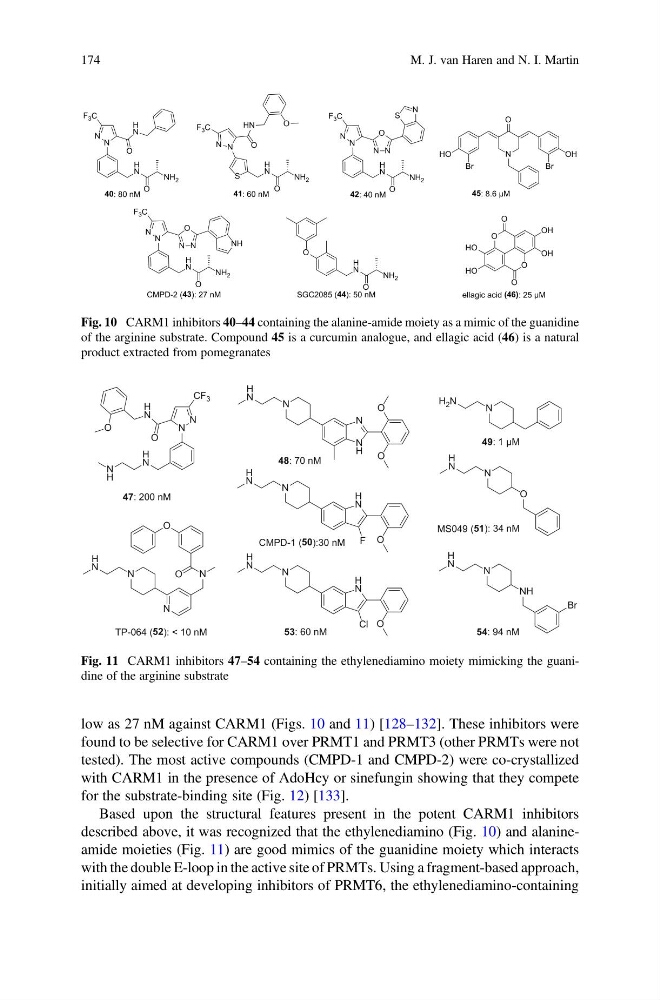
low as 27 nM against CARM1 (Figs. 10 and 11) [128–132]. These inhibitors were
found to be selective for CARM1 over PRMT1 and PRMT3 (other PRMTs were not
tested). The most active compounds (CMPD-1 and CMPD-2) were co-crystallized
with CARM1 in the presence of AdoHcy or sinefungin showing that they compete
for the substrate-binding site (Fig. 12) [133].
Based upon the structural features present in the potent CARM1 inhibitors
described above, it was recognized that the ethylenediamino (Fig. 10) and alanineamide moieties (Fig. 11) are good mimics of the guanidine moiety which interacts
with the double E-loop in the active site of PRMTs. Using a fragment-based approach,
initially aimed at developing inhibitors of PRMT6, the ethylenediamino-containing
N
H
N
O
NH 2
N
F 3 C
O
H
N
40: 80 nM
N
N
F 3 C
O
HN
S
O
H
N
O
NH 2
41: 60 nM
N
H
N
O
NH 2
N
F 3 C
N N
O
N
S
42: 40 nM
N
H
N
O
NH 2
N
F 3 C
N N
O
NH
CMPD-2 (43): 27 nM
O
H
N
NH 2
O
SGC2085 (44): 50 nM
N
O
Br
OH
Br
HO
45: 8.6 μM
O
O
OH
OH
O
O
HO
HO
ellagic acid (46): 25 μM
Fig. 10 CARM1 inhibitors 40–44 containing the alanine-amide moiety as a mimic of the guanidine
of the arginine substrate. Compound 45 is a curcumin analogue, and ellagic acid (46) is a natural
product extracted from pomegranates
N
H
N
N
H
N
O
O
48: 70 nM
N
N
CF 3
O
H
N
O
H
N
N
H
47: 200 nM
N
H
N
H
N
O
F
CMPD-1 (50):30 nM
N
H
N
H
N
O
Cl
53: 60 nM
49: 1 μM
MS049 (51): 34 nM
N
H
N
NH
54: 94 nM
Br
N
N
H
N
N
O
O
TP-064 (52): < 10 nM
N
H
N
O
N
H 2 N
Fig. 11 CARM1 inhibitors 47–54 containing the ethylenediamino moiety mimicking the guanidine of the arginine substrate
174
M. J. van Haren and N. I. Martin
found to be selective for CARM1 over PRMT1 and PRMT3 (other PRMTs were not
tested). The most active compounds (CMPD-1 and CMPD-2) were co-crystallized
with CARM1 in the presence of AdoHcy or sinefungin showing that they compete
for the substrate-binding site (Fig. 12) [133].
Based upon the structural features present in the potent CARM1 inhibitors
described above, it was recognized that the ethylenediamino (Fig. 10) and alanineamide moieties (Fig. 11) are good mimics of the guanidine moiety which interacts
with the double E-loop in the active site of PRMTs. Using a fragment-based approach,
initially aimed at developing inhibitors of PRMT6, the ethylenediamino-containing
N
H
N
O
NH 2
N
F 3 C
O
H
N
40: 80 nM
N
N
F 3 C
O
HN
S
O
H
N
O
NH 2
41: 60 nM
N
H
N
O
NH 2
N
F 3 C
N N
O
N
S
42: 40 nM
N
H
N
O
NH 2
N
F 3 C
N N
O
NH
CMPD-2 (43): 27 nM
O
H
N
NH 2
O
SGC2085 (44): 50 nM
N
O
Br
OH
Br
HO
45: 8.6 μM
O
O
OH
OH
O
O
HO
HO
ellagic acid (46): 25 μM
Fig. 10 CARM1 inhibitors 40–44 containing the alanine-amide moiety as a mimic of the guanidine
of the arginine substrate. Compound 45 is a curcumin analogue, and ellagic acid (46) is a natural
product extracted from pomegranates
N
H
N
N
H
N
O
O
48: 70 nM
N
N
CF 3
O
H
N
O
H
N
N
H
47: 200 nM
N
H
N
H
N
O
F
CMPD-1 (50):30 nM
N
H
N
H
N
O
Cl
53: 60 nM
49: 1 μM
MS049 (51): 34 nM
N
H
N
NH
54: 94 nM
Br
N
N
H
N
N
O
O
TP-064 (52): < 10 nM
N
H
N
O
N
H 2 N
Fig. 11 CARM1 inhibitors 47–54 containing the ethylenediamino moiety mimicking the guanidine of the arginine substrate
174
M. J. van Haren and N. I. Martin