

of PRMT2 from zebrafish and from mice were solved in complex with AdoHcy,
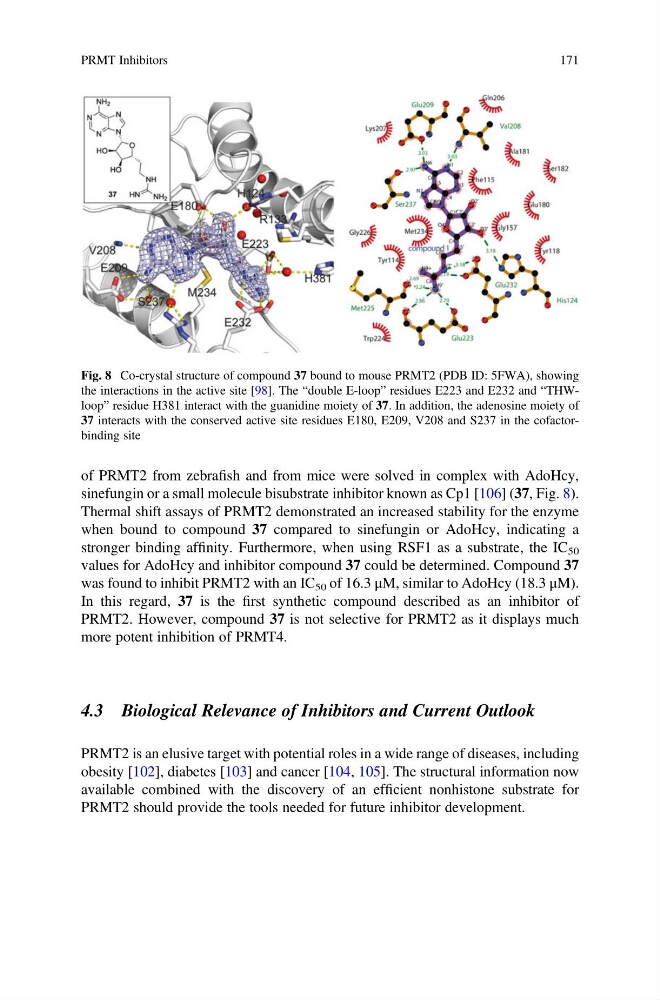
sinefungin or a small molecule bisubstrate inhibitor known as Cp1 [106] (37, Fig. 8).
Thermal shift assays of PRMT2 demonstrated an increased stability for the enzyme
when bound to compound 37 compared to sinefungin or AdoHcy, indicating a
stronger binding affinity. Furthermore, when using RSF1 as a substrate, the IC 50
values for AdoHcy and inhibitor compound 37 could be determined. Compound 37
was found to inhibit PRMT2 with an IC 50 of 16.3 μM, similar to AdoHcy (18.3 μM).
In this regard, 37 is the first synthetic compound described as an inhibitor of
PRMT2. However, compound 37 is not selective for PRMT2 as it displays much
more potent inhibition of PRMT4.
4.3 Biological Relevance of Inhibitors and Current Outlook
PRMT2 is an elusive target with potential roles in a wide range of diseases, including
obesity [102], diabetes [103] and cancer [104, 105]. The structural information now
available combined with the discovery of an efficient nonhistone substrate for
PRMT2 should provide the tools needed for future inhibitor development.
Fig. 8 Co-crystal structure of compound 37 bound to mouse PRMT2 (PDB ID: 5FWA), showing
the interactions in the active site [98]. The “double E-loop” residues E223 and E232 and “THWloop” residue H381 interact with the guanidine moiety of 37. In addition, the adenosine moiety of
37 interacts with the conserved active site residues E180, E209, V208 and S237 in the cofactorbinding site
PRMT Inhibitors
171
sinefungin or a small molecule bisubstrate inhibitor known as Cp1 [106] (37, Fig. 8).
Thermal shift assays of PRMT2 demonstrated an increased stability for the enzyme
when bound to compound 37 compared to sinefungin or AdoHcy, indicating a
stronger binding affinity. Furthermore, when using RSF1 as a substrate, the IC 50
values for AdoHcy and inhibitor compound 37 could be determined. Compound 37
was found to inhibit PRMT2 with an IC 50 of 16.3 μM, similar to AdoHcy (18.3 μM).
In this regard, 37 is the first synthetic compound described as an inhibitor of
PRMT2. However, compound 37 is not selective for PRMT2 as it displays much
more potent inhibition of PRMT4.
4.3 Biological Relevance of Inhibitors and Current Outlook
PRMT2 is an elusive target with potential roles in a wide range of diseases, including
obesity [102], diabetes [103] and cancer [104, 105]. The structural information now
available combined with the discovery of an efficient nonhistone substrate for
PRMT2 should provide the tools needed for future inhibitor development.
Fig. 8 Co-crystal structure of compound 37 bound to mouse PRMT2 (PDB ID: 5FWA), showing
the interactions in the active site [98]. The “double E-loop” residues E223 and E232 and “THWloop” residue H381 interact with the guanidine moiety of 37. In addition, the adenosine moiety of
37 interacts with the conserved active site residues E180, E209, V208 and S237 in the cofactorbinding site
PRMT Inhibitors
171