

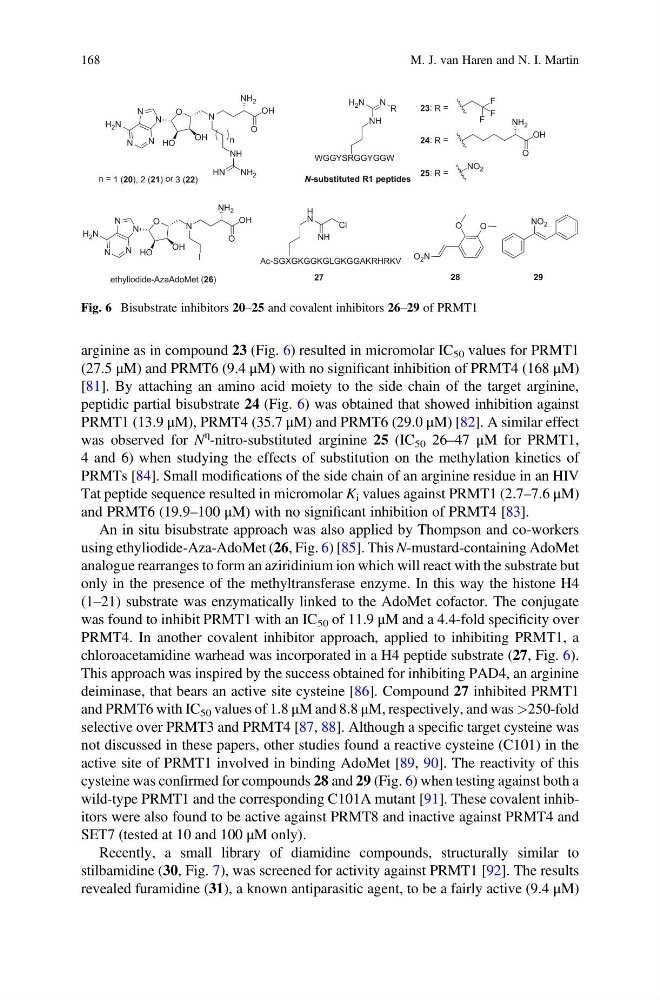
arginine as in compound 23 (Fig. 6) resulted in micromolar IC 50 values for PRMT1
(27.5 μM) and PRMT6 (9.4 μM) with no significant inhibition of PRMT4 (168 μM)
[81]. By attaching an amino acid moiety to the side chain of the target arginine,
peptidic partial bisubstrate 24 (Fig. 6) was obtained that showed inhibition against
PRMT1 (13.9 μM), PRMT4 (35.7 μM) and PRMT6 (29.0 μM) [82]. A similar effect
was observed for N
η
-nitro-substituted arginine 25 (IC 50 26–47 μM for PRMT1,
4 and 6) when studying the effects of substitution on the methylation kinetics of
PRMTs [84]. Small modifications of the side chain of an arginine residue in an HIV
Tat peptide sequence resulted in micromolar K i values against PRMT1 (2.7–7.6 μM)
and PRMT6 (19.9–100 μM) with no significant inhibition of PRMT4 [83].
An in situ bisubstrate approach was also applied by Thompson and co-workers
using ethyliodide-Aza-AdoMet (26, Fig. 6) [85]. This N-mustard-containing AdoMet
analogue rearranges to form an aziridinium ion which will react with the substrate but
only in the presence of the methyltransferase enzyme. In this way the histone H4
(1–21) substrate was enzymatically linked to the AdoMet cofactor. The conjugate
was found to inhibit PRMT1 with an IC 50 of 11.9 μM and a 4.4-fold specificity over
PRMT4. In another covalent inhibitor approach, applied to inhibiting PRMT1, a
chloroacetamidine warhead was incorporated in a H4 peptide substrate (27, Fig. 6).
This approach was inspired by the success obtained for inhibiting PAD4, an arginine
deiminase, that bears an active site cysteine [86]. Compound 27 inhibited PRMT1
and PRMT6 with IC 50 values of 1.8 μM and 8.8 μM, respectively, and was >250-fold
selective over PRMT3 and PRMT4 [87, 88]. Although a specific target cysteine was
not discussed in these papers, other studies found a reactive cysteine (C101) in the
active site of PRMT1 involved in binding AdoMet [89, 90]. The reactivity of this
cysteine was confirmed for compounds 28 and 29 (Fig. 6) when testing against both a
wild-type PRMT1 and the corresponding C101A mutant [91]. These covalent inhibitors were also found to be active against PRMT8 and inactive against PRMT4 and
SET7 (tested at 10 and 100 μM only).
Recently, a small library of diamidine compounds, structurally similar to
stilbamidine (30, Fig. 7), was screened for activity against PRMT1 [92]. The results
revealed furamidine (31), a known antiparasitic agent, to be a fairly active (9.4 μM)
O
HO
OH
N
N
N
N
H 2 N
N
NH
NH 2
OH
O
n
O
HO
OH
N
N
N
N
H 2 N
N
I
NH 2
OH
O
ethyliodide-AzaAdoMet (26)
Ac-SGXGKGGKGLGKGGAKRHRKV
H
N
NH
Cl
27
O 2 N
O
O
NO 2
28
29
NH 2
HN
n = 1 (20), 2 (21) or 3 (22)
WGGYSRGGYGGW
NH
N
H 2 N
R
23: R =
F
F
F
NO 2
OH
O
NH 2
N-substituted R1 peptides
24: R =
25: R =
Fig. 6 Bisubstrate inhibitors 20–25 and covalent inhibitors 26–29 of PRMT1
168
M. J. van Haren and N. I. Martin
(27.5 μM) and PRMT6 (9.4 μM) with no significant inhibition of PRMT4 (168 μM)
[81]. By attaching an amino acid moiety to the side chain of the target arginine,
peptidic partial bisubstrate 24 (Fig. 6) was obtained that showed inhibition against
PRMT1 (13.9 μM), PRMT4 (35.7 μM) and PRMT6 (29.0 μM) [82]. A similar effect
was observed for N
η
-nitro-substituted arginine 25 (IC 50 26–47 μM for PRMT1,
4 and 6) when studying the effects of substitution on the methylation kinetics of
PRMTs [84]. Small modifications of the side chain of an arginine residue in an HIV
Tat peptide sequence resulted in micromolar K i values against PRMT1 (2.7–7.6 μM)
and PRMT6 (19.9–100 μM) with no significant inhibition of PRMT4 [83].
An in situ bisubstrate approach was also applied by Thompson and co-workers
using ethyliodide-Aza-AdoMet (26, Fig. 6) [85]. This N-mustard-containing AdoMet
analogue rearranges to form an aziridinium ion which will react with the substrate but
only in the presence of the methyltransferase enzyme. In this way the histone H4
(1–21) substrate was enzymatically linked to the AdoMet cofactor. The conjugate
was found to inhibit PRMT1 with an IC 50 of 11.9 μM and a 4.4-fold specificity over
PRMT4. In another covalent inhibitor approach, applied to inhibiting PRMT1, a
chloroacetamidine warhead was incorporated in a H4 peptide substrate (27, Fig. 6).
This approach was inspired by the success obtained for inhibiting PAD4, an arginine
deiminase, that bears an active site cysteine [86]. Compound 27 inhibited PRMT1
and PRMT6 with IC 50 values of 1.8 μM and 8.8 μM, respectively, and was >250-fold
selective over PRMT3 and PRMT4 [87, 88]. Although a specific target cysteine was
not discussed in these papers, other studies found a reactive cysteine (C101) in the
active site of PRMT1 involved in binding AdoMet [89, 90]. The reactivity of this
cysteine was confirmed for compounds 28 and 29 (Fig. 6) when testing against both a
wild-type PRMT1 and the corresponding C101A mutant [91]. These covalent inhibitors were also found to be active against PRMT8 and inactive against PRMT4 and
SET7 (tested at 10 and 100 μM only).
Recently, a small library of diamidine compounds, structurally similar to
stilbamidine (30, Fig. 7), was screened for activity against PRMT1 [92]. The results
revealed furamidine (31), a known antiparasitic agent, to be a fairly active (9.4 μM)
O
HO
OH
N
N
N
N
H 2 N
N
NH
NH 2
OH
O
n
O
HO
OH
N
N
N
N
H 2 N
N
I
NH 2
OH
O
ethyliodide-AzaAdoMet (26)
Ac-SGXGKGGKGLGKGGAKRHRKV
H
N
NH
Cl
27
O 2 N
O
O
NO 2
28
29
NH 2
HN
n = 1 (20), 2 (21) or 3 (22)
WGGYSRGGYGGW
NH
N
H 2 N
R
23: R =
F
F
F
NO 2
OH
O
NH 2
N-substituted R1 peptides
24: R =
25: R =
Fig. 6 Bisubstrate inhibitors 20–25 and covalent inhibitors 26–29 of PRMT1
168
M. J. van Haren and N. I. Martin