

PRMT inhibitors [73]. Compound 13 of this series showed an IC 50 value of 4.2 μM
against PRMT1 and 2.7 μM against PRMT4 and also demonstrated activity against
PRMT3, PRMT5, PRMT6 and PRMT8 as shown by Western blot analysis. The
same inhibitor was only slightly active against lysine methyltransferase SET7 and
was found to be cell-permeable and decrease levels of H3R17 methylation and
lowers the secretion of interferon IFN-gamma and interleukin IL-4 from T helper
cells [73].
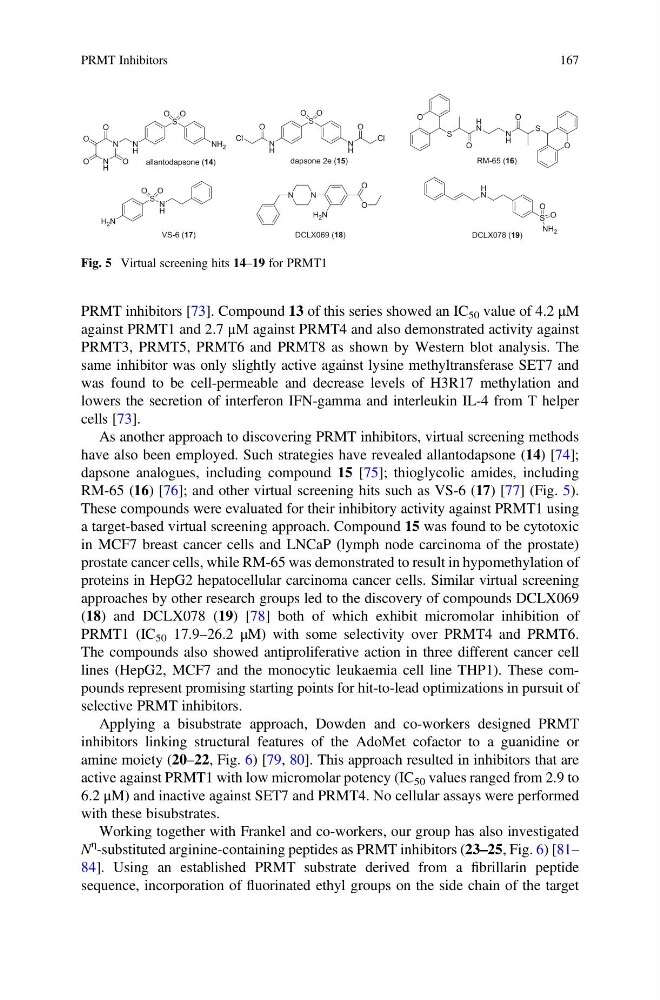
As another approach to discovering PRMT inhibitors, virtual screening methods
have also been employed. Such strategies have revealed allantodapsone (14) [74];
dapsone analogues, including compound 15 [75]; thioglycolic amides, including
RM-65 (16) [76]; and other virtual screening hits such as VS-6 (17) [77] (Fig. 5).
These compounds were evaluated for their inhibitory activity against PRMT1 using
a target-based virtual screening approach. Compound 15 was found to be cytotoxic
in MCF7 breast cancer cells and LNCaP (lymph node carcinoma of the prostate)
prostate cancer cells, while RM-65 was demonstrated to result in hypomethylation of
proteins in HepG2 hepatocellular carcinoma cancer cells. Similar virtual screening
approaches by other research groups led to the discovery of compounds DCLX069
(18) and DCLX078 (19) [78] both of which exhibit micromolar inhibition of
PRMT1 (IC 50 17.9–26.2 μM) with some selectivity over PRMT4 and PRMT6.
The compounds also showed antiproliferative action in three different cancer cell
lines (HepG2, MCF7 and the monocytic leukaemia cell line THP1). These compounds represent promising starting points for hit-to-lead optimizations in pursuit of
selective PRMT inhibitors.
Applying a bisubstrate approach, Dowden and co-workers designed PRMT
inhibitors linking structural features of the AdoMet cofactor to a guanidine or
amine moiety (20–22, Fig. 6) [79, 80]. This approach resulted in inhibitors that are
active against PRMT1 with low micromolar potency (IC 50 values ranged from 2.9 to
6.2 μM) and inactive against SET7 and PRMT4. No cellular assays were performed
with these bisubstrates.
Working together with Frankel and co-workers, our group has also investigated
N
η -substituted arginine-containing peptides as PRMT inhibitors (23–25, Fig. 6) [81–
84]. Using an established PRMT substrate derived from a fibrillarin peptide
sequence, incorporation of fluorinated ethyl groups on the side chain of the target
S
O O
N
H
O
Cl
N
H
O
Cl
NH 2
S
O O
N
H
N
N
H
O
O
O
O
allantodapsone (14)
O
S
O
H
N
O
S
O
N
H
RM-65 (16)
dapsone 2e (15)
S
O O
H 2 N
N
H
H
N
S
O
O
NH 2
N
N
H 2 N
O
O
DCLX069 (18)
DCLX078 (19)
VS-6 (17)
Fig. 5 Virtual screening hits 14–19 for PRMT1
PRMT Inhibitors
167
against PRMT1 and 2.7 μM against PRMT4 and also demonstrated activity against
PRMT3, PRMT5, PRMT6 and PRMT8 as shown by Western blot analysis. The
same inhibitor was only slightly active against lysine methyltransferase SET7 and
was found to be cell-permeable and decrease levels of H3R17 methylation and
lowers the secretion of interferon IFN-gamma and interleukin IL-4 from T helper
cells [73].
As another approach to discovering PRMT inhibitors, virtual screening methods
have also been employed. Such strategies have revealed allantodapsone (14) [74];
dapsone analogues, including compound 15 [75]; thioglycolic amides, including
RM-65 (16) [76]; and other virtual screening hits such as VS-6 (17) [77] (Fig. 5).
These compounds were evaluated for their inhibitory activity against PRMT1 using
a target-based virtual screening approach. Compound 15 was found to be cytotoxic
in MCF7 breast cancer cells and LNCaP (lymph node carcinoma of the prostate)
prostate cancer cells, while RM-65 was demonstrated to result in hypomethylation of
proteins in HepG2 hepatocellular carcinoma cancer cells. Similar virtual screening
approaches by other research groups led to the discovery of compounds DCLX069
(18) and DCLX078 (19) [78] both of which exhibit micromolar inhibition of
PRMT1 (IC 50 17.9–26.2 μM) with some selectivity over PRMT4 and PRMT6.
The compounds also showed antiproliferative action in three different cancer cell
lines (HepG2, MCF7 and the monocytic leukaemia cell line THP1). These compounds represent promising starting points for hit-to-lead optimizations in pursuit of
selective PRMT inhibitors.
Applying a bisubstrate approach, Dowden and co-workers designed PRMT
inhibitors linking structural features of the AdoMet cofactor to a guanidine or
amine moiety (20–22, Fig. 6) [79, 80]. This approach resulted in inhibitors that are
active against PRMT1 with low micromolar potency (IC 50 values ranged from 2.9 to
6.2 μM) and inactive against SET7 and PRMT4. No cellular assays were performed
with these bisubstrates.
Working together with Frankel and co-workers, our group has also investigated
N
η -substituted arginine-containing peptides as PRMT inhibitors (23–25, Fig. 6) [81–
84]. Using an established PRMT substrate derived from a fibrillarin peptide
sequence, incorporation of fluorinated ethyl groups on the side chain of the target
S
O O
N
H
O
Cl
N
H
O
Cl
NH 2
S
O O
N
H
N
N
H
O
O
O
O
allantodapsone (14)
O
S
O
H
N
O
S
O
N
H
RM-65 (16)
dapsone 2e (15)
S
O O
H 2 N
N
H
H
N
S
O
O
NH 2
N
N
H 2 N
O
O
DCLX069 (18)
DCLX078 (19)
VS-6 (17)
Fig. 5 Virtual screening hits 14–19 for PRMT1
PRMT Inhibitors
167