

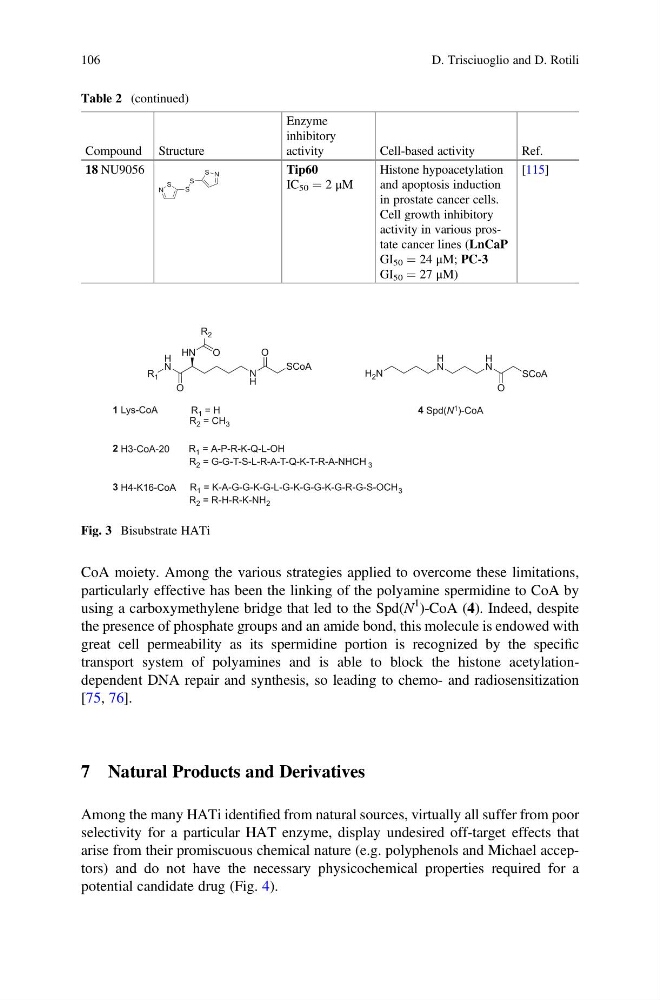
CoA moiety. Among the various strategies applied to overcome these limitations,
particularly effective has been the linking of the polyamine spermidine to CoA by
using a carboxymethylene bridge that led to the Spd(N
1 )-CoA (4). Indeed, despite
the presence of phosphate groups and an amide bond, this molecule is endowed with
great cell permeability as its spermidine portion is recognized by the specific
transport system of polyamines and is able to block the histone acetylationdependent DNA repair and synthesis, so leading to chemo- and radiosensitization
[75, 76].
7 Natural Products and Derivatives
Among the many HATi identified from natural sources, virtually all suffer from poor
selectivity for a particular HAT enzyme, display undesired off-target effects that
arise from their promiscuous chemical nature (e.g. polyphenols and Michael acceptors) and do not have the necessary physicochemical properties required for a
potential candidate drug (Fig. 4).
Table 2 (continued)
Compound Structure
Enzyme
inhibitory
activity
Cell-based activity
Ref.
18 NU9056
N
S
S
S
N
S
Tip60
IC 50 ¼ 2 μM
Histone hypoacetylation
and apoptosis induction
in prostate cancer cells.
Cell growth inhibitory
activity in various prostate cancer lines (LnCaP
GI 50 ¼ 24 μM; PC-3
GI 50 ¼ 27 μM)
[115]
R 1
H
N
O
HN
N
H
R 2
O
1 Lys-CoA
R 1 = H
2 H3-CoA-20
R 1 = A-P-R-K-Q-L-OH
R 2 = G-G-T-S-L-R-A-T-Q-K-T-R-A-NHCH 3
3 H4-K16-CoA R 1 = K-A-G-G-K-G-L-G-K-G-G-K-G-R-G-S-OCH 3
R 2 = R-H-R-K-NH 2
O
SCoA
R 2 = CH 3
H
N
H
N
O
SCoA
H 2 N
4 Spd(N 1 )-CoA
Fig. 3 Bisubstrate HATi
106
D. Trisciuoglio and D. Rotili
particularly effective has been the linking of the polyamine spermidine to CoA by
using a carboxymethylene bridge that led to the Spd(N
1 )-CoA (4). Indeed, despite
the presence of phosphate groups and an amide bond, this molecule is endowed with
great cell permeability as its spermidine portion is recognized by the specific
transport system of polyamines and is able to block the histone acetylationdependent DNA repair and synthesis, so leading to chemo- and radiosensitization
[75, 76].
7 Natural Products and Derivatives
Among the many HATi identified from natural sources, virtually all suffer from poor
selectivity for a particular HAT enzyme, display undesired off-target effects that
arise from their promiscuous chemical nature (e.g. polyphenols and Michael acceptors) and do not have the necessary physicochemical properties required for a
potential candidate drug (Fig. 4).
Table 2 (continued)
Compound Structure
Enzyme
inhibitory
activity
Cell-based activity
Ref.
18 NU9056
N
S
S
S
N
S
Tip60
IC 50 ¼ 2 μM
Histone hypoacetylation
and apoptosis induction
in prostate cancer cells.
Cell growth inhibitory
activity in various prostate cancer lines (LnCaP
GI 50 ¼ 24 μM; PC-3
GI 50 ¼ 27 μM)
[115]
R 1
H
N
O
HN
N
H
R 2
O
1 Lys-CoA
R 1 = H
2 H3-CoA-20
R 1 = A-P-R-K-Q-L-OH
R 2 = G-G-T-S-L-R-A-T-Q-K-T-R-A-NHCH 3
3 H4-K16-CoA R 1 = K-A-G-G-K-G-L-G-K-G-G-K-G-R-G-S-OCH 3
R 2 = R-H-R-K-NH 2
O
SCoA
R 2 = CH 3
H
N
H
N
O
SCoA
H 2 N
4 Spd(N 1 )-CoA
Fig. 3 Bisubstrate HATi
106
D. Trisciuoglio and D. Rotili