

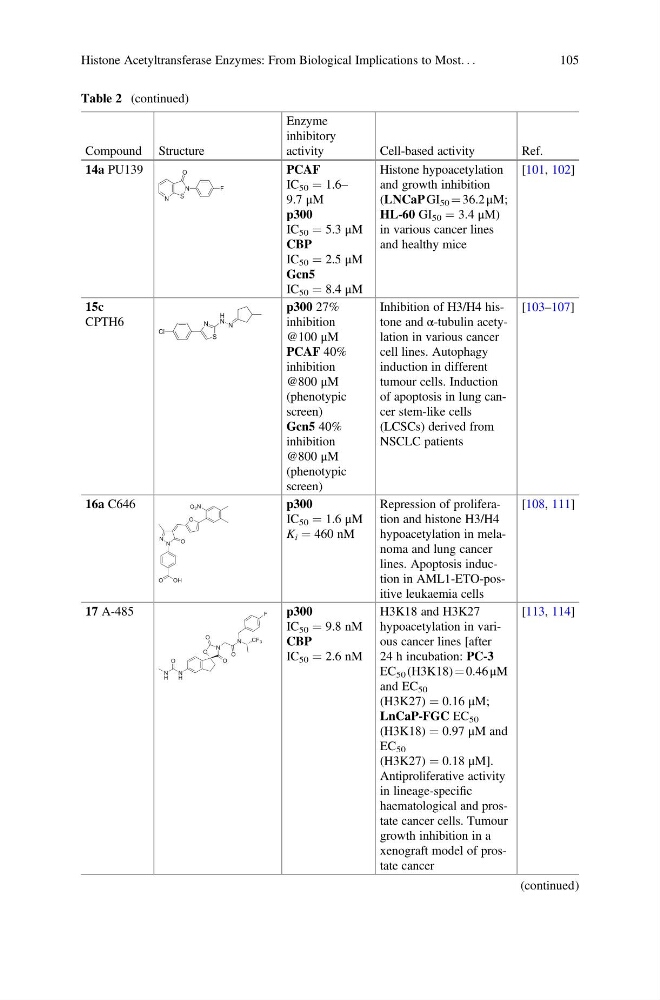
Table 2 (continued)
Compound Structure
Enzyme
inhibitory
activity
Cell-based activity
Ref.
14a PU139
S
N
O
N
F
PCAF
IC 50 ¼ 1.6–
9.7 μM
p300
IC 50 ¼ 5.3 μM
CBP
IC 50 ¼ 2.5 μM
Gcn5
IC 50 ¼ 8.4 μM
Histone hypoacetylation
and growth inhibition
(LNCaP GI 50 ¼ 36.2 μM;
HL-60 GI 50 ¼ 3.4 μM)
in various cancer lines
and healthy mice
[101, 102]
15c
CPTH6
N
H
N
N
S
Cl
p300 27%
inhibition
@100 μM
PCAF 40%
inhibition
@800 μM
(phenotypic
screen)
Gcn5 40%
inhibition
@800 μM
(phenotypic
screen)
Inhibition of H3/H4 histone and α-tubulin acetylation in various cancer
cell lines. Autophagy
induction in different
tumour cells. Induction
of apoptosis in lung cancer stem-like cells
(LCSCs) derived from
NSCLC patients
[103–107]
16a C646
O
O2N
O
N N
O
O H
p300
IC 50 ¼ 1.6 μM
K i ¼ 460 nM
Repression of proliferation and histone H3/H4
hypoacetylation in melanoma and lung cancer
lines. Apoptosis induction in AML1-ETO-positive leukaemia cells
[108, 111]
17 A-485
N
H
N
O
N
H
O
N
O
O
O
CF3
F
p300
IC 50 ¼ 9.8 nM
CBP
IC 50 ¼ 2.6 nM
H3K18 and H3K27
hypoacetylation in various cancer lines [after
24 h incubation: PC-3
EC 50 (H3K18) ¼ 0.46 μM
and EC 50
(H3K27) ¼ 0.16 μM;
LnCaP-FGC EC 50
(H3K18) ¼ 0.97 μM and
EC 50
(H3K27) ¼ 0.18 μM].
Antiproliferative activity
in lineage-specific
haematological and prostate cancer cells. Tumour
growth inhibition in a
xenograft model of prostate cancer
[113, 114]
(continued)
Histone Acetyltransferase Enzymes: From Biological Implications to Most. . .
105
Compound Structure
Enzyme
inhibitory
activity
Cell-based activity
Ref.
14a PU139
S
N
O
N
F
PCAF
IC 50 ¼ 1.6–
9.7 μM
p300
IC 50 ¼ 5.3 μM
CBP
IC 50 ¼ 2.5 μM
Gcn5
IC 50 ¼ 8.4 μM
Histone hypoacetylation
and growth inhibition
(LNCaP GI 50 ¼ 36.2 μM;
HL-60 GI 50 ¼ 3.4 μM)
in various cancer lines
and healthy mice
[101, 102]
15c
CPTH6
N
H
N
N
S
Cl
p300 27%
inhibition
@100 μM
PCAF 40%
inhibition
@800 μM
(phenotypic
screen)
Gcn5 40%
inhibition
@800 μM
(phenotypic
screen)
Inhibition of H3/H4 histone and α-tubulin acetylation in various cancer
cell lines. Autophagy
induction in different
tumour cells. Induction
of apoptosis in lung cancer stem-like cells
(LCSCs) derived from
NSCLC patients
[103–107]
16a C646
O
O2N
O
N N
O
O H
p300
IC 50 ¼ 1.6 μM
K i ¼ 460 nM
Repression of proliferation and histone H3/H4
hypoacetylation in melanoma and lung cancer
lines. Apoptosis induction in AML1-ETO-positive leukaemia cells
[108, 111]
17 A-485
N
H
N
O
N
H
O
N
O
O
O
CF3
F
p300
IC 50 ¼ 9.8 nM
CBP
IC 50 ¼ 2.6 nM
H3K18 and H3K27
hypoacetylation in various cancer lines [after
24 h incubation: PC-3
EC 50 (H3K18) ¼ 0.46 μM
and EC 50
(H3K27) ¼ 0.16 μM;
LnCaP-FGC EC 50
(H3K18) ¼ 0.97 μM and
EC 50
(H3K27) ¼ 0.18 μM].
Antiproliferative activity
in lineage-specific
haematological and prostate cancer cells. Tumour
growth inhibition in a
xenograft model of prostate cancer
[113, 114]
(continued)
Histone Acetyltransferase Enzymes: From Biological Implications to Most. . .
105