

example, on histone H3, the lysine residues which are mainly acetylated are those in
positions 9, 14, 18 and 23, while on histone H4, the preferentially acetylated residues
are K5, K8, K12 and K16. This reaction, neutralizing the positive charge of the
amino acid, weakens the electrostatic interaction between the histones and the
negatively charged DNA. In addition to the electrostatic repulsion that makes
the chromatin more lax, the addition of the acetyl group recalls the activation of
chromatin remodelling protein complexes (e.g. transcription factors, remodellers,
chromatin modifiers), thus leading to acetylation-mediated gene activation.
In the last decade, it has become clear that HAT enzymes can also acetylate
numerous nonhistone targets such as transcription factors, nuclear regulators and
various cytoplasmic proteins [2, 3]. Thus, the human HATs have been recently
classified as lysine acetyltransferases (KATs), considering their ability to acetylate
different proteins (Table 1). The HATs are grouped into three main superfamilies:
(1) Gcn5-related N-acetyltransferase (GNAT), (2) p300 and CREB-binding protein
S
CoA
-CoA
A
S
CoA
B
S
CoA
C
HS
CoA
D
CoASH
O
HN
NH 3
H4K8
H 3 C
O
acetyl
O
HN
NH 2
H 3 C
O
O
HN
NH 2
H 3 C
O
HO
H
N
O
Y1467
HN
O
NH
H
W1436
O
HN
NH
O
CH 3
H4K8Ac
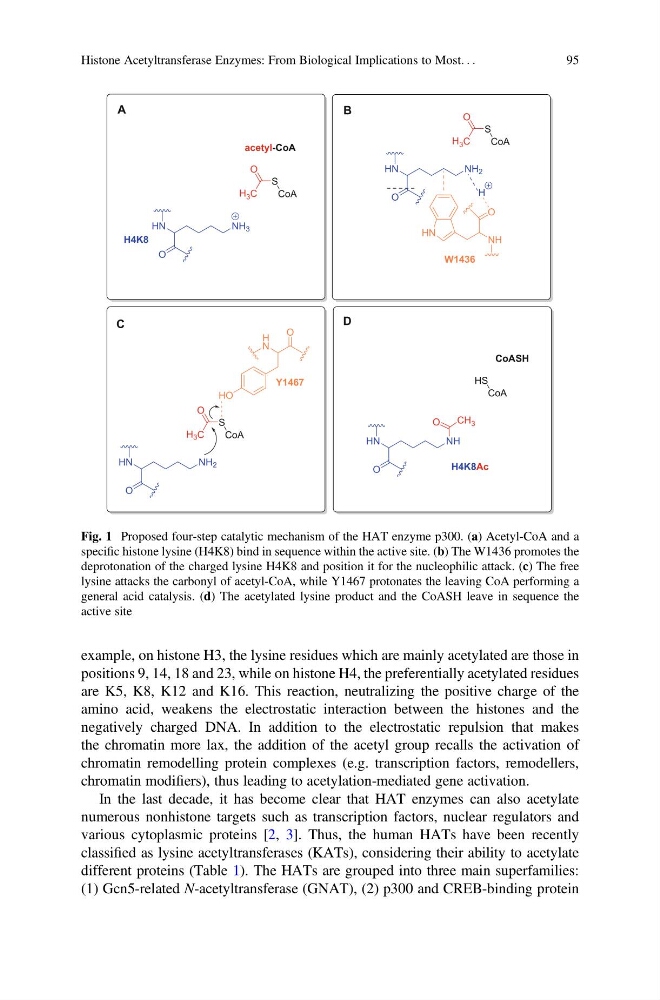
Fig. 1 Proposed four-step catalytic mechanism of the HAT enzyme p300. (a) Acetyl-CoA and a
specific histone lysine (H4K8) bind in sequence within the active site. (b) The W1436 promotes the
deprotonation of the charged lysine H4K8 and position it for the nucleophilic attack. (c) The free
lysine attacks the carbonyl of acetyl-CoA, while Y1467 protonates the leaving CoA performing a
general acid catalysis. (d) The acetylated lysine product and the CoASH leave in sequence the
active site
Histone Acetyltransferase Enzymes: From Biological Implications to Most. . .
95
positions 9, 14, 18 and 23, while on histone H4, the preferentially acetylated residues
are K5, K8, K12 and K16. This reaction, neutralizing the positive charge of the
amino acid, weakens the electrostatic interaction between the histones and the
negatively charged DNA. In addition to the electrostatic repulsion that makes
the chromatin more lax, the addition of the acetyl group recalls the activation of
chromatin remodelling protein complexes (e.g. transcription factors, remodellers,
chromatin modifiers), thus leading to acetylation-mediated gene activation.
In the last decade, it has become clear that HAT enzymes can also acetylate
numerous nonhistone targets such as transcription factors, nuclear regulators and
various cytoplasmic proteins [2, 3]. Thus, the human HATs have been recently
classified as lysine acetyltransferases (KATs), considering their ability to acetylate
different proteins (Table 1). The HATs are grouped into three main superfamilies:
(1) Gcn5-related N-acetyltransferase (GNAT), (2) p300 and CREB-binding protein
S
CoA
-CoA
A
S
CoA
B
S
CoA
C
HS
CoA
D
CoASH
O
HN
NH 3
H4K8
H 3 C
O
acetyl
O
HN
NH 2
H 3 C
O
O
HN
NH 2
H 3 C
O
HO
H
N
O
Y1467
HN
O
NH
H
W1436
O
HN
NH
O
CH 3
H4K8Ac
Fig. 1 Proposed four-step catalytic mechanism of the HAT enzyme p300. (a) Acetyl-CoA and a
specific histone lysine (H4K8) bind in sequence within the active site. (b) The W1436 promotes the
deprotonation of the charged lysine H4K8 and position it for the nucleophilic attack. (c) The free
lysine attacks the carbonyl of acetyl-CoA, while Y1467 protonates the leaving CoA performing a
general acid catalysis. (d) The acetylated lysine product and the CoASH leave in sequence the
active site
Histone Acetyltransferase Enzymes: From Biological Implications to Most. . .
95