

85
3.6 Sustainable Energy for All
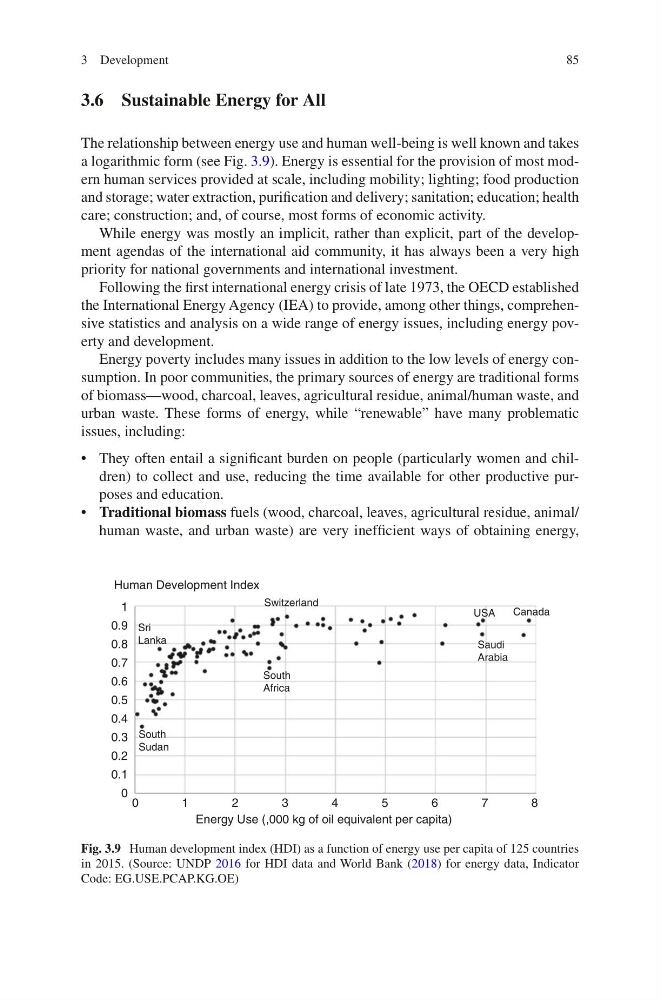
The relationship between energy use and human well-being is well known and takes
a logarithmic form (see Fig. 3.9). Energy is essential for the provision of most modern human services provided at scale, including mobility; lighting; food production
and storage; water extraction, purification and delivery; sanitation; education; health
care; construction; and, of course, most forms of economic activity.
While energy was mostly an implicit, rather than explicit, part of the development agendas of the international aid community, it has always been a very high
priority for national governments and international investment.
Following the first international energy crisis of late 1973, the OECD established
the International Energy Agency (IEA) to provide, among other things, comprehensive statistics and analysis on a wide range of energy issues, including energy poverty and development.
Energy poverty includes many issues in addition to the low levels of energy consumption. In poor communities, the primary sources of energy are traditional forms
of biomass—wood, charcoal, leaves, agricultural residue, animal/human waste, and
urban waste. These forms of energy, while “renewable” have many problematic
issues, including:
• They often entail a significant burden on people (particularly women and children) to collect and use, reducing the time available for other productive purposes and education.
• Traditional biomass fuels (wood, charcoal, leaves, agricultural residue, animal/
human waste, and urban waste) are very inefficient ways of obtaining energy,
0
0
0.1
0.2
0.3
0.4
0.5
0.6
0.7
0.8
0.9
1
Human Development Index
Sri
Lanka
Switzerland
South
Africa
South
Sudan
USA
Canada
Saudi
Arabia
1
2
3
4
Energy Use (,000 kg of oil equivalent per capita)
5
6
7
8
Fig. 3.9 Human development index (HDI) as a function of energy use per capita of 125 countries
in 2015. (Source: UNDP 2016 for HDI data and World Bank (2018) for energy data, Indicator
Code: EG.USE.PCAP.KG.OE)
3 Development
3.6 Sustainable Energy for All
The relationship between energy use and human well-being is well known and takes
a logarithmic form (see Fig. 3.9). Energy is essential for the provision of most modern human services provided at scale, including mobility; lighting; food production
and storage; water extraction, purification and delivery; sanitation; education; health
care; construction; and, of course, most forms of economic activity.
While energy was mostly an implicit, rather than explicit, part of the development agendas of the international aid community, it has always been a very high
priority for national governments and international investment.
Following the first international energy crisis of late 1973, the OECD established
the International Energy Agency (IEA) to provide, among other things, comprehensive statistics and analysis on a wide range of energy issues, including energy poverty and development.
Energy poverty includes many issues in addition to the low levels of energy consumption. In poor communities, the primary sources of energy are traditional forms
of biomass—wood, charcoal, leaves, agricultural residue, animal/human waste, and
urban waste. These forms of energy, while “renewable” have many problematic
issues, including:
• They often entail a significant burden on people (particularly women and children) to collect and use, reducing the time available for other productive purposes and education.
• Traditional biomass fuels (wood, charcoal, leaves, agricultural residue, animal/
human waste, and urban waste) are very inefficient ways of obtaining energy,
0
0
0.1
0.2
0.3
0.4
0.5
0.6
0.7
0.8
0.9
1
Human Development Index
Sri
Lanka
Switzerland
South
Africa
South
Sudan
USA
Canada
Saudi
Arabia
1
2
3
4
Energy Use (,000 kg of oil equivalent per capita)
5
6
7
8
Fig. 3.9 Human development index (HDI) as a function of energy use per capita of 125 countries
in 2015. (Source: UNDP 2016 for HDI data and World Bank (2018) for energy data, Indicator
Code: EG.USE.PCAP.KG.OE)
3 Development