

86
typically only 10% of the potential energy is utilized for an energy service such
as cooking. Traditional biomass is considered renewable.
• They result in harmful levels of air pollution in homes. The WHO estimates that
3.8 million deaths occur each year as a result of exposure to dirty cookstoves and
the indoor use of unclean fuels.
• Gathering traditional biomass fuels on a large scale can have adverse environmental consequences such as increasing deforestation, soil loss, and degrading
of ecosystem services.
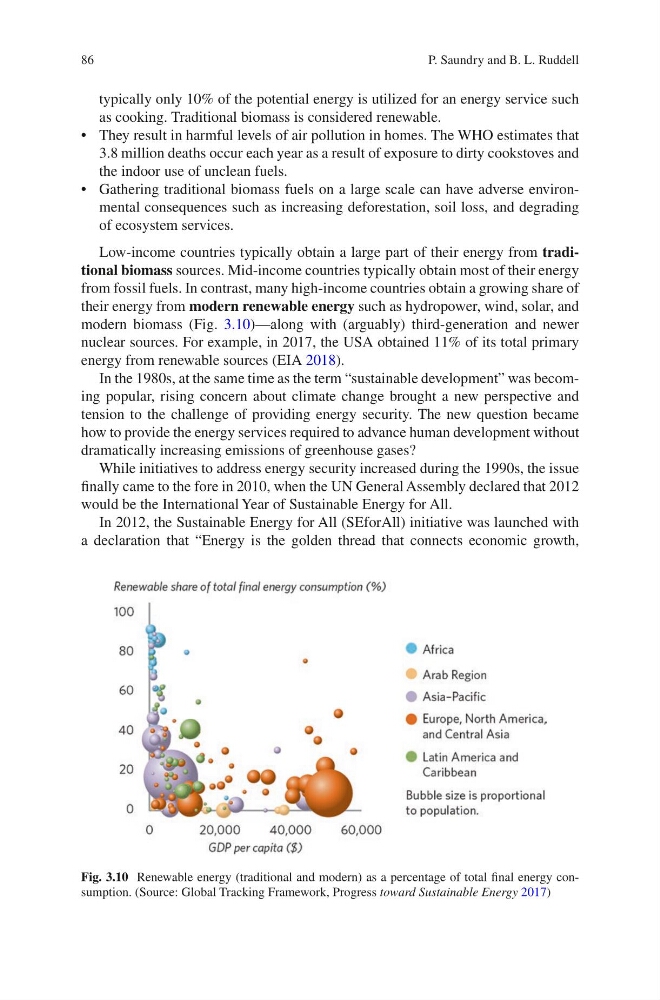
Low-income countries typically obtain a large part of their energy from traditional biomass sources. Mid-income countries typically obtain most of their energy
from fossil fuels. In contrast, many high-income countries obtain a growing share of
their energy from modern renewable energy such as hydropower, wind, solar, and
modern biomass (Fig. 3.10)—along with (arguably) third-generation and newer
nuclear sources. For example, in 2017, the USA obtained 11% of its total primary
energy from renewable sources (EIA 2018).
In the 1980s, at the same time as the term “sustainable development” was becoming popular, rising concern about climate change brought a new perspective and
tension to the challenge of providing energy security. The new question became
how to provide the energy services required to advance human development without
dramatically increasing emissions of greenhouse gases?
While initiatives to address energy security increased during the 1990s, the issue
finally came to the fore in 2010, when the UN General Assembly declared that 2012
would be the International Year of Sustainable Energy for All.
In 2012, the Sustainable Energy for All (SEforAll) initiative was launched with
a declaration that “Energy is the golden thread that connects economic growth,
Fig. 3.10 Renewable energy (traditional and modern) as a percentage of total final energy consumption. (Source: Global Tracking Framework, Progress toward Sustainable Energy 2017)
P. Saundry and B. L. Ruddell
typically only 10% of the potential energy is utilized for an energy service such
as cooking. Traditional biomass is considered renewable.
• They result in harmful levels of air pollution in homes. The WHO estimates that
3.8 million deaths occur each year as a result of exposure to dirty cookstoves and
the indoor use of unclean fuels.
• Gathering traditional biomass fuels on a large scale can have adverse environmental consequences such as increasing deforestation, soil loss, and degrading
of ecosystem services.
Low-income countries typically obtain a large part of their energy from traditional biomass sources. Mid-income countries typically obtain most of their energy
from fossil fuels. In contrast, many high-income countries obtain a growing share of
their energy from modern renewable energy such as hydropower, wind, solar, and
modern biomass (Fig. 3.10)—along with (arguably) third-generation and newer
nuclear sources. For example, in 2017, the USA obtained 11% of its total primary
energy from renewable sources (EIA 2018).
In the 1980s, at the same time as the term “sustainable development” was becoming popular, rising concern about climate change brought a new perspective and
tension to the challenge of providing energy security. The new question became
how to provide the energy services required to advance human development without
dramatically increasing emissions of greenhouse gases?
While initiatives to address energy security increased during the 1990s, the issue
finally came to the fore in 2010, when the UN General Assembly declared that 2012
would be the International Year of Sustainable Energy for All.
In 2012, the Sustainable Energy for All (SEforAll) initiative was launched with
a declaration that “Energy is the golden thread that connects economic growth,
Fig. 3.10 Renewable energy (traditional and modern) as a percentage of total final energy consumption. (Source: Global Tracking Framework, Progress toward Sustainable Energy 2017)
P. Saundry and B. L. Ruddell