

82
are “those designed to hygienically separate excreta from human contact.” The JMP
also has a “sanitation ladder” metrics:
• Open defecation: Disposal of human feces in fields, forests, bushes, open bodies
of water, beaches and other open spaces or with solid waste
• Unimproved: Use of pit latrines without a slab or platform, hanging latrines, or
bucket latrines
• Limited: Use of improved facilities shared between two or more households
• Basic: Use of improved facilities which are not shared with other households
• Safely Managed: Use of improved facilities which are not shared with other
households and where excreta are safely disposed in situ or transported and
treated off-site
Figure 3.8 shows that the percentage of the world’s population without access to
basic sanitation services dropped from 41.5% (2.54 billion) in 2000 to 31.9%
(2.35 billion) in 2015, a 23% improvement. Again, note the significant difference
between rural and urban populations.
3.5.2.5 Metrics, Data, and Models
The metrics used in the Millennium Development Goals did not address many
aspects of food, energy, and water security because of both the political desire to
have a small number of metrics and for the practical reason that the data underlying
many desirable metrics is limited on a global scale or inconsistently gathered in
different countries. The complexities associated with metrics, data, and modeling
and computation illustrated here are explored in later Chapters.
0%
2000
Year
Urban
World
Rural
2005
2010
2015
5%
10%
15%
20%
25%
30%
35%
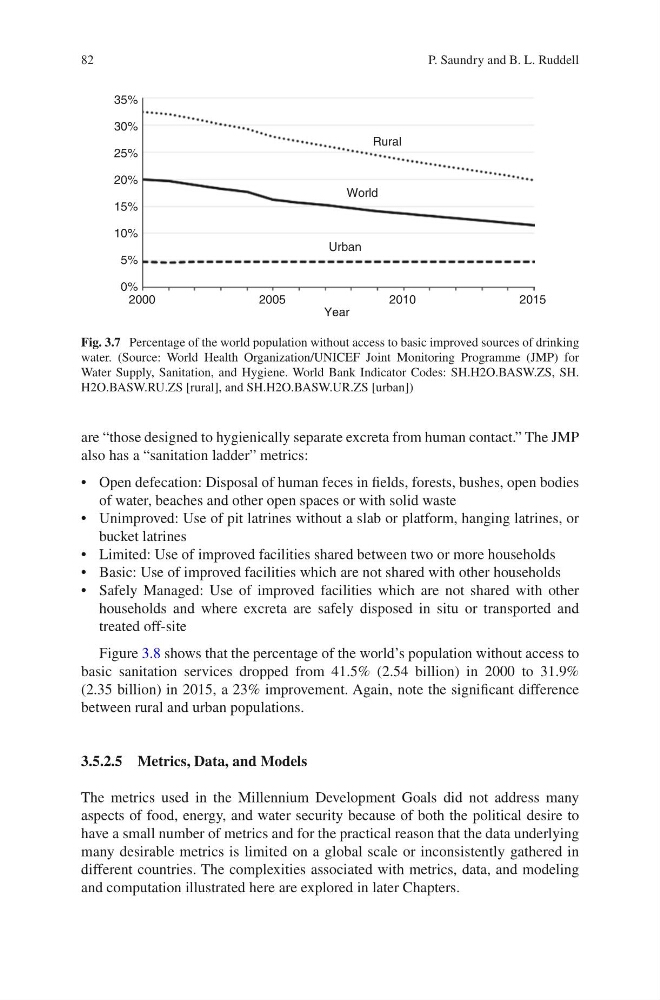
Fig. 3.7 Percentage of the world population without access to basic improved sources of drinking
water. (Source: World Health Organization/UNICEF Joint Monitoring Programme (JMP) for
Water Supply, Sanitation, and Hygiene. World Bank Indicator Codes: SH.H2O.BASW.ZS, SH.
H2O.BASW.RU.ZS [rural], and SH.H2O.BASW.UR.ZS [urban])
P. Saundry and B. L. Ruddell
are “those designed to hygienically separate excreta from human contact.” The JMP
also has a “sanitation ladder” metrics:
• Open defecation: Disposal of human feces in fields, forests, bushes, open bodies
of water, beaches and other open spaces or with solid waste
• Unimproved: Use of pit latrines without a slab or platform, hanging latrines, or
bucket latrines
• Limited: Use of improved facilities shared between two or more households
• Basic: Use of improved facilities which are not shared with other households
• Safely Managed: Use of improved facilities which are not shared with other
households and where excreta are safely disposed in situ or transported and
treated off-site
Figure 3.8 shows that the percentage of the world’s population without access to
basic sanitation services dropped from 41.5% (2.54 billion) in 2000 to 31.9%
(2.35 billion) in 2015, a 23% improvement. Again, note the significant difference
between rural and urban populations.
3.5.2.5 Metrics, Data, and Models
The metrics used in the Millennium Development Goals did not address many
aspects of food, energy, and water security because of both the political desire to
have a small number of metrics and for the practical reason that the data underlying
many desirable metrics is limited on a global scale or inconsistently gathered in
different countries. The complexities associated with metrics, data, and modeling
and computation illustrated here are explored in later Chapters.
0%
2000
Year
Urban
World
Rural
2005
2010
2015
5%
10%
15%
20%
25%
30%
35%
Fig. 3.7 Percentage of the world population without access to basic improved sources of drinking
water. (Source: World Health Organization/UNICEF Joint Monitoring Programme (JMP) for
Water Supply, Sanitation, and Hygiene. World Bank Indicator Codes: SH.H2O.BASW.ZS, SH.
H2O.BASW.RU.ZS [rural], and SH.H2O.BASW.UR.ZS [urban])
P. Saundry and B. L. Ruddell