

77
• Gender Development Index (GDI), which calculates separate HDIs for males
and females.
• Gender Inequality Index (GII), which utilizes metrics differentiated by gender
on health, empowerment, and labor.
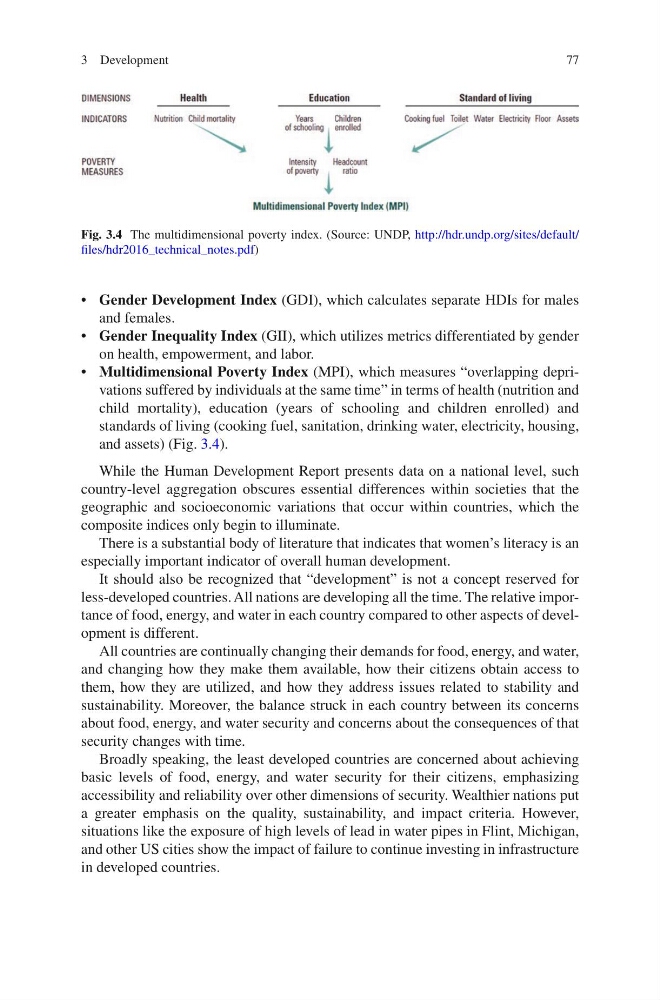
• Multidimensional Poverty Index (MPI), which measures “overlapping deprivations suffered by individuals at the same time” in terms of health (nutrition and
child mortality), education (years of schooling and children enrolled) and
standards of living (cooking fuel, sanitation, drinking water, electricity, housing,
and assets) (Fig. 3.4).
While the Human Development Report presents data on a national level, such
country-level aggregation obscures essential differences within societies that the
geographic and socioeconomic variations that occur within countries, which the
composite indices only begin to illuminate.
There is a substantial body of literature that indicates that women’s literacy is an
especially important indicator of overall human development.
It should also be recognized that “development” is not a concept reserved for
less-developed countries. All nations are developing all the time. The relative importance of food, energy, and water in each country compared to other aspects of development is different.
All countries are continually changing their demands for food, energy, and water,
and changing how they make them available, how their citizens obtain access to
them, how they are utilized, and how they address issues related to stability and
sustainability. Moreover, the balance struck in each country between its concerns
about food, energy, and water security and concerns about the consequences of that
security changes with time.
Broadly speaking, the least developed countries are concerned about achieving
basic levels of food, energy, and water security for their citizens, emphasizing
accessibility and reliability over other dimensions of security. Wealthier nations put
a greater emphasis on the quality, sustainability, and impact criteria. However,
situations like the exposure of high levels of lead in water pipes in Flint, Michigan,
and other US cities show the impact of failure to continue investing in infrastructure
in developed countries.
Fig. 3.4 The multidimensional poverty index. (Source: UNDP, http://hdr.undp.org/sites/default/
files/hdr2016_technical_notes.pdf)
3 Development
• Gender Development Index (GDI), which calculates separate HDIs for males
and females.
• Gender Inequality Index (GII), which utilizes metrics differentiated by gender
on health, empowerment, and labor.
• Multidimensional Poverty Index (MPI), which measures “overlapping deprivations suffered by individuals at the same time” in terms of health (nutrition and
child mortality), education (years of schooling and children enrolled) and
standards of living (cooking fuel, sanitation, drinking water, electricity, housing,
and assets) (Fig. 3.4).
While the Human Development Report presents data on a national level, such
country-level aggregation obscures essential differences within societies that the
geographic and socioeconomic variations that occur within countries, which the
composite indices only begin to illuminate.
There is a substantial body of literature that indicates that women’s literacy is an
especially important indicator of overall human development.
It should also be recognized that “development” is not a concept reserved for
less-developed countries. All nations are developing all the time. The relative importance of food, energy, and water in each country compared to other aspects of development is different.
All countries are continually changing their demands for food, energy, and water,
and changing how they make them available, how their citizens obtain access to
them, how they are utilized, and how they address issues related to stability and
sustainability. Moreover, the balance struck in each country between its concerns
about food, energy, and water security and concerns about the consequences of that
security changes with time.
Broadly speaking, the least developed countries are concerned about achieving
basic levels of food, energy, and water security for their citizens, emphasizing
accessibility and reliability over other dimensions of security. Wealthier nations put
a greater emphasis on the quality, sustainability, and impact criteria. However,
situations like the exposure of high levels of lead in water pipes in Flint, Michigan,
and other US cities show the impact of failure to continue investing in infrastructure
in developed countries.
Fig. 3.4 The multidimensional poverty index. (Source: UNDP, http://hdr.undp.org/sites/default/
files/hdr2016_technical_notes.pdf)
3 Development