

76
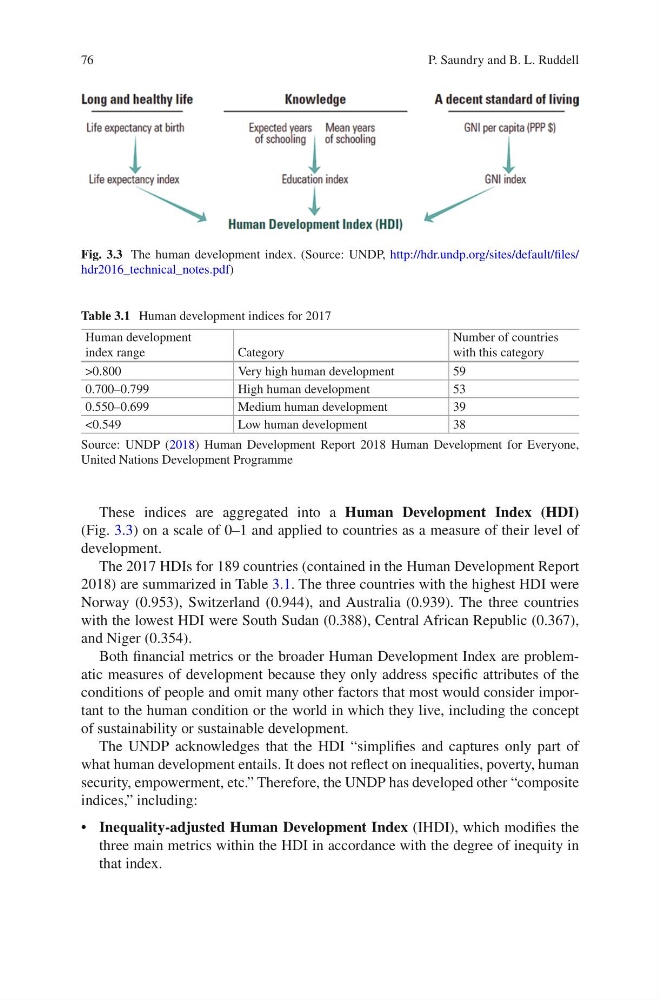
These indices are aggregated into a Human Development Index (HDI)
(Fig. 3.3) on a scale of 0–1 and applied to countries as a measure of their level of
development.
The 2017 HDIs for 189 countries (contained in the Human Development Report
2018) are summarized in Table 3.1. The three countries with the highest HDI were
Norway (0.953), Switzerland (0.944), and Australia (0.939). The three countries
with the lowest HDI were South Sudan (0.388), Central African Republic (0.367),
and Niger (0.354).
Both financial metrics or the broader Human Development Index are problematic measures of development because they only address specific attributes of the
conditions of people and omit many other factors that most would consider important to the human condition or the world in which they live, including the concept
of sustainability or sustainable development.
The UNDP acknowledges that the HDI “simplifies and captures only part of
what human development entails. It does not reflect on inequalities, poverty, human
security, empowerment, etc.” Therefore, the UNDP has developed other “composite
indices,” including:
• Inequality-adjusted Human Development Index (IHDI), which modifies the
three main metrics within the HDI in accordance with the degree of inequity in
that index.
Fig. 3.3 The human development index. (Source: UNDP, http://hdr.undp.org/sites/default/files/
hdr2016_technical_notes.pdf)
Table 3.1 Human development indices for 2017
Human development
index range
Category
Number of countries
with this category
>0.800
Very high human development
59
0.700–0.799
High human development
53
0.550–0.699
Medium human development
39
<0.549
Low human development
38
Source: UNDP (2018) Human Development Report 2018 Human Development for Everyone,
United Nations Development Programme
P. Saundry and B. L. Ruddell
These indices are aggregated into a Human Development Index (HDI)
(Fig. 3.3) on a scale of 0–1 and applied to countries as a measure of their level of
development.
The 2017 HDIs for 189 countries (contained in the Human Development Report
2018) are summarized in Table 3.1. The three countries with the highest HDI were
Norway (0.953), Switzerland (0.944), and Australia (0.939). The three countries
with the lowest HDI were South Sudan (0.388), Central African Republic (0.367),
and Niger (0.354).
Both financial metrics or the broader Human Development Index are problematic measures of development because they only address specific attributes of the
conditions of people and omit many other factors that most would consider important to the human condition or the world in which they live, including the concept
of sustainability or sustainable development.
The UNDP acknowledges that the HDI “simplifies and captures only part of
what human development entails. It does not reflect on inequalities, poverty, human
security, empowerment, etc.” Therefore, the UNDP has developed other “composite
indices,” including:
• Inequality-adjusted Human Development Index (IHDI), which modifies the
three main metrics within the HDI in accordance with the degree of inequity in
that index.
Fig. 3.3 The human development index. (Source: UNDP, http://hdr.undp.org/sites/default/files/
hdr2016_technical_notes.pdf)
Table 3.1 Human development indices for 2017
Human development
index range
Category
Number of countries
with this category
>0.800
Very high human development
59
0.700–0.799
High human development
53
0.550–0.699
Medium human development
39
<0.549
Low human development
38
Source: UNDP (2018) Human Development Report 2018 Human Development for Everyone,
United Nations Development Programme
P. Saundry and B. L. Ruddell