

74
rates of population growth. In 1950, the more developed nations possessed 32% of
the global population; in 2015, 17% and are projected to have 12% of the global
population in 2080.
It is equally important to recognize that during the twentieth century, humans
gained considerable ability to control their fertility through the use of contraception,
later marriage, and in other ways. As a result, the rate of growth in population has
slowed throughout the world and has slowed more rapidly and dramatically than
expected in most countries. The full story of the demographic transition that the
world has been going through, voluntary and involuntary in some instances, is
beyond the scope of this book.
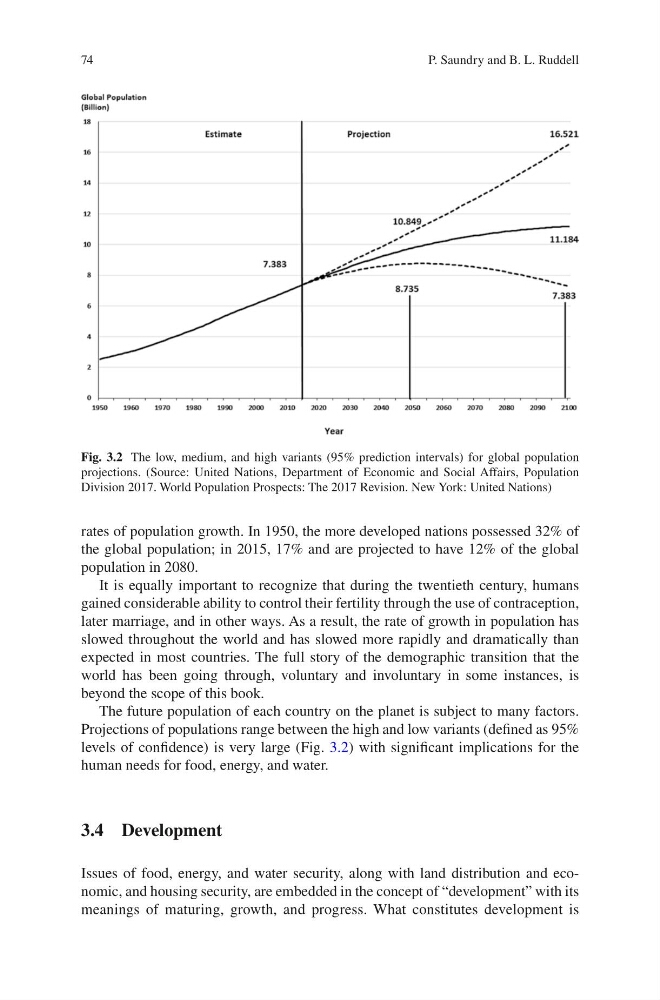
The future population of each country on the planet is subject to many factors.
Projections of populations range between the high and low variants (defined as 95%
levels of confidence) is very large (Fig. 3.2) with significant implications for the
human needs for food, energy, and water.
3.4 Development
Issues of food, energy, and water security, along with land distribution and economic, and housing security, are embedded in the concept of “development” with its
meanings of maturing, growth, and progress. What constitutes development is
Fig. 3.2 The low, medium, and high variants (95% prediction intervals) for global population
projections. (Source: United Nations, Department of Economic and Social Affairs, Population
Division 2017. World Population Prospects: The 2017 Revision. New York: United Nations)
P. Saundry and B. L. Ruddell
rates of population growth. In 1950, the more developed nations possessed 32% of
the global population; in 2015, 17% and are projected to have 12% of the global
population in 2080.
It is equally important to recognize that during the twentieth century, humans
gained considerable ability to control their fertility through the use of contraception,
later marriage, and in other ways. As a result, the rate of growth in population has
slowed throughout the world and has slowed more rapidly and dramatically than
expected in most countries. The full story of the demographic transition that the
world has been going through, voluntary and involuntary in some instances, is
beyond the scope of this book.
The future population of each country on the planet is subject to many factors.
Projections of populations range between the high and low variants (defined as 95%
levels of confidence) is very large (Fig. 3.2) with significant implications for the
human needs for food, energy, and water.
3.4 Development
Issues of food, energy, and water security, along with land distribution and economic, and housing security, are embedded in the concept of “development” with its
meanings of maturing, growth, and progress. What constitutes development is
Fig. 3.2 The low, medium, and high variants (95% prediction intervals) for global population
projections. (Source: United Nations, Department of Economic and Social Affairs, Population
Division 2017. World Population Prospects: The 2017 Revision. New York: United Nations)
P. Saundry and B. L. Ruddell