

577
over seven million people through a 2015 resolution. This resolution formally
agreed to the 2030 Agenda for Sustainable Development and its 17 Sustainable
Development Goals, adopting these as part of the “Road to Paris” for the 2015
Climate Agreement discussed above.
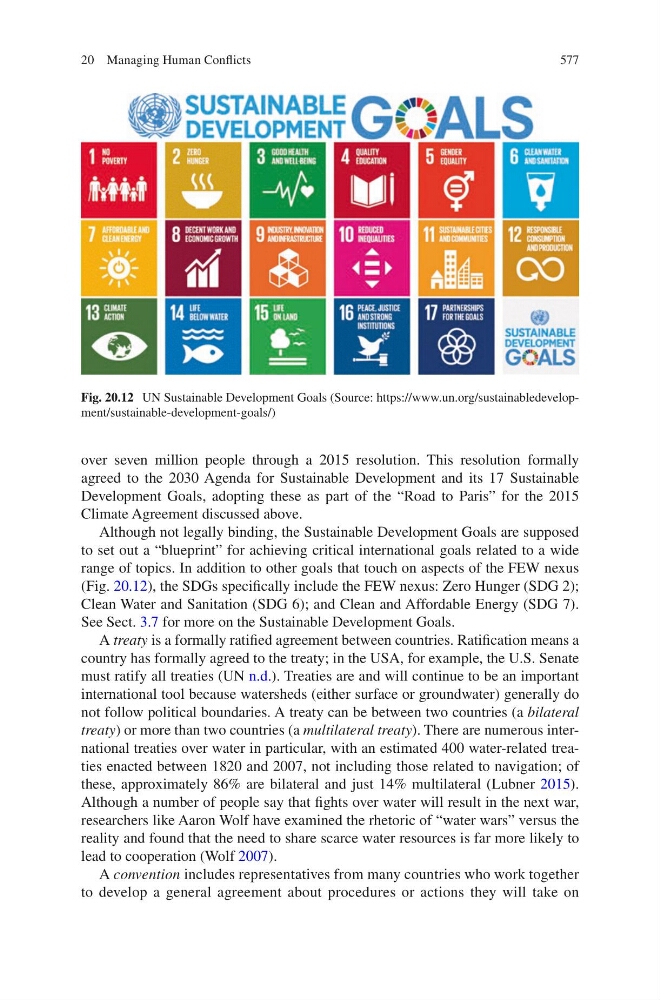
Although not legally binding, the Sustainable Development Goals are supposed
to set out a “blueprint” for achieving critical international goals related to a wide
range of topics. In addition to other goals that touch on aspects of the FEW nexus
(Fig. 20.12), the SDGs specifically include the FEW nexus: Zero Hunger (SDG 2);
Clean Water and Sanitation (SDG 6); and Clean and Affordable Energy (SDG 7).
See Sect. 3.7 for more on the Sustainable Development Goals.
A treaty is a formally ratified agreement between countries. Ratification means a
country has formally agreed to the treaty; in the USA, for example, the U.S. Senate
must ratify all treaties (UN n.d.). Treaties are and will continue to be an important
international tool because watersheds (either surface or groundwater) generally do
not follow political boundaries. A treaty can be between two countries (a bilateral
treaty) or more than two countries (a multilateral treaty). There are numerous international treaties over water in particular, with an estimated 400 water-related treaties enacted between 1820 and 2007, not including those related to navigation; of
these, approximately 86% are bilateral and just 14% multilateral (Lubner 2015).
Although a number of people say that fights over water will result in the next war,
researchers like Aaron Wolf have examined the rhetoric of “water wars” versus the
reality and found that the need to share scarce water resources is far more likely to
lead to cooperation (Wolf 2007).
A convention includes representatives from many countries who work together
to develop a general agreement about procedures or actions they will take on
Fig. 20.12 UN Sustainable Development Goals (Source: https://www.un.org/sustainabledevelopment/sustainable-development-goals/)
20 Managing Human Conflicts
over seven million people through a 2015 resolution. This resolution formally
agreed to the 2030 Agenda for Sustainable Development and its 17 Sustainable
Development Goals, adopting these as part of the “Road to Paris” for the 2015
Climate Agreement discussed above.
Although not legally binding, the Sustainable Development Goals are supposed
to set out a “blueprint” for achieving critical international goals related to a wide
range of topics. In addition to other goals that touch on aspects of the FEW nexus
(Fig. 20.12), the SDGs specifically include the FEW nexus: Zero Hunger (SDG 2);
Clean Water and Sanitation (SDG 6); and Clean and Affordable Energy (SDG 7).
See Sect. 3.7 for more on the Sustainable Development Goals.
A treaty is a formally ratified agreement between countries. Ratification means a
country has formally agreed to the treaty; in the USA, for example, the U.S. Senate
must ratify all treaties (UN n.d.). Treaties are and will continue to be an important
international tool because watersheds (either surface or groundwater) generally do
not follow political boundaries. A treaty can be between two countries (a bilateral
treaty) or more than two countries (a multilateral treaty). There are numerous international treaties over water in particular, with an estimated 400 water-related treaties enacted between 1820 and 2007, not including those related to navigation; of
these, approximately 86% are bilateral and just 14% multilateral (Lubner 2015).
Although a number of people say that fights over water will result in the next war,
researchers like Aaron Wolf have examined the rhetoric of “water wars” versus the
reality and found that the need to share scarce water resources is far more likely to
lead to cooperation (Wolf 2007).
A convention includes representatives from many countries who work together
to develop a general agreement about procedures or actions they will take on
Fig. 20.12 UN Sustainable Development Goals (Source: https://www.un.org/sustainabledevelopment/sustainable-development-goals/)
20 Managing Human Conflicts