

566
do people value? Digging deeper and seeking a better understanding of interests
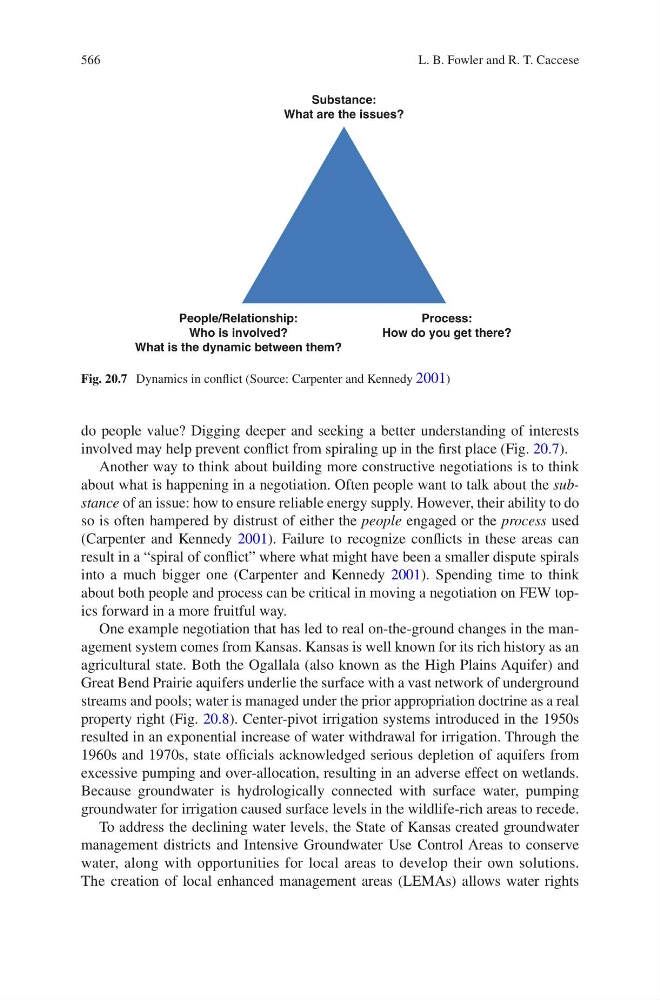
involved may help prevent conflict from spiraling up in the first place (Fig. 20.7).
Another way to think about building more constructive negotiations is to think
about what is happening in a negotiation. Often people want to talk about the substance of an issue: how to ensure reliable energy supply. However, their ability to do
so is often hampered by distrust of either the people engaged or the process used
(Carpenter and Kennedy 2001). Failure to recognize conflicts in these areas can
result in a “spiral of conflict” where what might have been a smaller dispute spirals
into a much bigger one (Carpenter and Kennedy 2001). Spending time to think
about both people and process can be critical in moving a negotiation on FEW topics forward in a more fruitful way.
One example negotiation that has led to real on-the-ground changes in the management system comes from Kansas. Kansas is well known for its rich history as an
agricultural state. Both the Ogallala (also known as the High Plains Aquifer) and
Great Bend Prairie aquifers underlie the surface with a vast network of underground
streams and pools; water is managed under the prior appropriation doctrine as a real
property right (Fig. 20.8). Center-pivot irrigation systems introduced in the 1950s
resulted in an exponential increase of water withdrawal for irrigation. Through the
1960s and 1970s, state officials acknowledged serious depletion of aquifers from
excessive pumping and over-allocation, resulting in an adverse effect on wetlands.
Because groundwater is hydrologically connected with surface water, pumping
groundwater for irrigation caused surface levels in the wildlife-rich areas to recede.
To address the declining water levels, the State of Kansas created groundwater
management districts and Intensive Groundwater Use Control Areas to conserve
water, along with opportunities for local areas to develop their own solutions.
The creation of local enhanced management areas (LEMAs) allows water rights
Substance:
What are the issues?
Process:
How do you get there?
People/Relationship:
Who is involved?
What is the dynamic between them?
Fig. 20.7 Dynamics in conflict (Source: Carpenter and Kennedy 2001)
L. B. Fowler and R. T. Caccese
do people value? Digging deeper and seeking a better understanding of interests
involved may help prevent conflict from spiraling up in the first place (Fig. 20.7).
Another way to think about building more constructive negotiations is to think
about what is happening in a negotiation. Often people want to talk about the substance of an issue: how to ensure reliable energy supply. However, their ability to do
so is often hampered by distrust of either the people engaged or the process used
(Carpenter and Kennedy 2001). Failure to recognize conflicts in these areas can
result in a “spiral of conflict” where what might have been a smaller dispute spirals
into a much bigger one (Carpenter and Kennedy 2001). Spending time to think
about both people and process can be critical in moving a negotiation on FEW topics forward in a more fruitful way.
One example negotiation that has led to real on-the-ground changes in the management system comes from Kansas. Kansas is well known for its rich history as an
agricultural state. Both the Ogallala (also known as the High Plains Aquifer) and
Great Bend Prairie aquifers underlie the surface with a vast network of underground
streams and pools; water is managed under the prior appropriation doctrine as a real
property right (Fig. 20.8). Center-pivot irrigation systems introduced in the 1950s
resulted in an exponential increase of water withdrawal for irrigation. Through the
1960s and 1970s, state officials acknowledged serious depletion of aquifers from
excessive pumping and over-allocation, resulting in an adverse effect on wetlands.
Because groundwater is hydrologically connected with surface water, pumping
groundwater for irrigation caused surface levels in the wildlife-rich areas to recede.
To address the declining water levels, the State of Kansas created groundwater
management districts and Intensive Groundwater Use Control Areas to conserve
water, along with opportunities for local areas to develop their own solutions.
The creation of local enhanced management areas (LEMAs) allows water rights
Substance:
What are the issues?
Process:
How do you get there?
People/Relationship:
Who is involved?
What is the dynamic between them?
Fig. 20.7 Dynamics in conflict (Source: Carpenter and Kennedy 2001)
L. B. Fowler and R. T. Caccese