

556
Problems of higher temperature and drought are especially exacerbated in states
like Texas and Kansas where crop irrigation is entirely dependent on groundwater.
Because this region supplies nearly one-fifth of the US agricultural harvest of wheat,
corn, and cotton (Little 2009), the decline in this aquifer impacts not only the US
but beyond.
Conflicts over water scarcity are not just a western US issue. For example, there
have been legal fights over the Apalachicola-Chattahoochee-Flint (ACF) River
Basin in Georgia, Alabama, and Florida (Fig. 20.4) since 1990. In the most recent
legal battle brought to the U.S. Supreme Court, Florida attributed its lack of water
and crashing oyster populations in Apalachicola Bay to increasing water use and
withdrawal in Georgia. Georgia argued the need for fresh water for the City of
Atlanta and irrigation for its farmers. Despite millions spent on legal fees, this case
has not yet been resolved (see, e.g., Reilly 2017).
Although Alabama is not a party to the U.S. Supreme Court case, it has been
part of other litigation dating to the 1990s. Alabama uses water from the ACF
Basin for agriculture, fisheries, power generation, and recreation. In recent years,
Alabama has suffered impacts from severe to extreme droughts that greatly
impacted agricultural production, energy supplies, and drinking water. Figure 20.5
below shows the percent of Alabama in mild (yellow) to extreme (dark red) drought
below since the year 2000.
These types of issues are not limited to the US. In parts of southern Africa, strong
economic and military nations control natural resources for potential political gain
and agenda; access to water is a key piece of this. For example, the Limpopo River
flows through South Africa, Botswana, Zimbabwe, and Mozambique.
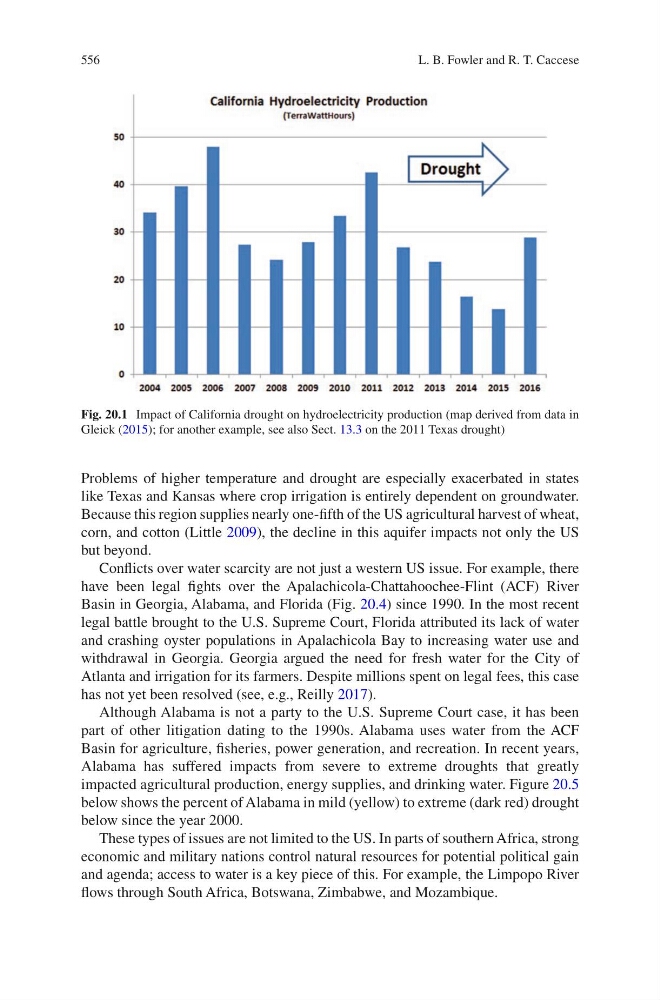
Fig. 20.1 Impact of California drought on hydroelectricity production (map derived from data in
Gleick (2015); for another example, see also Sect. 13.3 on the 2011 Texas drought)
L. B. Fowler and R. T. Caccese
Problems of higher temperature and drought are especially exacerbated in states
like Texas and Kansas where crop irrigation is entirely dependent on groundwater.
Because this region supplies nearly one-fifth of the US agricultural harvest of wheat,
corn, and cotton (Little 2009), the decline in this aquifer impacts not only the US
but beyond.
Conflicts over water scarcity are not just a western US issue. For example, there
have been legal fights over the Apalachicola-Chattahoochee-Flint (ACF) River
Basin in Georgia, Alabama, and Florida (Fig. 20.4) since 1990. In the most recent
legal battle brought to the U.S. Supreme Court, Florida attributed its lack of water
and crashing oyster populations in Apalachicola Bay to increasing water use and
withdrawal in Georgia. Georgia argued the need for fresh water for the City of
Atlanta and irrigation for its farmers. Despite millions spent on legal fees, this case
has not yet been resolved (see, e.g., Reilly 2017).
Although Alabama is not a party to the U.S. Supreme Court case, it has been
part of other litigation dating to the 1990s. Alabama uses water from the ACF
Basin for agriculture, fisheries, power generation, and recreation. In recent years,
Alabama has suffered impacts from severe to extreme droughts that greatly
impacted agricultural production, energy supplies, and drinking water. Figure 20.5
below shows the percent of Alabama in mild (yellow) to extreme (dark red) drought
below since the year 2000.
These types of issues are not limited to the US. In parts of southern Africa, strong
economic and military nations control natural resources for potential political gain
and agenda; access to water is a key piece of this. For example, the Limpopo River
flows through South Africa, Botswana, Zimbabwe, and Mozambique.
Fig. 20.1 Impact of California drought on hydroelectricity production (map derived from data in
Gleick (2015); for another example, see also Sect. 13.3 on the 2011 Texas drought)
L. B. Fowler and R. T. Caccese