

537
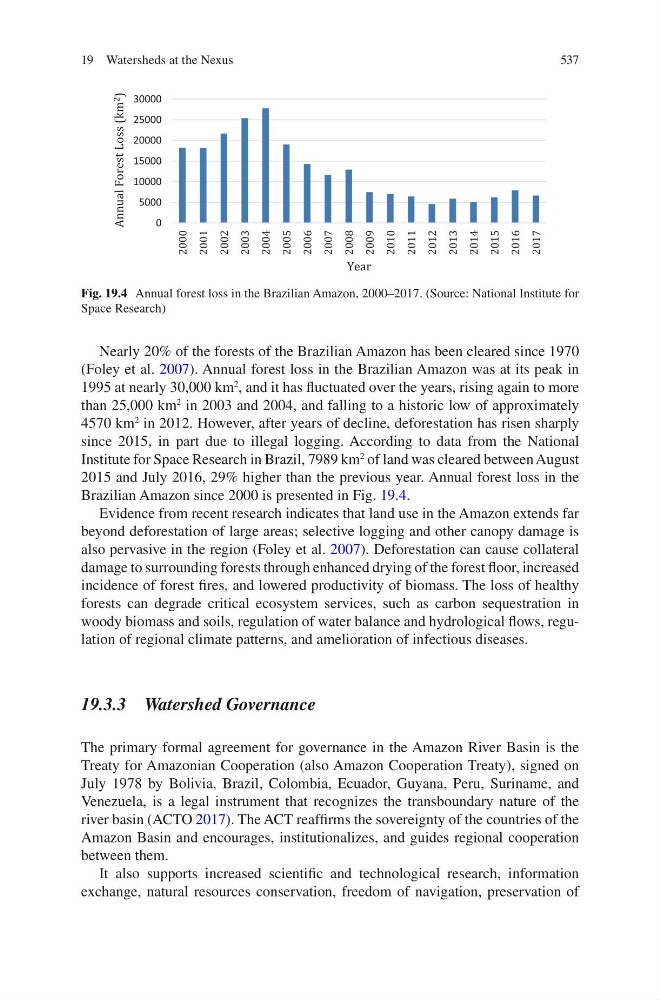
Nearly 20% of the forests of the Brazilian Amazon has been cleared since 1970
(Foley et al. 2007). Annual forest loss in the Brazilian Amazon was at its peak in
1995 at nearly 30,000 km
2
, and it has fluctuated over the years, rising again to more
than 25,000 km
2
in 2003 and 2004, and falling to a historic low of approximately
4570 km
2
in 2012. However, after years of decline, deforestation has risen sharply
since 2015, in part due to illegal logging. According to data from the National
Institute for Space Research in Brazil, 7989 km
2
of land was cleared between August
2015 and July 2016, 29% higher than the previous year. Annual forest loss in the
Brazilian Amazon since 2000 is presented in Fig. 19.4.
Evidence from recent research indicates that land use in the Amazon extends far
beyond deforestation of large areas; selective logging and other canopy damage is
also pervasive in the region (Foley et al. 2007). Deforestation can cause collateral
damage to surrounding forests through enhanced drying of the forest floor, increased
incidence of forest fires, and lowered productivity of biomass. The loss of healthy
forests can degrade critical ecosystem services, such as carbon sequestration in
woody biomass and soils, regulation of water balance and hydrological flows, regulation of regional climate patterns, and amelioration of infectious diseases.
19.3.3 Watershed Governance
The primary formal agreement for governance in the Amazon River Basin is the
Treaty for Amazonian Cooperation (also Amazon Cooperation Treaty), signed on
July 1978 by Bolivia, Brazil, Colombia, Ecuador, Guyana, Peru, Suriname, and
Venezuela, is a legal instrument that recognizes the transboundary nature of the
river basin (ACTO 2017). The ACT reaffirms the sovereignty of the countries of the
Amazon Basin and encourages, institutionalizes, and guides regional cooperation
between them.
It also supports increased scientific and technological research, information
exchange, natural resources conservation, freedom of navigation, preservation of
Fig. 19.4 Annual forest loss in the Brazilian Amazon, 2000–2017. (Source: National Institute for
Space Research)
19 Watersheds at the Nexus
Nearly 20% of the forests of the Brazilian Amazon has been cleared since 1970
(Foley et al. 2007). Annual forest loss in the Brazilian Amazon was at its peak in
1995 at nearly 30,000 km
2
, and it has fluctuated over the years, rising again to more
than 25,000 km
2
in 2003 and 2004, and falling to a historic low of approximately
4570 km
2
in 2012. However, after years of decline, deforestation has risen sharply
since 2015, in part due to illegal logging. According to data from the National
Institute for Space Research in Brazil, 7989 km
2
of land was cleared between August
2015 and July 2016, 29% higher than the previous year. Annual forest loss in the
Brazilian Amazon since 2000 is presented in Fig. 19.4.
Evidence from recent research indicates that land use in the Amazon extends far
beyond deforestation of large areas; selective logging and other canopy damage is
also pervasive in the region (Foley et al. 2007). Deforestation can cause collateral
damage to surrounding forests through enhanced drying of the forest floor, increased
incidence of forest fires, and lowered productivity of biomass. The loss of healthy
forests can degrade critical ecosystem services, such as carbon sequestration in
woody biomass and soils, regulation of water balance and hydrological flows, regulation of regional climate patterns, and amelioration of infectious diseases.
19.3.3 Watershed Governance
The primary formal agreement for governance in the Amazon River Basin is the
Treaty for Amazonian Cooperation (also Amazon Cooperation Treaty), signed on
July 1978 by Bolivia, Brazil, Colombia, Ecuador, Guyana, Peru, Suriname, and
Venezuela, is a legal instrument that recognizes the transboundary nature of the
river basin (ACTO 2017). The ACT reaffirms the sovereignty of the countries of the
Amazon Basin and encourages, institutionalizes, and guides regional cooperation
between them.
It also supports increased scientific and technological research, information
exchange, natural resources conservation, freedom of navigation, preservation of
Fig. 19.4 Annual forest loss in the Brazilian Amazon, 2000–2017. (Source: National Institute for
Space Research)
19 Watersheds at the Nexus