

536
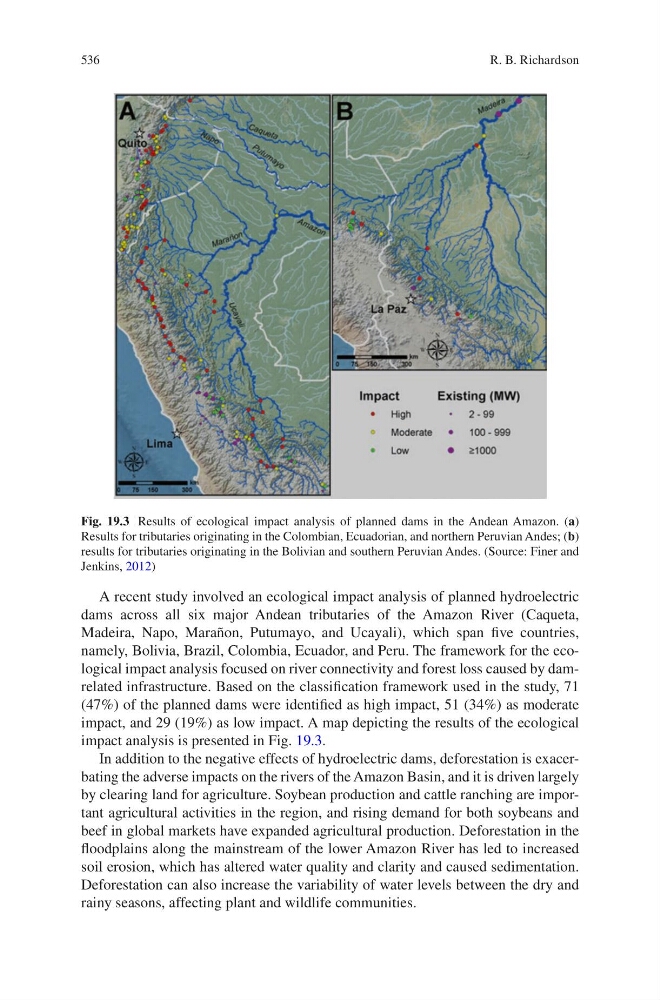
A recent study involved an ecological impact analysis of planned hydroelectric
dams across all six major Andean tributaries of the Amazon River (Caqueta,
Madeira, Napo, Marañon, Putumayo, and Ucayali), which span five countries,
namely, Bolivia, Brazil, Colombia, Ecuador, and Peru. The framework for the ecological impact analysis focused on river connectivity and forest loss caused by damrelated infrastructure. Based on the classification framework used in the study, 71
(47%) of the planned dams were identified as high impact, 51 (34%) as moderate
impact, and 29 (19%) as low impact. A map depicting the results of the ecological
impact analysis is presented in Fig. 19.3.
In addition to the negative effects of hydroelectric dams, deforestation is exacerbating the adverse impacts on the rivers of the Amazon Basin, and it is driven largely
by clearing land for agriculture. Soybean production and cattle ranching are important agricultural activities in the region, and rising demand for both soybeans and
beef in global markets have expanded agricultural production. Deforestation in the
floodplains along the mainstream of the lower Amazon River has led to increased
soil erosion, which has altered water quality and clarity and caused sedimentation.
Deforestation can also increase the variability of water levels between the dry and
rainy seasons, affecting plant and wildlife communities.
Fig. 19.3 Results of ecological impact analysis of planned dams in the Andean Amazon. (a)
Results for tributaries originating in the Colombian, Ecuadorian, and northern Peruvian Andes; (b)
results for tributaries originating in the Bolivian and southern Peruvian Andes. (Source: Finer and
Jenkins, 2012)
R. B. Richardson
A recent study involved an ecological impact analysis of planned hydroelectric
dams across all six major Andean tributaries of the Amazon River (Caqueta,
Madeira, Napo, Marañon, Putumayo, and Ucayali), which span five countries,
namely, Bolivia, Brazil, Colombia, Ecuador, and Peru. The framework for the ecological impact analysis focused on river connectivity and forest loss caused by damrelated infrastructure. Based on the classification framework used in the study, 71
(47%) of the planned dams were identified as high impact, 51 (34%) as moderate
impact, and 29 (19%) as low impact. A map depicting the results of the ecological
impact analysis is presented in Fig. 19.3.
In addition to the negative effects of hydroelectric dams, deforestation is exacerbating the adverse impacts on the rivers of the Amazon Basin, and it is driven largely
by clearing land for agriculture. Soybean production and cattle ranching are important agricultural activities in the region, and rising demand for both soybeans and
beef in global markets have expanded agricultural production. Deforestation in the
floodplains along the mainstream of the lower Amazon River has led to increased
soil erosion, which has altered water quality and clarity and caused sedimentation.
Deforestation can also increase the variability of water levels between the dry and
rainy seasons, affecting plant and wildlife communities.
Fig. 19.3 Results of ecological impact analysis of planned dams in the Andean Amazon. (a)
Results for tributaries originating in the Colombian, Ecuadorian, and northern Peruvian Andes; (b)
results for tributaries originating in the Bolivian and southern Peruvian Andes. (Source: Finer and
Jenkins, 2012)
R. B. Richardson