

528
(Great Lakes Commission 2014). Beyond this reliance on the Great Lakes for water
supply, residents of the basin and visitors from far afield also realize recreational,
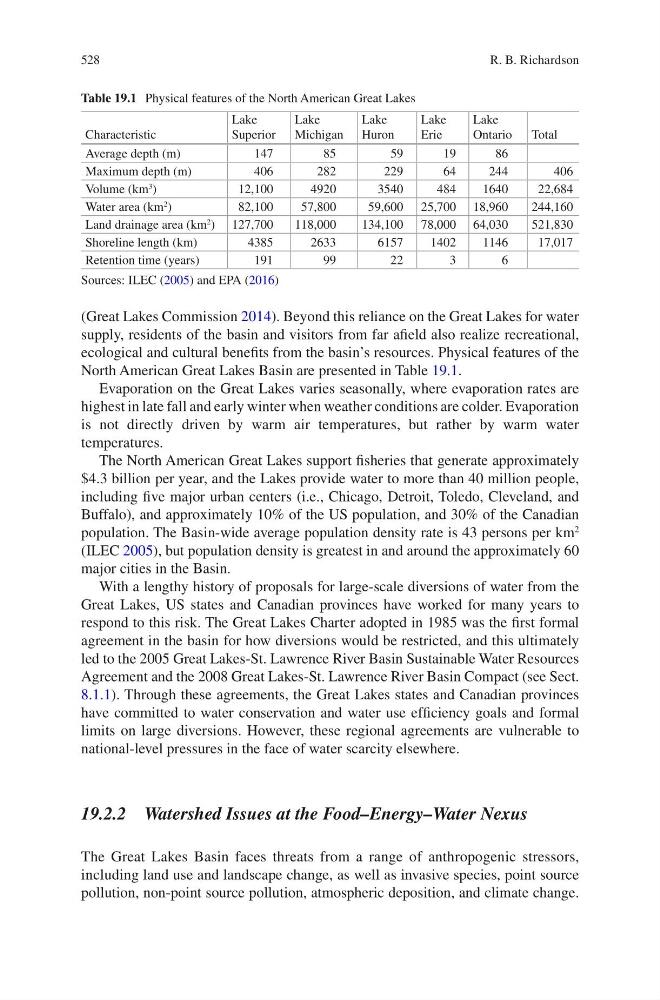
ecological and cultural benefits from the basin’s resources. Physical features of the
North American Great Lakes Basin are presented in Table 19.1.
Evaporation on the Great Lakes varies seasonally, where evaporation rates are
highest in late fall and early winter when weather conditions are colder. Evaporation
is not directly driven by warm air temperatures, but rather by warm water
temperatures.
The North American Great Lakes support fisheries that generate approximately
$4.3 billion per year, and the Lakes provide water to more than 40 million people,
including five major urban centers (i.e., Chicago, Detroit, Toledo, Cleveland, and
Buffalo), and approximately 10% of the US population, and 30% of the Canadian
population. The Basin-wide average population density rate is 43 persons per km
2
(ILEC 2005), but population density is greatest in and around the approximately 60
major cities in the Basin.
With a lengthy history of proposals for large-scale diversions of water from the
Great Lakes, US states and Canadian provinces have worked for many years to
respond to this risk. The Great Lakes Charter adopted in 1985 was the first formal
agreement in the basin for how diversions would be restricted, and this ultimately
led to the 2005 Great Lakes-St. Lawrence River Basin Sustainable Water Resources
Agreement and the 2008 Great Lakes-St. Lawrence River Basin Compact (see Sect.
8.1.1). Through these agreements, the Great Lakes states and Canadian provinces
have committed to water conservation and water use efficiency goals and formal
limits on large diversions. However, these regional agreements are vulnerable to
national-level pressures in the face of water scarcity elsewhere.
19.2.2 Watershed Issues at the Food–Energy–Water Nexus
The Great Lakes Basin faces threats from a range of anthropogenic stressors,
including land use and landscape change, as well as invasive species, point source
pollution, non-point source pollution, atmospheric deposition, and climate change.
Table 19.1 Physical features of the North American Great Lakes
Characteristic
Lake
Superior
Lake
Michigan
Lake
Huron
Lake
Erie
Lake
Ontario
Total
Average depth (m)
147
85
59
19
86
Maximum depth (m)
406
282
229
64
244
406
Volume (km
3 )
12,100
4920
3540
484
1640
22,684
Water area (km
2 )
82,100
57,800
59,600 25,700 18,960
244,160
Land drainage area (km
2
) 127,700
118,000
134,100 78,000 64,030
521,830
Shoreline length (km)
4385
2633
6157
1402
1146
17,017
Retention time (years)
191
99
22
3
6
Sources: ILEC (2005) and EPA (2016)
R. B. Richardson
(Great Lakes Commission 2014). Beyond this reliance on the Great Lakes for water
supply, residents of the basin and visitors from far afield also realize recreational,
ecological and cultural benefits from the basin’s resources. Physical features of the
North American Great Lakes Basin are presented in Table 19.1.
Evaporation on the Great Lakes varies seasonally, where evaporation rates are
highest in late fall and early winter when weather conditions are colder. Evaporation
is not directly driven by warm air temperatures, but rather by warm water
temperatures.
The North American Great Lakes support fisheries that generate approximately
$4.3 billion per year, and the Lakes provide water to more than 40 million people,
including five major urban centers (i.e., Chicago, Detroit, Toledo, Cleveland, and
Buffalo), and approximately 10% of the US population, and 30% of the Canadian
population. The Basin-wide average population density rate is 43 persons per km
2
(ILEC 2005), but population density is greatest in and around the approximately 60
major cities in the Basin.
With a lengthy history of proposals for large-scale diversions of water from the
Great Lakes, US states and Canadian provinces have worked for many years to
respond to this risk. The Great Lakes Charter adopted in 1985 was the first formal
agreement in the basin for how diversions would be restricted, and this ultimately
led to the 2005 Great Lakes-St. Lawrence River Basin Sustainable Water Resources
Agreement and the 2008 Great Lakes-St. Lawrence River Basin Compact (see Sect.
8.1.1). Through these agreements, the Great Lakes states and Canadian provinces
have committed to water conservation and water use efficiency goals and formal
limits on large diversions. However, these regional agreements are vulnerable to
national-level pressures in the face of water scarcity elsewhere.
19.2.2 Watershed Issues at the Food–Energy–Water Nexus
The Great Lakes Basin faces threats from a range of anthropogenic stressors,
including land use and landscape change, as well as invasive species, point source
pollution, non-point source pollution, atmospheric deposition, and climate change.
Table 19.1 Physical features of the North American Great Lakes
Characteristic
Lake
Superior
Lake
Michigan
Lake
Huron
Lake
Erie
Lake
Ontario
Total
Average depth (m)
147
85
59
19
86
Maximum depth (m)
406
282
229
64
244
406
Volume (km
3 )
12,100
4920
3540
484
1640
22,684
Water area (km
2 )
82,100
57,800
59,600 25,700 18,960
244,160
Land drainage area (km
2
) 127,700
118,000
134,100 78,000 64,030
521,830
Shoreline length (km)
4385
2633
6157
1402
1146
17,017
Retention time (years)
191
99
22
3
6
Sources: ILEC (2005) and EPA (2016)
R. B. Richardson