

25
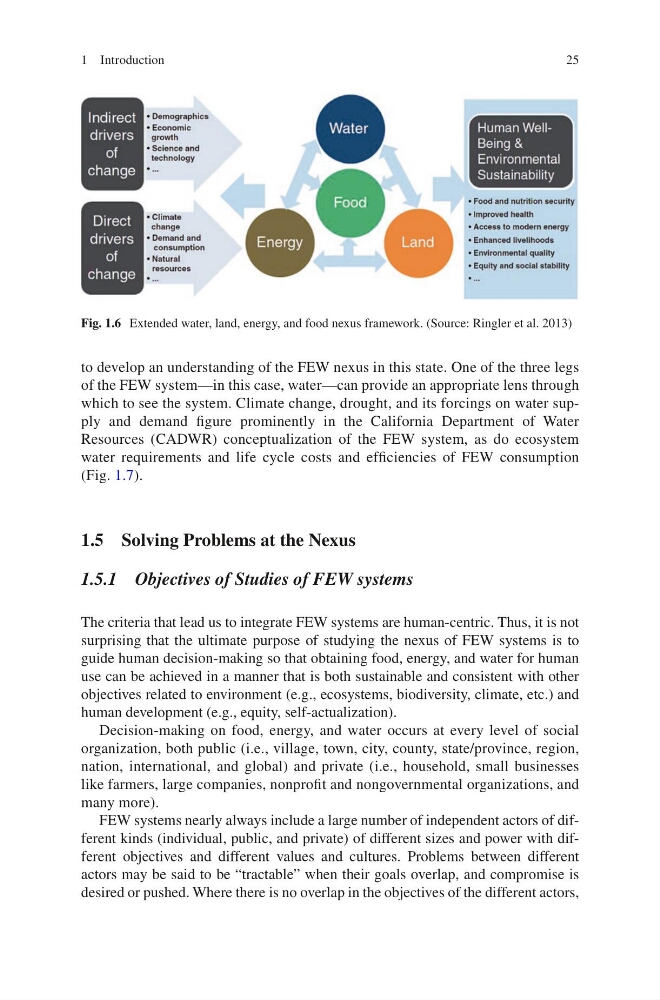
Fig. 1.6 Extended water, land, energy, and food nexus framework. (Source: Ringler et al. 2013)
to develop an understanding of the FEW nexus in this state. One of the three legs
of the FEW system—in this case, water—can provide an appropriate lens through
which to see the system. Climate change, drought, and its forcings on water supply and demand figure prominently in the California Department of Water
Resources (CADWR) conceptualization of the FEW system, as do ecosystem
water requirements and life cycle costs and efficiencies of FEW consumption
(Fig. 1.7).
1.5 Solving Problems at the Nexus
1.5.1 Objectives of Studies of FEW systems
The criteria that lead us to integrate FEW systems are human-centric. Thus, it is not
surprising that the ultimate purpose of studying the nexus of FEW systems is to
guide human decision-making so that obtaining food, energy, and water for human
use can be achieved in a manner that is both sustainable and consistent with other
objectives related to environment (e.g., ecosystems, biodiversity, climate, etc.) and
human development (e.g., equity, self-actualization).
Decision-making on food, energy, and water occurs at every level of social
organization, both public (i.e., village, town, city, county, state/province, region,
nation, international, and global) and private (i.e., household, small businesses
like farmers, large companies, nonprofit and nongovernmental organizations, and
many more).
FEW systems nearly always include a large number of independent actors of different kinds (individual, public, and private) of different sizes and power with different objectives and different values and cultures. Problems between different
actors may be said to be “tractable” when their goals overlap, and compromise is
desired or pushed. Where there is no overlap in the objectives of the different actors,
1 Introduction
Fig. 1.6 Extended water, land, energy, and food nexus framework. (Source: Ringler et al. 2013)
to develop an understanding of the FEW nexus in this state. One of the three legs
of the FEW system—in this case, water—can provide an appropriate lens through
which to see the system. Climate change, drought, and its forcings on water supply and demand figure prominently in the California Department of Water
Resources (CADWR) conceptualization of the FEW system, as do ecosystem
water requirements and life cycle costs and efficiencies of FEW consumption
(Fig. 1.7).
1.5 Solving Problems at the Nexus
1.5.1 Objectives of Studies of FEW systems
The criteria that lead us to integrate FEW systems are human-centric. Thus, it is not
surprising that the ultimate purpose of studying the nexus of FEW systems is to
guide human decision-making so that obtaining food, energy, and water for human
use can be achieved in a manner that is both sustainable and consistent with other
objectives related to environment (e.g., ecosystems, biodiversity, climate, etc.) and
human development (e.g., equity, self-actualization).
Decision-making on food, energy, and water occurs at every level of social
organization, both public (i.e., village, town, city, county, state/province, region,
nation, international, and global) and private (i.e., household, small businesses
like farmers, large companies, nonprofit and nongovernmental organizations, and
many more).
FEW systems nearly always include a large number of independent actors of different kinds (individual, public, and private) of different sizes and power with different objectives and different values and cultures. Problems between different
actors may be said to be “tractable” when their goals overlap, and compromise is
desired or pushed. Where there is no overlap in the objectives of the different actors,
1 Introduction