

354
Two dimensions can help define the purpose of an existing or proposed metric:
(A) intensive vs. extensive and (B) absolute vs. relative.
13.2.3.1 Intensive vs. Extensive
In thermodynamics, intensive properties are those whose value is independent of
the amount of material present. Examples are temperature, pressure, and mass density. The density of water is the same (1000 kg/m
3
at standard temperature and pressure) whether you have filled a bathtub or one of the Great Lakes.
On the other hand, extensive variables, which include volume, momentum, and
mass, change depending on the quantity of material present. For example, the mass of
water in your bathtub, measured as density multiplied by the water’s volume, is much
lower than the mass of the water in Lake Michigan, despite having the same density.
We draw a parallel from thermodynamics to describe technological metrics and
socioeconomic metrics.
At the establishment level, an intensive metric might be cubic meters of water
consumed per kilowatt of electricity generated [m
3
/kWh]. In fact, we often describe
such metrics as water intensity. At the establishment scale, this intensive metric is
independent of the number of power plants in the surrounding region or network.
The inputs into the LCA framework in Fig. 13.1 are intensive metrics (e.g., the
amount of input required for a unit of product output). At the meso/macro scale, we
might calculate the water intensity of electricity production (again as m
3
/kWh) in
each region, by accounting the water consumed per unit of electricity produced in a
certain time period, such as a day or year, and by all plants in that region.
Extensive metrics are based on the concept of scale or size, asking such questions as, “How much food, energy, or water is desired?” or “What are the total
inputs needed?”
Intensive metrics do not determine whether something is “too big” or “not
enough,” as they are largely metrics of the relationships between inputs and outputs.
In contrast, extensive metrics help understand ‘how much’ relative to what is known
about total availability or limiting quantity (see Sect. 13.2.3.2 below).
Examples of extensive metrics include the total water consumption by a thermal
power plant over its lifetime or within a given year (establishment-level), and total
water consumption for electricity produced for all power plants within a given
region in a given year (meso/macro scale).
Those familiar with life cycle assessment will notice that at the establishment
level the difference between intensive and extensive metrics is a change in the functional unit (e.g., what is our reference flow).
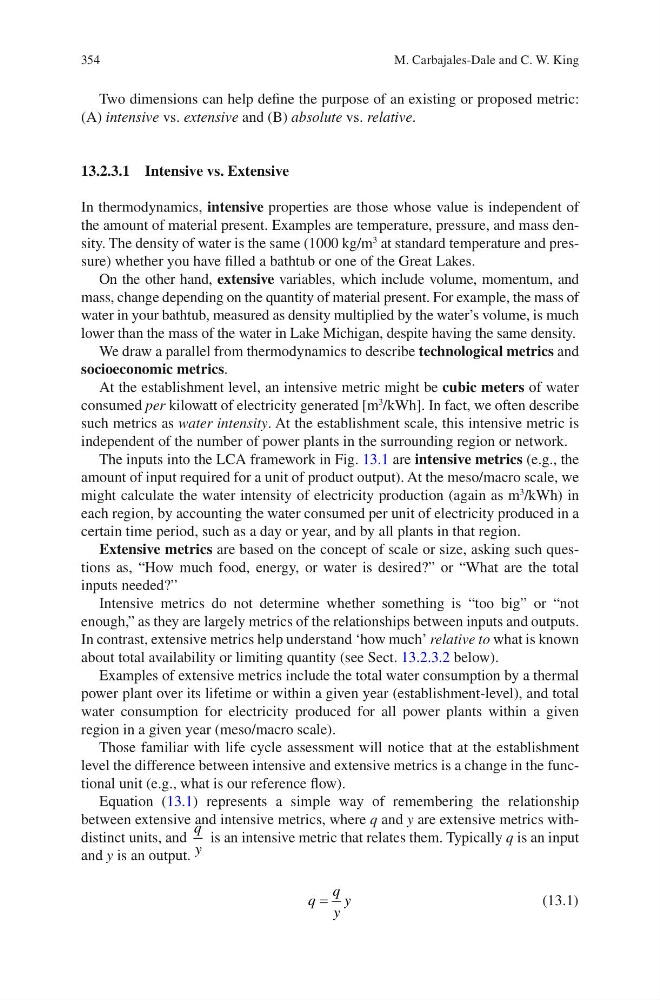
Equation (13.1) represents a simple way of remembering the relationship
between extensive and intensive metrics, where q and y are extensive metrics withdistinct units, and
q
y
is an intensive metric that relates them. Typically q is an input
and y is an output.
q
q
y
y
=
(13.1)
M. Carbajales-Dale and C. W. King
Two dimensions can help define the purpose of an existing or proposed metric:
(A) intensive vs. extensive and (B) absolute vs. relative.
13.2.3.1 Intensive vs. Extensive
In thermodynamics, intensive properties are those whose value is independent of
the amount of material present. Examples are temperature, pressure, and mass density. The density of water is the same (1000 kg/m
3
at standard temperature and pressure) whether you have filled a bathtub or one of the Great Lakes.
On the other hand, extensive variables, which include volume, momentum, and
mass, change depending on the quantity of material present. For example, the mass of
water in your bathtub, measured as density multiplied by the water’s volume, is much
lower than the mass of the water in Lake Michigan, despite having the same density.
We draw a parallel from thermodynamics to describe technological metrics and
socioeconomic metrics.
At the establishment level, an intensive metric might be cubic meters of water
consumed per kilowatt of electricity generated [m
3
/kWh]. In fact, we often describe
such metrics as water intensity. At the establishment scale, this intensive metric is
independent of the number of power plants in the surrounding region or network.
The inputs into the LCA framework in Fig. 13.1 are intensive metrics (e.g., the
amount of input required for a unit of product output). At the meso/macro scale, we
might calculate the water intensity of electricity production (again as m
3
/kWh) in
each region, by accounting the water consumed per unit of electricity produced in a
certain time period, such as a day or year, and by all plants in that region.
Extensive metrics are based on the concept of scale or size, asking such questions as, “How much food, energy, or water is desired?” or “What are the total
inputs needed?”
Intensive metrics do not determine whether something is “too big” or “not
enough,” as they are largely metrics of the relationships between inputs and outputs.
In contrast, extensive metrics help understand ‘how much’ relative to what is known
about total availability or limiting quantity (see Sect. 13.2.3.2 below).
Examples of extensive metrics include the total water consumption by a thermal
power plant over its lifetime or within a given year (establishment-level), and total
water consumption for electricity produced for all power plants within a given
region in a given year (meso/macro scale).
Those familiar with life cycle assessment will notice that at the establishment
level the difference between intensive and extensive metrics is a change in the functional unit (e.g., what is our reference flow).
Equation (13.1) represents a simple way of remembering the relationship
between extensive and intensive metrics, where q and y are extensive metrics withdistinct units, and
q
y
is an intensive metric that relates them. Typically q is an input
and y is an output.
q
q
y
y
=
(13.1)
M. Carbajales-Dale and C. W. King