

353
13.2.3 Metric Taxonomy
As stated previously, the purpose of metrics is to guide action in the hopes of more
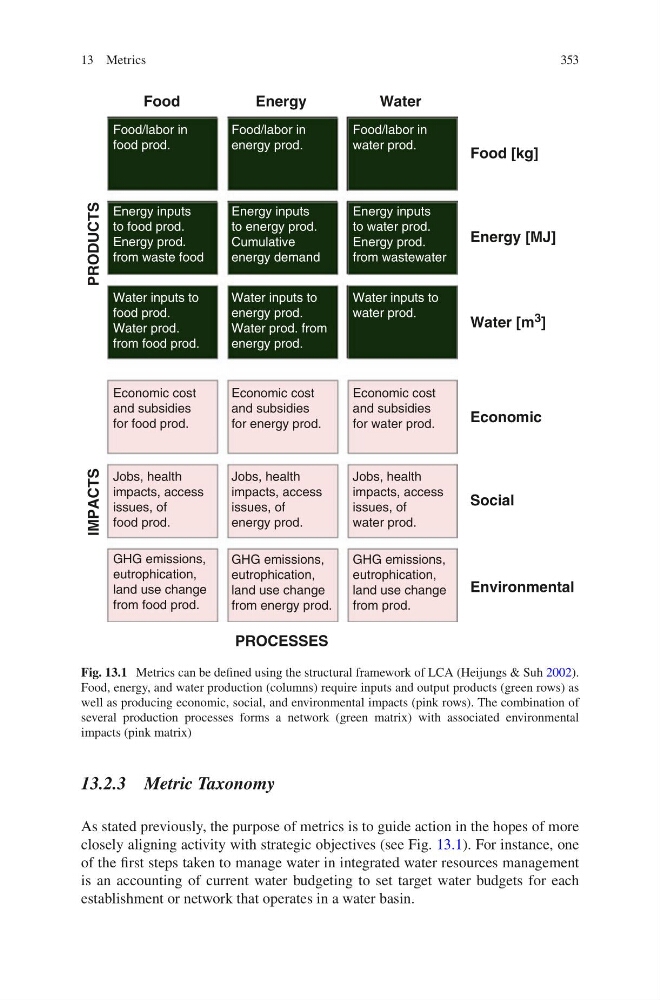
closely aligning activity with strategic objectives (see Fig. 13.1). For instance, one
of the first steps taken to manage water in integrated water resources management
is an accounting of current water budgeting to set target water budgets for each
establishment or network that operates in a water basin.
Food
Food [kg]
Energy
Energy [MJ]
Water
Water [m 3 ]
Economic
Social
Environmental
PROCESSES
IMPACTS
PRODUCTS
Food/labor in
food prod.
Energy inputs
to food prod.
Energy prod.
from waste food
Water inputs to
food prod.
Water prod.
from food prod.
Water inputs to
energy prod.
Water prod. from
energy prod.
Water inputs to
water prod.
Economic cost
and subsidies
for food prod.
Jobs, health
impacts, access
issues, of
food prod.
GHG emissions,
eutrophication,
land use change
from food prod.
GHG emissions,
eutrophication,
land use change
from energy prod.
GHG emissions,
eutrophication,
land use change
from prod.
Jobs, health
impacts, access
issues, of
energy prod.
Jobs, health
impacts, access
issues, of
water prod.
Economic cost
and subsidies
for energy prod.
Economic cost
and subsidies
for water prod.
Energy inputs
to energy prod.
Cumulative
energy demand
Energy inputs
to water prod.
Energy prod.
from wastewater
Food/labor in
energy prod.
Food/labor in
water prod.
Fig. 13.1 Metrics can be defined using the structural framework of LCA (Heijungs & Suh 2002).
Food, energy, and water production (columns) require inputs and output products (green rows) as
well as producing economic, social, and environmental impacts (pink rows). The combination of
several production processes forms a network (green matrix) with associated environmental
impacts (pink matrix)
13 Metrics
13.2.3 Metric Taxonomy
As stated previously, the purpose of metrics is to guide action in the hopes of more
closely aligning activity with strategic objectives (see Fig. 13.1). For instance, one
of the first steps taken to manage water in integrated water resources management
is an accounting of current water budgeting to set target water budgets for each
establishment or network that operates in a water basin.
Food
Food [kg]
Energy
Energy [MJ]
Water
Water [m 3 ]
Economic
Social
Environmental
PROCESSES
IMPACTS
PRODUCTS
Food/labor in
food prod.
Energy inputs
to food prod.
Energy prod.
from waste food
Water inputs to
food prod.
Water prod.
from food prod.
Water inputs to
energy prod.
Water prod. from
energy prod.
Water inputs to
water prod.
Economic cost
and subsidies
for food prod.
Jobs, health
impacts, access
issues, of
food prod.
GHG emissions,
eutrophication,
land use change
from food prod.
GHG emissions,
eutrophication,
land use change
from energy prod.
GHG emissions,
eutrophication,
land use change
from prod.
Jobs, health
impacts, access
issues, of
energy prod.
Jobs, health
impacts, access
issues, of
water prod.
Economic cost
and subsidies
for energy prod.
Economic cost
and subsidies
for water prod.
Energy inputs
to energy prod.
Cumulative
energy demand
Energy inputs
to water prod.
Energy prod.
from wastewater
Food/labor in
energy prod.
Food/labor in
water prod.
Fig. 13.1 Metrics can be defined using the structural framework of LCA (Heijungs & Suh 2002).
Food, energy, and water production (columns) require inputs and output products (green rows) as
well as producing economic, social, and environmental impacts (pink rows). The combination of
several production processes forms a network (green matrix) with associated environmental
impacts (pink matrix)
13 Metrics