

270
that add value along the supply chain, for instance when a producer of raw crude oil
delivers that oil to a refinery to produce derivative products like gasoline; these intermediates tend to be “business to business” transactions.
It is possible to describe supply chains and infrastructure very generally as a
sequence of seven typical supply chain steps, each of which utilizes infrastructure
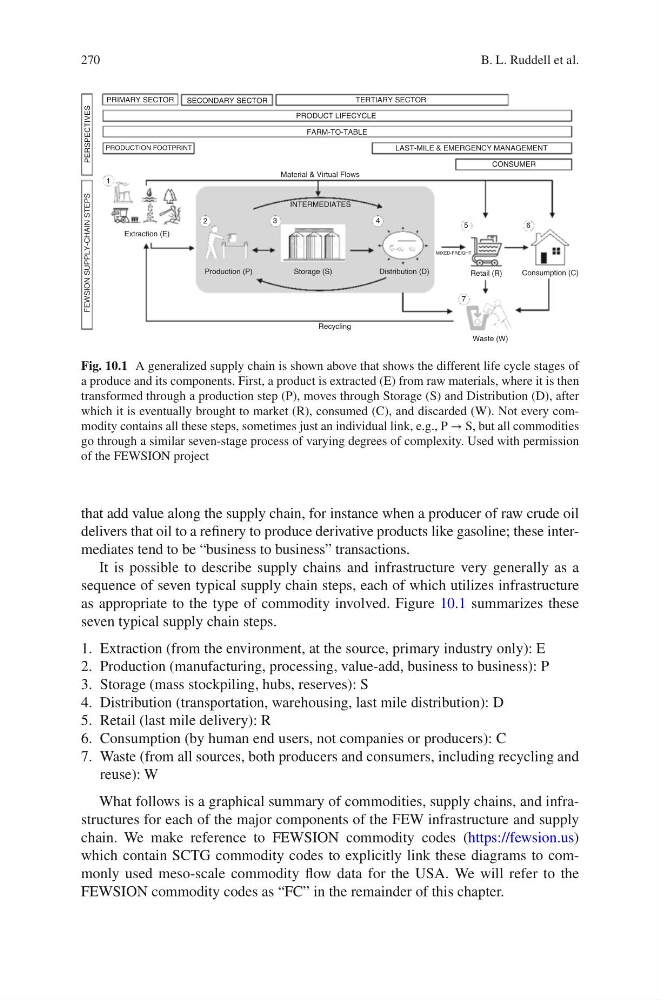
as appropriate to the type of commodity involved. Figure 10.1 summarizes these
seven typical supply chain steps.
1. Extraction (from the environment, at the source, primary industry only): E
2. Production (manufacturing, processing, value-add, business to business): P
3. Storage (mass stockpiling, hubs, reserves): S
4. Distribution (transportation, warehousing, last mile distribution): D
5. Retail (last mile delivery): R
6. Consumption (by human end users, not companies or producers): C
7. Waste (from all sources, both producers and consumers, including recycling and
reuse): W
What follows is a graphical summary of commodities, supply chains, and infrastructures for each of the major components of the FEW infrastructure and supply
chain. We make reference to FEWSION commodity codes (https://fewsion.us)
which contain SCTG commodity codes to explicitly link these diagrams to commonly used meso-scale commodity flow data for the USA. We will refer to the
FEWSION commodity codes as “FC” in the remainder of this chapter.
PRIMARY SECTOR
PRODUCTION FOOTPRINT
PERSPECTIVES
FEWSION SUPPLY-CHAIN STEPS
SECONDARY SECTOR
TERTIARY SECTOR
PRODUCT LIFECYCLE
FARM-TO-TABLE
Material & Virtual Flows
Production (P)
Storage (S)
Distribution (D)
MIXED-FREIGHT
Retail (R)
6
7
5
4
3
2
1
Consumption (C)
Waste (W)
Recycling
INTERMEDIATES
Extraction (E)
LAST-MILE & EMERGENCY MANAGEMENT
CONSUMER
Fig. 10.1 A generalized supply chain is shown above that shows the different life cycle stages of
a produce and its components. First, a product is extracted (E) from raw materials, where it is then
transformed through a production step (P), moves through Storage (S) and Distribution (D), after
which it is eventually brought to market (R), consumed (C), and discarded (W). Not every commodity contains all these steps, sometimes just an individual link, e.g., P → S, but all commodities
go through a similar seven-stage process of varying degrees of complexity. Used with permission
of the FEWSION project
B. L. Ruddell et al.
that add value along the supply chain, for instance when a producer of raw crude oil
delivers that oil to a refinery to produce derivative products like gasoline; these intermediates tend to be “business to business” transactions.
It is possible to describe supply chains and infrastructure very generally as a
sequence of seven typical supply chain steps, each of which utilizes infrastructure
as appropriate to the type of commodity involved. Figure 10.1 summarizes these
seven typical supply chain steps.
1. Extraction (from the environment, at the source, primary industry only): E
2. Production (manufacturing, processing, value-add, business to business): P
3. Storage (mass stockpiling, hubs, reserves): S
4. Distribution (transportation, warehousing, last mile distribution): D
5. Retail (last mile delivery): R
6. Consumption (by human end users, not companies or producers): C
7. Waste (from all sources, both producers and consumers, including recycling and
reuse): W
What follows is a graphical summary of commodities, supply chains, and infrastructures for each of the major components of the FEW infrastructure and supply
chain. We make reference to FEWSION commodity codes (https://fewsion.us)
which contain SCTG commodity codes to explicitly link these diagrams to commonly used meso-scale commodity flow data for the USA. We will refer to the
FEWSION commodity codes as “FC” in the remainder of this chapter.
PRIMARY SECTOR
PRODUCTION FOOTPRINT
PERSPECTIVES
FEWSION SUPPLY-CHAIN STEPS
SECONDARY SECTOR
TERTIARY SECTOR
PRODUCT LIFECYCLE
FARM-TO-TABLE
Material & Virtual Flows
Production (P)
Storage (S)
Distribution (D)
MIXED-FREIGHT
Retail (R)
6
7
5
4
3
2
1
Consumption (C)
Waste (W)
Recycling
INTERMEDIATES
Extraction (E)
LAST-MILE & EMERGENCY MANAGEMENT
CONSUMER
Fig. 10.1 A generalized supply chain is shown above that shows the different life cycle stages of
a produce and its components. First, a product is extracted (E) from raw materials, where it is then
transformed through a production step (P), moves through Storage (S) and Distribution (D), after
which it is eventually brought to market (R), consumed (C), and discarded (W). Not every commodity contains all these steps, sometimes just an individual link, e.g., P → S, but all commodities
go through a similar seven-stage process of varying degrees of complexity. Used with permission
of the FEWSION project
B. L. Ruddell et al.