

193
The international food trade is essential for global food security in most nations
and regions. “Just three crops—maize, wheat and rice—account for around 60% of
global food energy intake. A fourth crop, soybean, is the world’s largest source of
animal protein feed, accounting for 65% of global protein feed supply. Each year,
the world’s transport system moves enough maize, wheat, rice, and soybean to feed
approximately 2.8 billion people. Meanwhile, the 180 million tonnes of fertilizers
applied to farmland annually play a vital role in helping us grow enough wheat, rice
and maize to sustain our expanding populations.” (Bailey and Wellesley 2017)
Nearly all countries are both importers and exporters of food (Table 7.1).
However, the importance of food imports to a nation’s food security is dependent on
several factors. Wealthy countries have the financial ability to purchase foods as a
matter of preference rather than need. This is reflected in the fact that the members
of the European Union (collectively) and the USA are the top two importers and
exporters of food by value and account for half of all such trade.
FEW systems that address countries and subregions must acknowledge flows of
food into and out of the system boundaries—flows that are increasing with time and
changing structurally in terms of food types and locations, as illustrated in Fig. 7.2.
Note that North America and Europe are net exporters (exports-imports) of food.
Imports are also a reflection of population. The past two decades have seen a rise
in both imports and exports from large emerging economies such as Brazil, China,
India, and Indonesia. The growing wealth of China, in particular, saw its share of
food imports rise from 2.3% of global imports in 2000 to 8.2% in 2016 whiles its
share of food exports increased from 3.0% to 4.2%. These changes reflect part of the
overall advances in human development achieved (see Sects. 3.4 and 3.5).
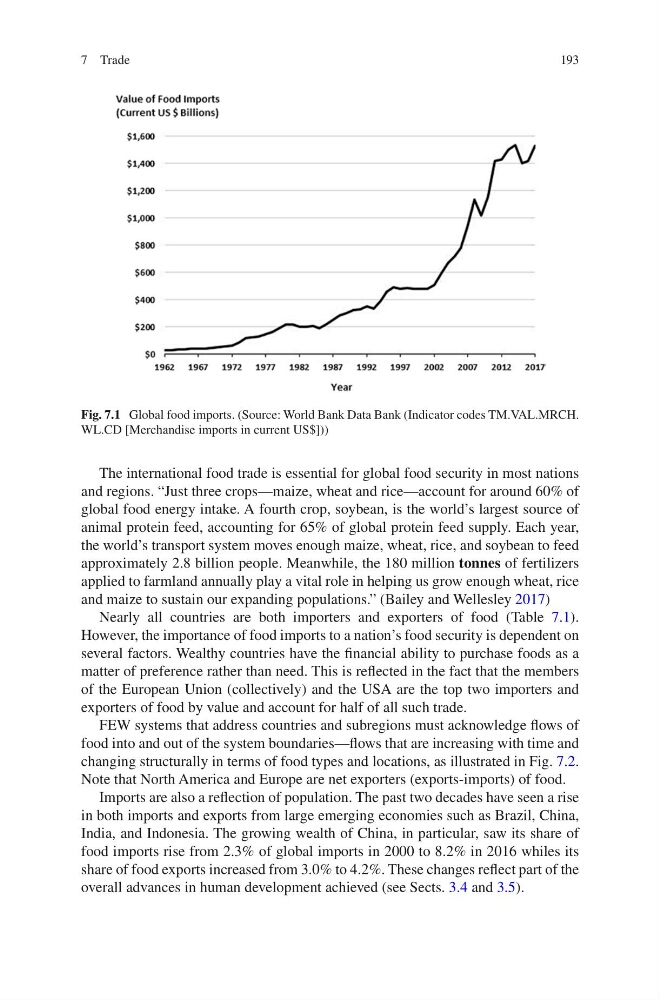
Fig. 7.1 Global food imports. (Source: World Bank Data Bank (Indicator codes TM.VAL.MRCH.
WL.CD [Merchandise imports in current US$]))
7 Trade
The international food trade is essential for global food security in most nations
and regions. “Just three crops—maize, wheat and rice—account for around 60% of
global food energy intake. A fourth crop, soybean, is the world’s largest source of
animal protein feed, accounting for 65% of global protein feed supply. Each year,
the world’s transport system moves enough maize, wheat, rice, and soybean to feed
approximately 2.8 billion people. Meanwhile, the 180 million tonnes of fertilizers
applied to farmland annually play a vital role in helping us grow enough wheat, rice
and maize to sustain our expanding populations.” (Bailey and Wellesley 2017)
Nearly all countries are both importers and exporters of food (Table 7.1).
However, the importance of food imports to a nation’s food security is dependent on
several factors. Wealthy countries have the financial ability to purchase foods as a
matter of preference rather than need. This is reflected in the fact that the members
of the European Union (collectively) and the USA are the top two importers and
exporters of food by value and account for half of all such trade.
FEW systems that address countries and subregions must acknowledge flows of
food into and out of the system boundaries—flows that are increasing with time and
changing structurally in terms of food types and locations, as illustrated in Fig. 7.2.
Note that North America and Europe are net exporters (exports-imports) of food.
Imports are also a reflection of population. The past two decades have seen a rise
in both imports and exports from large emerging economies such as Brazil, China,
India, and Indonesia. The growing wealth of China, in particular, saw its share of
food imports rise from 2.3% of global imports in 2000 to 8.2% in 2016 whiles its
share of food exports increased from 3.0% to 4.2%. These changes reflect part of the
overall advances in human development achieved (see Sects. 3.4 and 3.5).
Fig. 7.1 Global food imports. (Source: World Bank Data Bank (Indicator codes TM.VAL.MRCH.
WL.CD [Merchandise imports in current US$]))
7 Trade