

135
Market-based methods (Colby 1989) include:
1. A comparable sales approach which involves a comparison of specific water,
one is trying to value with the prices and characteristics of similar water that has
been recently sold or leased;
2. A capitalization approach which involves taking the net present value of the
stream of income arising from the water;
3. A land value differentials approach which assumes the value of water is capitalized into land values and involves a comparison of the values of agricultural
land with and without water access;
4. A replacement approach which involves the estimation of the replacement
cost when replacing the water with the lowest cost alternative water supply
source; and
5. An econometric estimate of water demand can be formed in some situations,
where trading data can be attained along with sufficient information on other
characteristics of the trade (i.e., is the water conveyed from a senior or junior
right? (senior or junior water right here means, for example, priority in water use
when scarcity arise with senior water rights having first priority.) Or, is the transfer permanent or a lease? And what are the lease terms?).
5.2.6 Economic Influences on Observed Nexus Strategies
One way to identify possible Nexus strategies that might be undertaken in the future
in target region is to observe the impact of prior actions that addressed the Nexus
either in the target region or similar regions. In such a case, there is an inherent bias
in what can be observed that arises due to economic prices. In particular, the range
of prices that have been observed for both output and inputs restrict what Nexus
opportunities may have been chosen and thus can be observed. Let us look at theoretical and practical examples of this.
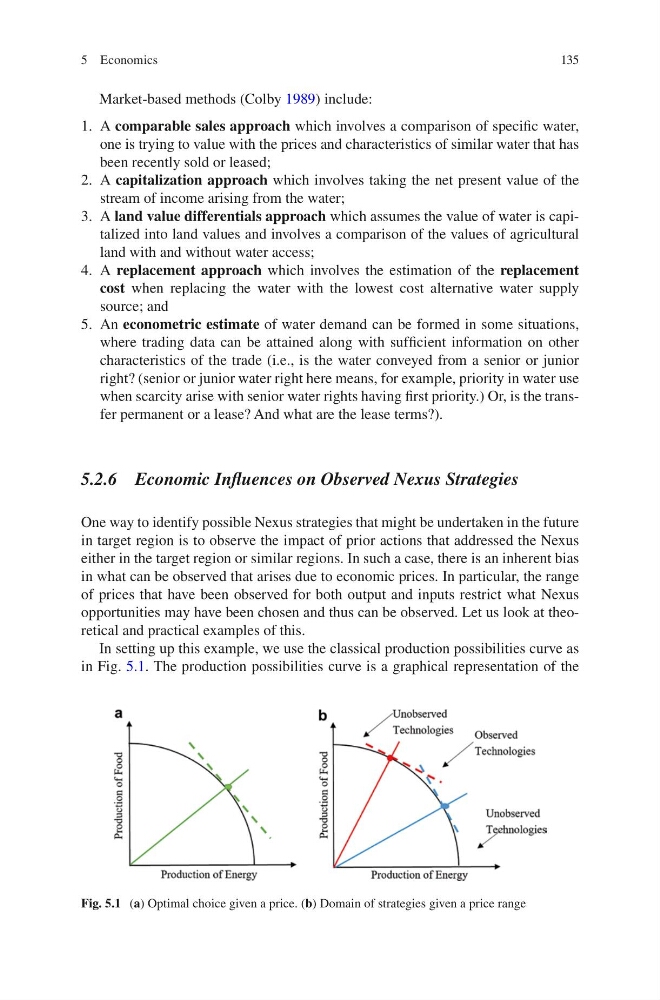
In setting up this example, we use the classical production possibilities curve as
in Fig. 5.1. The production possibilities curve is a graphical representation of the
Fig. 5.1 (a) Optimal choice given a price. (b) Domain of strategies given a price range
5 Economics
Market-based methods (Colby 1989) include:
1. A comparable sales approach which involves a comparison of specific water,
one is trying to value with the prices and characteristics of similar water that has
been recently sold or leased;
2. A capitalization approach which involves taking the net present value of the
stream of income arising from the water;
3. A land value differentials approach which assumes the value of water is capitalized into land values and involves a comparison of the values of agricultural
land with and without water access;
4. A replacement approach which involves the estimation of the replacement
cost when replacing the water with the lowest cost alternative water supply
source; and
5. An econometric estimate of water demand can be formed in some situations,
where trading data can be attained along with sufficient information on other
characteristics of the trade (i.e., is the water conveyed from a senior or junior
right? (senior or junior water right here means, for example, priority in water use
when scarcity arise with senior water rights having first priority.) Or, is the transfer permanent or a lease? And what are the lease terms?).
5.2.6 Economic Influences on Observed Nexus Strategies
One way to identify possible Nexus strategies that might be undertaken in the future
in target region is to observe the impact of prior actions that addressed the Nexus
either in the target region or similar regions. In such a case, there is an inherent bias
in what can be observed that arises due to economic prices. In particular, the range
of prices that have been observed for both output and inputs restrict what Nexus
opportunities may have been chosen and thus can be observed. Let us look at theoretical and practical examples of this.
In setting up this example, we use the classical production possibilities curve as
in Fig. 5.1. The production possibilities curve is a graphical representation of the
Fig. 5.1 (a) Optimal choice given a price. (b) Domain of strategies given a price range
5 Economics