

107
play in FEW systems. For example, adoption of solar panels by homeowners has
been shown to be partially driven by adoption by peers, where one additional solar
panel unit in a zip code increases the probability of another unit being adopted by
almost 1% (Bollinger and Gillingham 2012).
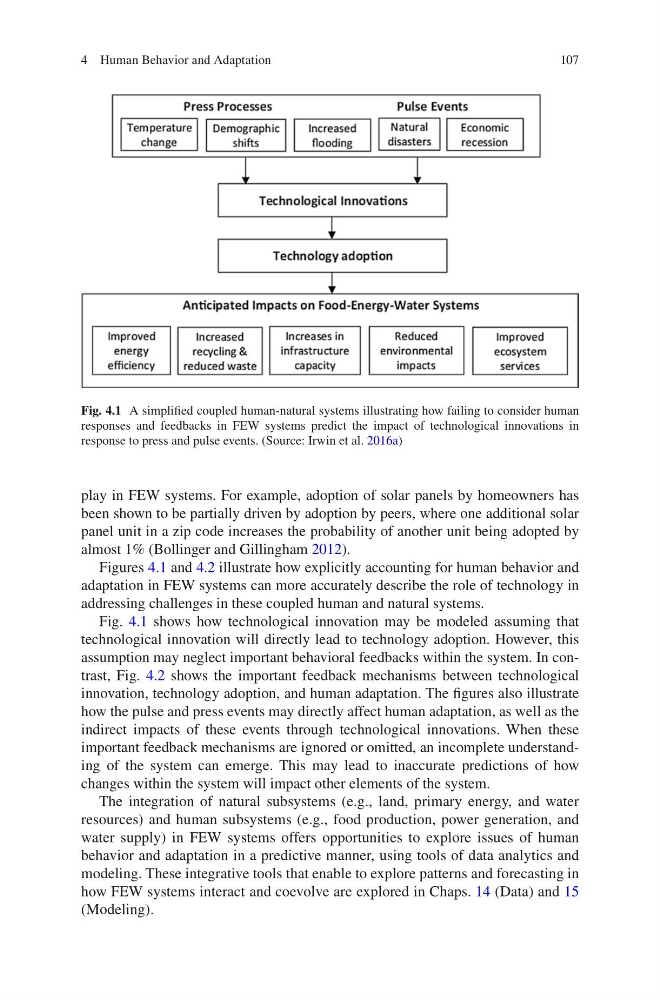
Figures 4.1 and 4.2 illustrate how explicitly accounting for human behavior and
adaptation in FEW systems can more accurately describe the role of technology in
addressing challenges in these coupled human and natural systems.
Fig. 4.1 shows how technological innovation may be modeled assuming that
technological innovation will directly lead to technology adoption. However, this
assumption may neglect important behavioral feedbacks within the system. In contrast, Fig. 4.2 shows the important feedback mechanisms between technological
innovation, technology adoption, and human adaptation. The figures also illustrate
how the pulse and press events may directly affect human adaptation, as well as the
indirect impacts of these events through technological innovations. When these
important feedback mechanisms are ignored or omitted, an incomplete understanding of the system can emerge. This may lead to inaccurate predictions of how
changes within the system will impact other elements of the system.
The integration of natural subsystems (e.g., land, primary energy, and water
resources) and human subsystems (e.g., food production, power generation, and
water supply) in FEW systems offers opportunities to explore issues of human
behavior and adaptation in a predictive manner, using tools of data analytics and
modeling. These integrative tools that enable to explore patterns and forecasting in
how FEW systems interact and coevolve are explored in Chaps. 14 (Data) and 15
(Modeling).
Fig. 4.1 A simplified coupled human-natural systems illustrating how failing to consider human
responses and feedbacks in FEW systems predict the impact of technological innovations in
response to press and pulse events. (Source: Irwin et al. 2016a)
4 Human Behavior and Adaptation
play in FEW systems. For example, adoption of solar panels by homeowners has
been shown to be partially driven by adoption by peers, where one additional solar
panel unit in a zip code increases the probability of another unit being adopted by
almost 1% (Bollinger and Gillingham 2012).
Figures 4.1 and 4.2 illustrate how explicitly accounting for human behavior and
adaptation in FEW systems can more accurately describe the role of technology in
addressing challenges in these coupled human and natural systems.
Fig. 4.1 shows how technological innovation may be modeled assuming that
technological innovation will directly lead to technology adoption. However, this
assumption may neglect important behavioral feedbacks within the system. In contrast, Fig. 4.2 shows the important feedback mechanisms between technological
innovation, technology adoption, and human adaptation. The figures also illustrate
how the pulse and press events may directly affect human adaptation, as well as the
indirect impacts of these events through technological innovations. When these
important feedback mechanisms are ignored or omitted, an incomplete understanding of the system can emerge. This may lead to inaccurate predictions of how
changes within the system will impact other elements of the system.
The integration of natural subsystems (e.g., land, primary energy, and water
resources) and human subsystems (e.g., food production, power generation, and
water supply) in FEW systems offers opportunities to explore issues of human
behavior and adaptation in a predictive manner, using tools of data analytics and
modeling. These integrative tools that enable to explore patterns and forecasting in
how FEW systems interact and coevolve are explored in Chaps. 14 (Data) and 15
(Modeling).
Fig. 4.1 A simplified coupled human-natural systems illustrating how failing to consider human
responses and feedbacks in FEW systems predict the impact of technological innovations in
response to press and pulse events. (Source: Irwin et al. 2016a)
4 Human Behavior and Adaptation