

92
Metric 7.1.2: Proportion of population with primary reliance on clean
fuels and technology (see Fig. 3.11).
Target 7.2. By 2030, increase substantially the share of renewable energy in the
global energy mix.
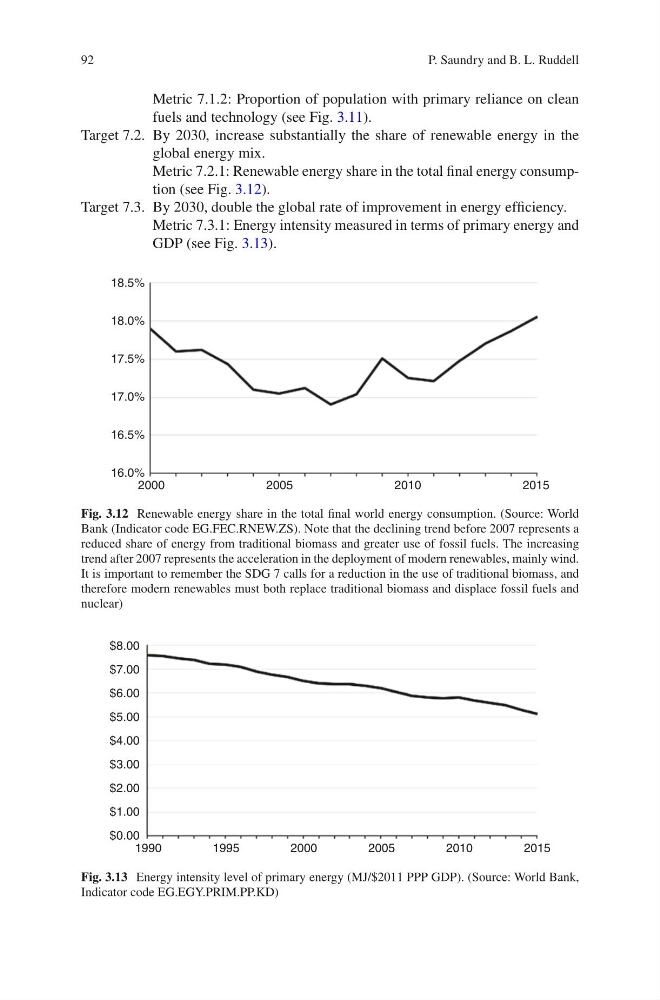
Metric 7.2.1: Renewable energy share in the total final energy consumption (see Fig. 3.12).
Target 7.3. By 2030, double the global rate of improvement in energy efficiency.
Metric 7.3.1: Energy intensity measured in terms of primary energy and
GDP (see Fig. 3.13).
16.0%
16.5%
17.0%
17.5%
18.5%
18.0%
2000
2005
2010
2015
Fig. 3.12 Renewable energy share in the total final world energy consumption. (Source: World
Bank (Indicator code EG.FEC.RNEW.ZS). Note that the declining trend before 2007 represents a
reduced share of energy from traditional biomass and greater use of fossil fuels. The increasing
trend after 2007 represents the acceleration in the deployment of modern renewables, mainly wind.
It is important to remember the SDG 7 calls for a reduction in the use of traditional biomass, and
therefore modern renewables must both replace traditional biomass and displace fossil fuels and
nuclear)
$0.00
$1.00
$2.00
$3.00
$4.00
$5.00
$6.00
$7.00
$8.00
2000
2005
2010
2015
1990
1995
Fig. 3.13 Energy intensity level of primary energy (MJ/$2011 PPP GDP). (Source: World Bank,
Indicator code EG.EGY.PRIM.PP.KD)
P. Saundry and B. L. Ruddell
Metric 7.1.2: Proportion of population with primary reliance on clean
fuels and technology (see Fig. 3.11).
Target 7.2. By 2030, increase substantially the share of renewable energy in the
global energy mix.
Metric 7.2.1: Renewable energy share in the total final energy consumption (see Fig. 3.12).
Target 7.3. By 2030, double the global rate of improvement in energy efficiency.
Metric 7.3.1: Energy intensity measured in terms of primary energy and
GDP (see Fig. 3.13).
16.0%
16.5%
17.0%
17.5%
18.5%
18.0%
2000
2005
2010
2015
Fig. 3.12 Renewable energy share in the total final world energy consumption. (Source: World
Bank (Indicator code EG.FEC.RNEW.ZS). Note that the declining trend before 2007 represents a
reduced share of energy from traditional biomass and greater use of fossil fuels. The increasing
trend after 2007 represents the acceleration in the deployment of modern renewables, mainly wind.
It is important to remember the SDG 7 calls for a reduction in the use of traditional biomass, and
therefore modern renewables must both replace traditional biomass and displace fossil fuels and
nuclear)
$0.00
$1.00
$2.00
$3.00
$4.00
$5.00
$6.00
$7.00
$8.00
2000
2005
2010
2015
1990
1995
Fig. 3.13 Energy intensity level of primary energy (MJ/$2011 PPP GDP). (Source: World Bank,
Indicator code EG.EGY.PRIM.PP.KD)
P. Saundry and B. L. Ruddell